Hawaii awarded $188.9 million federal Rural Health Transformation grant; legislators press for sustainability and uninsured access
March 07, 2026 | Senate, Legislative , Hawaii
This article was created by AI summarizing key points discussed. AI makes mistakes, so for full details and context, please refer to the video of the full meeting. Please report any errors so we can fix them. Report an error »
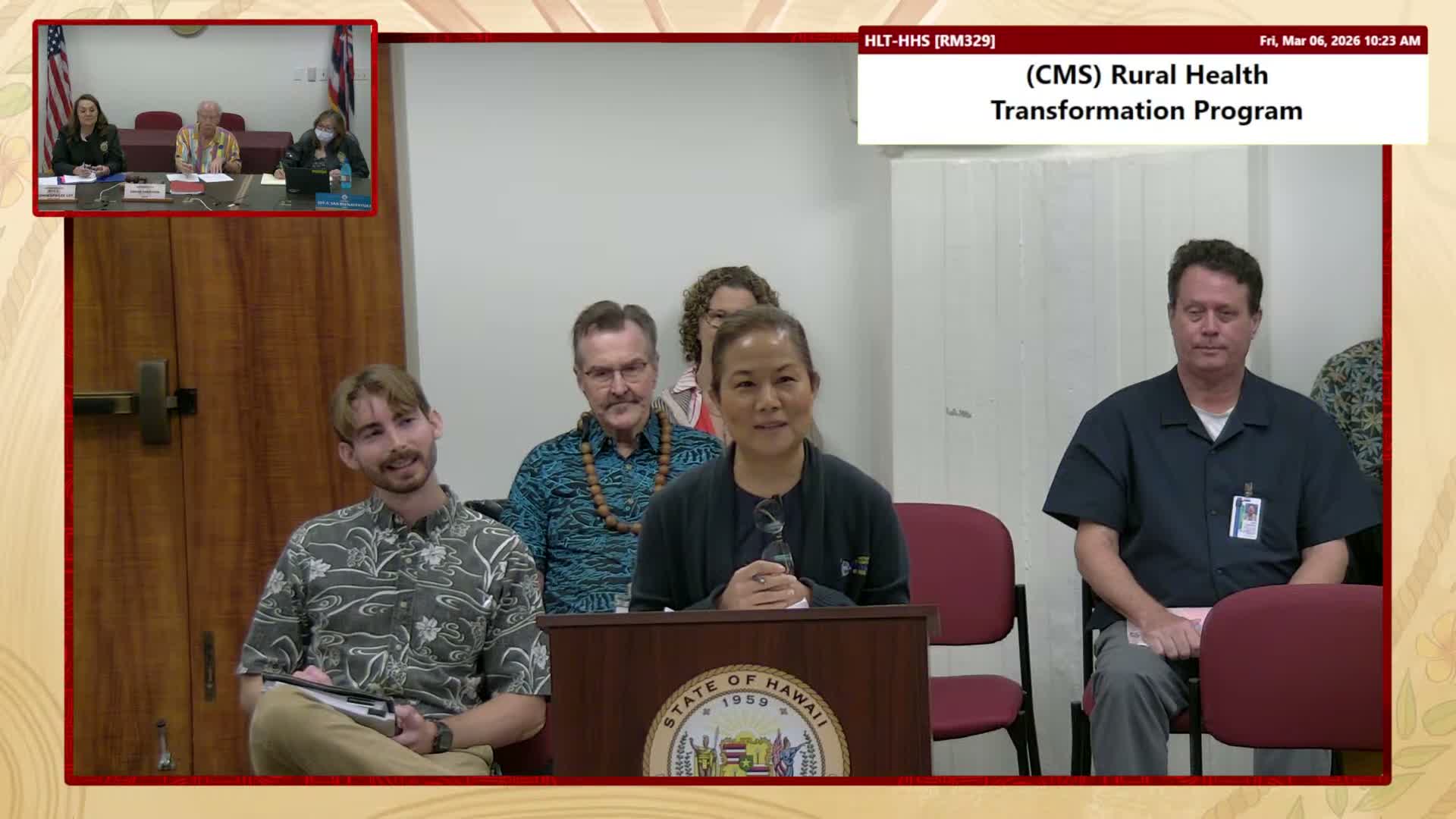
Hawaii announced a first-year federal award of $188,892,439.75 for the Rural Health Transformation Program (RHTP) during a joint informational briefing of the House Committee on Health and the Senate Health and Human Services Committee on March 6.
"The state of Hawaii received $188,892,439.75," said Lauren Kim, legislative coordinator in the Office of the Governor, who outlined the cooperative-agreement structure and the need for close federal oversight by CMS.
The briefing presented six priority initiative areas funded by the grant: a workforce pipeline ("Home Run") led by the University of Hawaii JABSOM; a Rural Health Information Network to expand electronic health records and data analytics; a Rural Value-Based Initiative to prepare providers for alternative payment models; a statewide telehealth program (PD OLA); a Rural Infrastructure for Care Access (RECA) hub focused on EMS, trauma and mobile clinics; and a five-site rural respite network run by the Department of Human Services.
Jack Lewin, administrator of SHPTA, described the information-network hub as a major investment "about... over $45,000,000 a year" to deploy and upgrade electronic health records, build interfaces and create a statewide hub for quality measurement. He also said the value-based initiative would be funded at about $25,000,000 a year to ready hospitals and community providers for alternative payment opportunities.
Presenters described program features: JABSOM officials said Home Run will offer healthcare certificate training in rural schools, travel support for rural students, island-based academic tutors and education awards that require recipients to work in rural areas for five years. Claudine Chan Namousay said there will also be provider incentive payments "of up to $200,000" for clinicians who commit to five-year placements in neighbor-island areas.
Christina Higa, director of the Pacific Basin Telehealth Resource Center, said the PD OLA telehealth initiative will scale telehealth access points and navigators (libraries, community centers), workplace telehealth pilots, kiosks for remote monitoring and school-based telehealth, and will emphasize stakeholder engagement and training.
Officials stressed that the RHTP award is a cooperative agreement with substantial CMS involvement. Ian Wikiberry, policy assistant in the governor’s office, said the state meets biweekly with CMS project officers, will submit an annual progress report due August 30 (covering activity through July) and plans quarterly reports thereafter to secure future annual awards.
Lawmakers repeatedly pressed presenters on two recurring concerns: sustainability after the five-year award and access for people losing insurance coverage. A committee member asked, "I didn't hear anything about how we're gonna help the uninsured," and sought clear mechanisms for uninsured people to receive care under the program.
Wikiberry and other presenters responded that many interventions are designed to be needs-based and could accommodate uninsured people, but they cautioned that enabling legislation for the federal program places a specific limit on provider payments for uninsured services. "They put that cap at 15%," Wikiberry said, adding that the 15% constraint is spread across initiatives rather than set aside in a single uninsured-only program.
Committee members also pressed how the state will sustain equipment, ambulances, kiosks and other assets after federal funds end. Presenters said sustainability was included in the project's narrative and will be addressed by an oversight team and initiative leads; they offered to return written answers on specific RFP timing, procurement processes and the role of outside consultants and lobbyists.
The briefing emphasized evaluation and compliance: presenters said each initiative will include outcome targets and process measures, an oversight team is being stood up to coordinate the initiatives, and CMS must approve line items and contracts before funds are obligated. The first budget period is a shortened 10-month period, meaning some obligations will rely on existing contracts or memorandum-of-agreement approaches to obligate funds quickly.
The committees requested written follow-ups on procurement timing, RFP processes and staffing/contracting questions. The briefing was adjourned after presenters agreed to distribute additional information to members.
"The state of Hawaii received $188,892,439.75," said Lauren Kim, legislative coordinator in the Office of the Governor, who outlined the cooperative-agreement structure and the need for close federal oversight by CMS.
The briefing presented six priority initiative areas funded by the grant: a workforce pipeline ("Home Run") led by the University of Hawaii JABSOM; a Rural Health Information Network to expand electronic health records and data analytics; a Rural Value-Based Initiative to prepare providers for alternative payment models; a statewide telehealth program (PD OLA); a Rural Infrastructure for Care Access (RECA) hub focused on EMS, trauma and mobile clinics; and a five-site rural respite network run by the Department of Human Services.
Jack Lewin, administrator of SHPTA, described the information-network hub as a major investment "about... over $45,000,000 a year" to deploy and upgrade electronic health records, build interfaces and create a statewide hub for quality measurement. He also said the value-based initiative would be funded at about $25,000,000 a year to ready hospitals and community providers for alternative payment opportunities.
Presenters described program features: JABSOM officials said Home Run will offer healthcare certificate training in rural schools, travel support for rural students, island-based academic tutors and education awards that require recipients to work in rural areas for five years. Claudine Chan Namousay said there will also be provider incentive payments "of up to $200,000" for clinicians who commit to five-year placements in neighbor-island areas.
Christina Higa, director of the Pacific Basin Telehealth Resource Center, said the PD OLA telehealth initiative will scale telehealth access points and navigators (libraries, community centers), workplace telehealth pilots, kiosks for remote monitoring and school-based telehealth, and will emphasize stakeholder engagement and training.
Officials stressed that the RHTP award is a cooperative agreement with substantial CMS involvement. Ian Wikiberry, policy assistant in the governor’s office, said the state meets biweekly with CMS project officers, will submit an annual progress report due August 30 (covering activity through July) and plans quarterly reports thereafter to secure future annual awards.
Lawmakers repeatedly pressed presenters on two recurring concerns: sustainability after the five-year award and access for people losing insurance coverage. A committee member asked, "I didn't hear anything about how we're gonna help the uninsured," and sought clear mechanisms for uninsured people to receive care under the program.
Wikiberry and other presenters responded that many interventions are designed to be needs-based and could accommodate uninsured people, but they cautioned that enabling legislation for the federal program places a specific limit on provider payments for uninsured services. "They put that cap at 15%," Wikiberry said, adding that the 15% constraint is spread across initiatives rather than set aside in a single uninsured-only program.
Committee members also pressed how the state will sustain equipment, ambulances, kiosks and other assets after federal funds end. Presenters said sustainability was included in the project's narrative and will be addressed by an oversight team and initiative leads; they offered to return written answers on specific RFP timing, procurement processes and the role of outside consultants and lobbyists.
The briefing emphasized evaluation and compliance: presenters said each initiative will include outcome targets and process measures, an oversight team is being stood up to coordinate the initiatives, and CMS must approve line items and contracts before funds are obligated. The first budget period is a shortened 10-month period, meaning some obligations will rely on existing contracts or memorandum-of-agreement approaches to obligate funds quickly.
The committees requested written follow-ups on procurement timing, RFP processes and staffing/contracting questions. The briefing was adjourned after presenters agreed to distribute additional information to members.
View the Full Meeting & All Its Details
This article offers just a summary. Unlock complete video, transcripts, and insights as a Founder Member.
✓
Watch full, unedited meeting videos
✓
Search every word spoken in unlimited transcripts
✓
AI summaries & real-time alerts (all government levels)
✓
Permanent access to expanding government content
30-day money-back guarantee
