Committee defers psychology interstate compact after board flags training and enforcement gaps
March 19, 2026 | House Public Hearing, House of Representatives, Legislative , Hawaii
This article was created by AI summarizing key points discussed. AI makes mistakes, so for full details and context, please refer to the video of the full meeting. Please report any errors so we can fix them. Report an error »
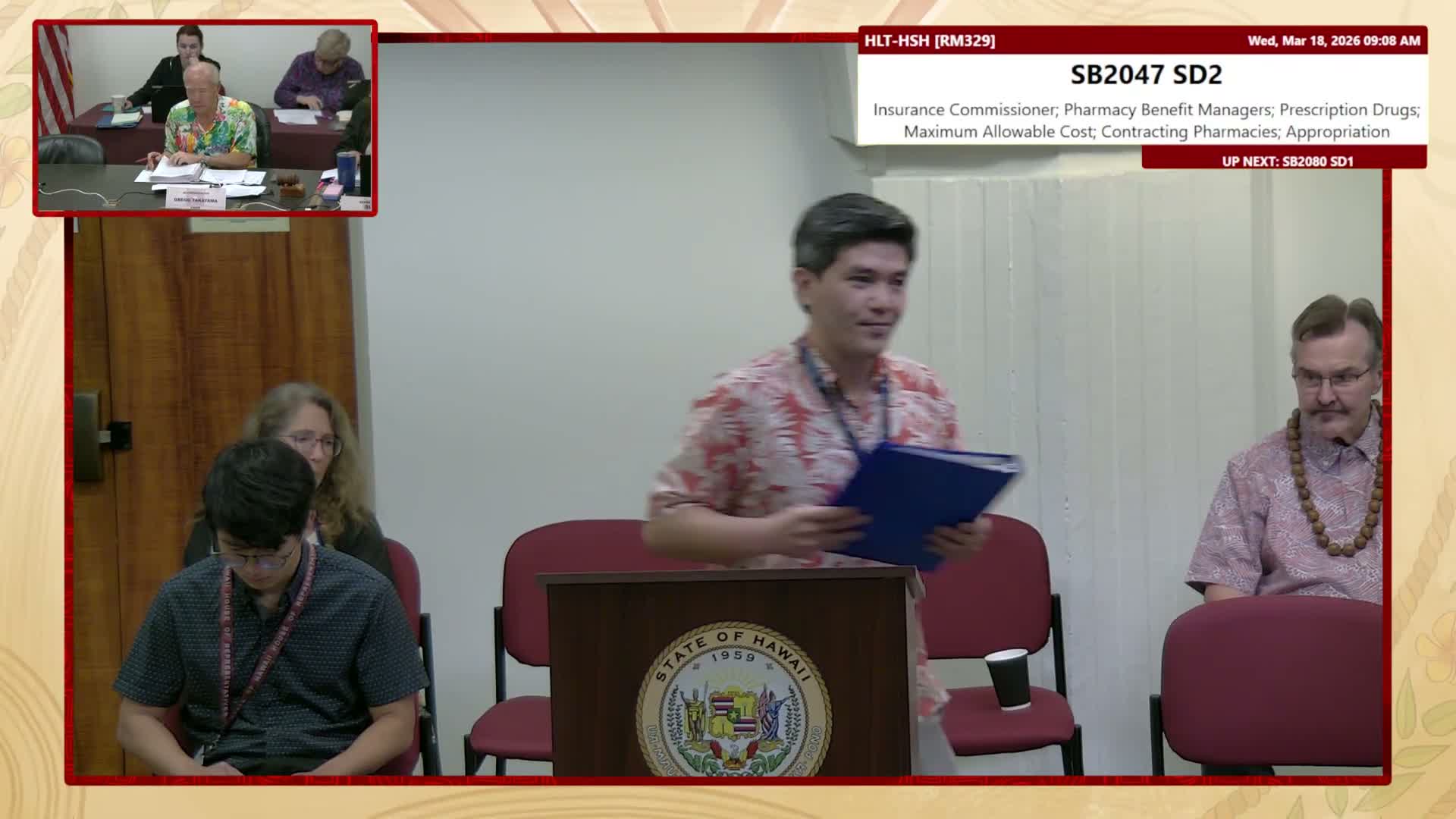
Supporters told the committee SB2080 (the psychology interjurisdictional compact) would broaden access to psychologists via compact privileges and telehealth. Dr. Erin Wilkinson, mental health branch administrator for the Department of Corrections, said adopting the compact "would allow them to practice in Hawaii without having to actually physically be here," expanding choices for clients and continuity of care.
The Board of Psychology’s executive officer, Christopher Fernandez, opposed the bill. He raised specific concerns about the compact’s lack of clear guidance for crisis response, potential new enforcement costs (including travel and FBI background-check implementation), and differences in postdoctoral/internship hour requirements (Hawaii’s rules require approximately 1,900 internship/postdoc hours vs. the compact’s lower threshold). Fernandez said several large states have chosen not to join the compact and urged exploring state provisional licensing reforms as an alternative.
Chaminade program director Sean Scanlon and other local psychologists expressed concerns about cultural competency and the potential impact on local trainees, noting Hawaii’s psychology workforce and training pathways differ from other states. Lawmakers and the board discussed provisional licensing and the recently passed provisional license that will go online in July as a complementary step.
Outcome: The chair recommended deferral of SB2080, noting the Board of Psychology’s concerns about training-hour differences and pending regulatory questions. The committee agreed to defer to allow time for technical work and coordination with licensing boards.
Sources: Testimony from Erin Wilkinson (DCR), Christopher Fernandez (Board of Psychology), Sean Scanlon (Chaminade University).
The Board of Psychology’s executive officer, Christopher Fernandez, opposed the bill. He raised specific concerns about the compact’s lack of clear guidance for crisis response, potential new enforcement costs (including travel and FBI background-check implementation), and differences in postdoctoral/internship hour requirements (Hawaii’s rules require approximately 1,900 internship/postdoc hours vs. the compact’s lower threshold). Fernandez said several large states have chosen not to join the compact and urged exploring state provisional licensing reforms as an alternative.
Chaminade program director Sean Scanlon and other local psychologists expressed concerns about cultural competency and the potential impact on local trainees, noting Hawaii’s psychology workforce and training pathways differ from other states. Lawmakers and the board discussed provisional licensing and the recently passed provisional license that will go online in July as a complementary step.
Outcome: The chair recommended deferral of SB2080, noting the Board of Psychology’s concerns about training-hour differences and pending regulatory questions. The committee agreed to defer to allow time for technical work and coordination with licensing boards.
Sources: Testimony from Erin Wilkinson (DCR), Christopher Fernandez (Board of Psychology), Sean Scanlon (Chaminade University).
View the Full Meeting & All Its Details
This article offers just a summary. Unlock complete video, transcripts, and insights as a Founder Member.
✓
Watch full, unedited meeting videos
✓
Search every word spoken in unlimited transcripts
✓
AI summaries & real-time alerts (all government levels)
✓
Permanent access to expanding government content
30-day money-back guarantee
