Committee advances assignment-of-benefits bill aimed at easing access to substance-use disorder treatment
March 19, 2026 | House Public Hearing, House of Representatives, Legislative , Hawaii
This article was created by AI summarizing key points discussed. AI makes mistakes, so for full details and context, please refer to the video of the full meeting. Please report any errors so we can fix them. Report an error »
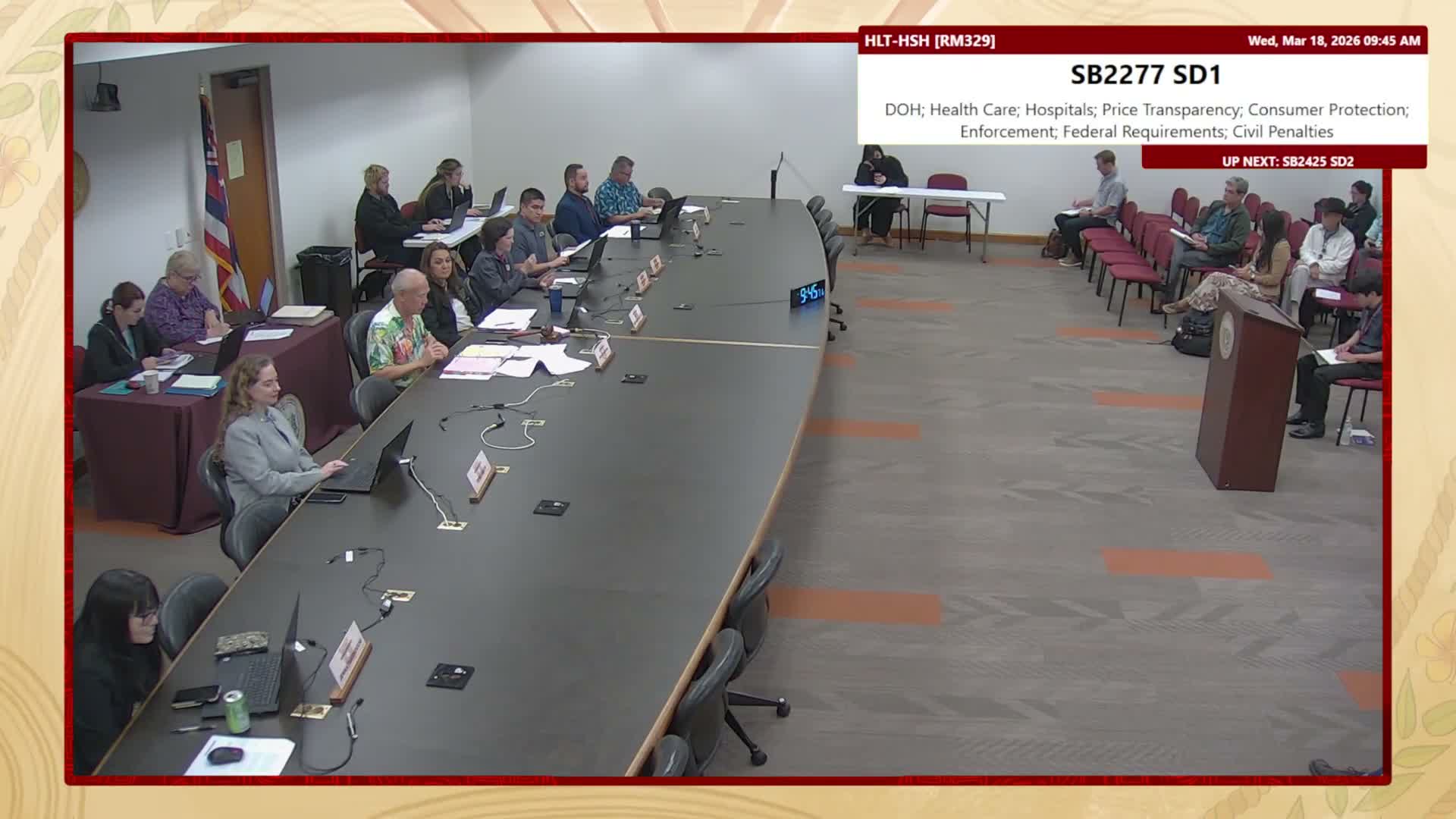
Proponents of SB2425 including treatment providers and family advocates told the committee the bill is narrow and focused on OCA‑licensed residential and detoxification substance-use disorder (SUD) providers. Elliot Smith, CEO of Ohana Addiction Treatment Center, said many families must come up with large sums up front — sometimes "$30,000 or more" — to get a loved one into care because reimbursements are sent to patients rather than providers. "This is a patient safety issue, an access to care issue, and a claims transparency issue," Smith said, urging the committee to pass the measure.
Insurers, led by a representative from HMSA, opposed the bill as written, citing fraud investigations elsewhere (the speaker referenced recent large schemes in Arizona and California) and concerns that assignment-of-benefits could increase out-of-pocket costs for patients, lower oversight and destabilize provider networks. HMSA said it is exploring options to pay nonparticipating providers directly in discrete SUD cases to avoid sending large reimbursements to vulnerable patients.
The chair moved to advance SB2425 as a house draft adopting the attorney general’s language that clarifies the measure does not impair existing contracts and includes technical fixes; committee members adopted the recommendation and moved the bill forward with report language requesting the insurance division clarify what constitutes a valid written assignment of benefits.
What happens next: SB2425 advances with AG-recommended technical edits and report language urging clarity on the form and timing of valid assignments; insurers signaled willingness to explore direct-pay arrangements for certain nonparticipating SUD providers.
Sources: Testimony from Elliot Smith (Ohana Addiction Treatment Center), HMSA representative, Insurance Division comments in committee.
Insurers, led by a representative from HMSA, opposed the bill as written, citing fraud investigations elsewhere (the speaker referenced recent large schemes in Arizona and California) and concerns that assignment-of-benefits could increase out-of-pocket costs for patients, lower oversight and destabilize provider networks. HMSA said it is exploring options to pay nonparticipating providers directly in discrete SUD cases to avoid sending large reimbursements to vulnerable patients.
The chair moved to advance SB2425 as a house draft adopting the attorney general’s language that clarifies the measure does not impair existing contracts and includes technical fixes; committee members adopted the recommendation and moved the bill forward with report language requesting the insurance division clarify what constitutes a valid written assignment of benefits.
What happens next: SB2425 advances with AG-recommended technical edits and report language urging clarity on the form and timing of valid assignments; insurers signaled willingness to explore direct-pay arrangements for certain nonparticipating SUD providers.
Sources: Testimony from Elliot Smith (Ohana Addiction Treatment Center), HMSA representative, Insurance Division comments in committee.
View the Full Meeting & All Its Details
This article offers just a summary. Unlock complete video, transcripts, and insights as a Founder Member.
✓
Watch full, unedited meeting videos
✓
Search every word spoken in unlimited transcripts
✓
AI summaries & real-time alerts (all government levels)
✓
Permanent access to expanding government content
30-day money-back guarantee
