Committee backs $2.5M plan for solar microgrids at rural community health centers
March 19, 2026 | House Public Hearing, House of Representatives, Legislative , Hawaii
This article was created by AI summarizing key points discussed. AI makes mistakes, so for full details and context, please refer to the video of the full meeting. Please report any errors so we can fix them. Report an error »
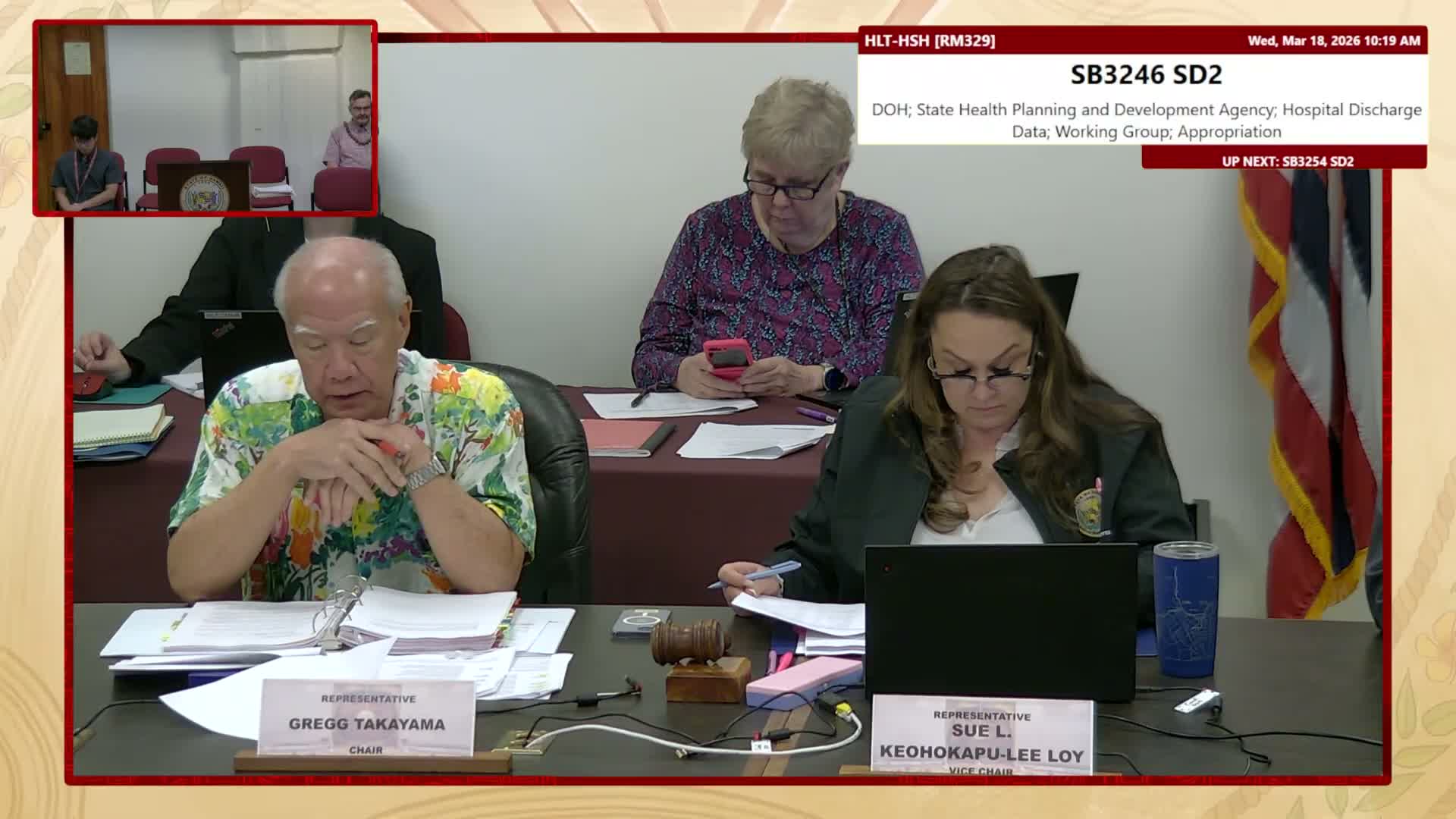
Supporters of SB3254 said solar-plus-storage microgrids would increase resiliency for rural community health centers, protect vaccine stock and reduce operating expenses.
Terry Ratti, project manager for Molokai Community Health Center, urged support for the center on Molokai — the island’s only federally qualified health center — and said the project could save the center up to $87,000 annually and more than $2.1 million over 25 years. Emily Chung, CEO of the Hawaii Primary Care Association, said the proposal covers nine sites across four islands and would pay back in five to seven years, enabling long-term savings and continuity of care during outages.
The technical implementer, Cindy Khan of Collective Energy, told the committee the state financial gap for project closings is roughly $2.5 million, with $196,000 in operational funds requested to support initial implementation. The chair moved the bill forward with those funding levels noted in report language.
What happens next: SB3254 advances with report language requesting $2.5 million in CIP funds and $196,000 in operational grant funds to support nine sites; implementing details will be worked out with DOH and grantees.
Sources: Testimony from Terry Ratti (Molokai Community Health Center), Emily Chung (Hawaii Primary Care Association), Cindy Khan (Collective Energy).
Terry Ratti, project manager for Molokai Community Health Center, urged support for the center on Molokai — the island’s only federally qualified health center — and said the project could save the center up to $87,000 annually and more than $2.1 million over 25 years. Emily Chung, CEO of the Hawaii Primary Care Association, said the proposal covers nine sites across four islands and would pay back in five to seven years, enabling long-term savings and continuity of care during outages.
The technical implementer, Cindy Khan of Collective Energy, told the committee the state financial gap for project closings is roughly $2.5 million, with $196,000 in operational funds requested to support initial implementation. The chair moved the bill forward with those funding levels noted in report language.
What happens next: SB3254 advances with report language requesting $2.5 million in CIP funds and $196,000 in operational grant funds to support nine sites; implementing details will be worked out with DOH and grantees.
Sources: Testimony from Terry Ratti (Molokai Community Health Center), Emily Chung (Hawaii Primary Care Association), Cindy Khan (Collective Energy).
View the Full Meeting & All Its Details
This article offers just a summary. Unlock complete video, transcripts, and insights as a Founder Member.
✓
Watch full, unedited meeting videos
✓
Search every word spoken in unlimited transcripts
✓
AI summaries & real-time alerts (all government levels)
✓
Permanent access to expanding government content
30-day money-back guarantee
