Billings chief backs updated noise ordinance to tackle aggressive driving; council debates fines and enforcement
March 16, 2026 | Billings, Yellowstone, Montana
This article was created by AI summarizing key points discussed. AI makes mistakes, so for full details and context, please refer to the video of the full meeting. Please report any errors so we can fix them. Report an error »
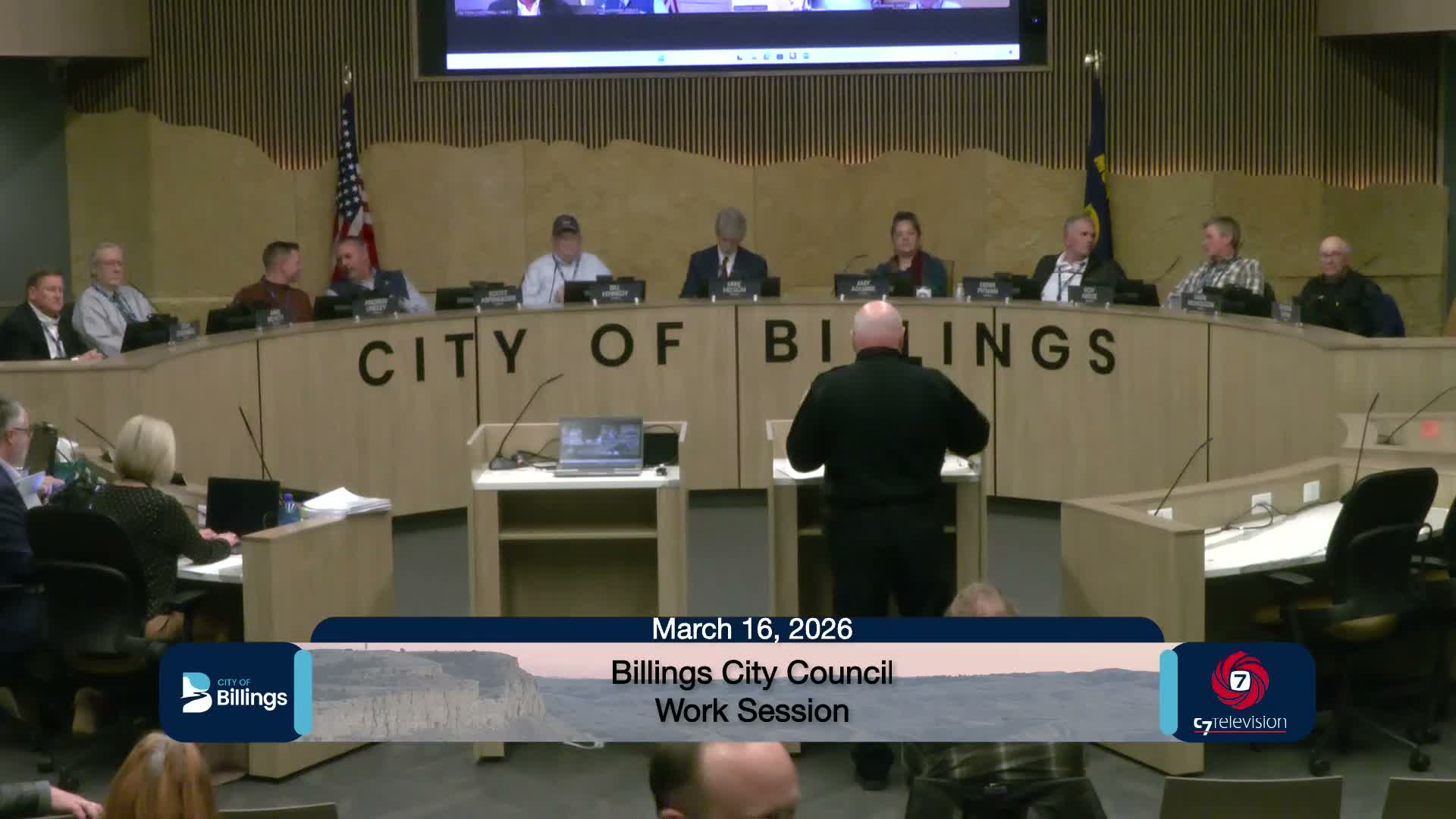
The Billings Police Department presented draft amendments to the citys noise ordinance on March 16 intended to strengthen the city's ability to address excessive vehicle noise tied to aggressive driving.
The draft updates clarify language, remove vague standards, and adopt a plainly audible threshold that allows officers to act when excessive vehicle noise is plainly audible from 50 feet away rather than relying on a decibel meter. Police officials told the council the plain-audibility approach is intended to be a content-neutral, time/place/manner rule that better aligns with state law and constitutional protections while covering sources beyond amplified music, such as loud mufflers, revving motors and motorcycles.
Council members pressed staff on the ordinances penalty structure. The ordinance classifies violations as municipal infractions and refers to section 18-13-04 for penalty ranges (the city attorney said maxima in that section run from about $100 up to $300-$500, depending on repeated offenses). Several council members proposed making the current maximums into mandatory minimums (one proposal floated a $300 minimum for the first offense and $500 for a repeat), but the mayor asked staff to return to a business meeting with a recommended range rather than setting fines tonight.
On enforcement, Police Chief Rich St. John said prior enforcement that required a decibel reading was impractical in many field situations; under the proposed standard an officers observation would be a citable basis for action. He described prior enforcement details that used drones and unmarked vehicles and noted the legislature recently upgraded eluding a police officer to a felony, which he said will increase deterrence for drivers who flee. The chief and council also discussed potential exemptions and the need to avoid creating dangerous pursuits while enforcing the ordinance.
The council did not adopt new fines or finalize the ordinance at the work session; staff were asked to return with recommended penalty ranges and any suggested code edits to clarify mandatory minimums or other enforcement tools.
The draft updates clarify language, remove vague standards, and adopt a plainly audible threshold that allows officers to act when excessive vehicle noise is plainly audible from 50 feet away rather than relying on a decibel meter. Police officials told the council the plain-audibility approach is intended to be a content-neutral, time/place/manner rule that better aligns with state law and constitutional protections while covering sources beyond amplified music, such as loud mufflers, revving motors and motorcycles.
Council members pressed staff on the ordinances penalty structure. The ordinance classifies violations as municipal infractions and refers to section 18-13-04 for penalty ranges (the city attorney said maxima in that section run from about $100 up to $300-$500, depending on repeated offenses). Several council members proposed making the current maximums into mandatory minimums (one proposal floated a $300 minimum for the first offense and $500 for a repeat), but the mayor asked staff to return to a business meeting with a recommended range rather than setting fines tonight.
On enforcement, Police Chief Rich St. John said prior enforcement that required a decibel reading was impractical in many field situations; under the proposed standard an officers observation would be a citable basis for action. He described prior enforcement details that used drones and unmarked vehicles and noted the legislature recently upgraded eluding a police officer to a felony, which he said will increase deterrence for drivers who flee. The chief and council also discussed potential exemptions and the need to avoid creating dangerous pursuits while enforcing the ordinance.
The council did not adopt new fines or finalize the ordinance at the work session; staff were asked to return with recommended penalty ranges and any suggested code edits to clarify mandatory minimums or other enforcement tools.
Don't Miss a Word: See the Full Meeting!
Go beyond summaries. Unlock every video, transcript, and key insight with a Founder Membership.
✓
Get instant access to full meeting videos
✓
Search and clip any phrase from complete transcripts
✓
Receive AI-powered summaries & custom alerts
✓
Enjoy lifetime, unrestricted access to government data
30-day money-back guarantee
