Informational hearing examines proposal to put California Department of Education under appointed commissioner; experts disagree on effects
March 25, 2026 | California State Assembly, House, Legislative, California
This article was created by AI summarizing key points discussed. AI makes mistakes, so for full details and context, please refer to the video of the full meeting. Please report any errors so we can fix them. Report an error »
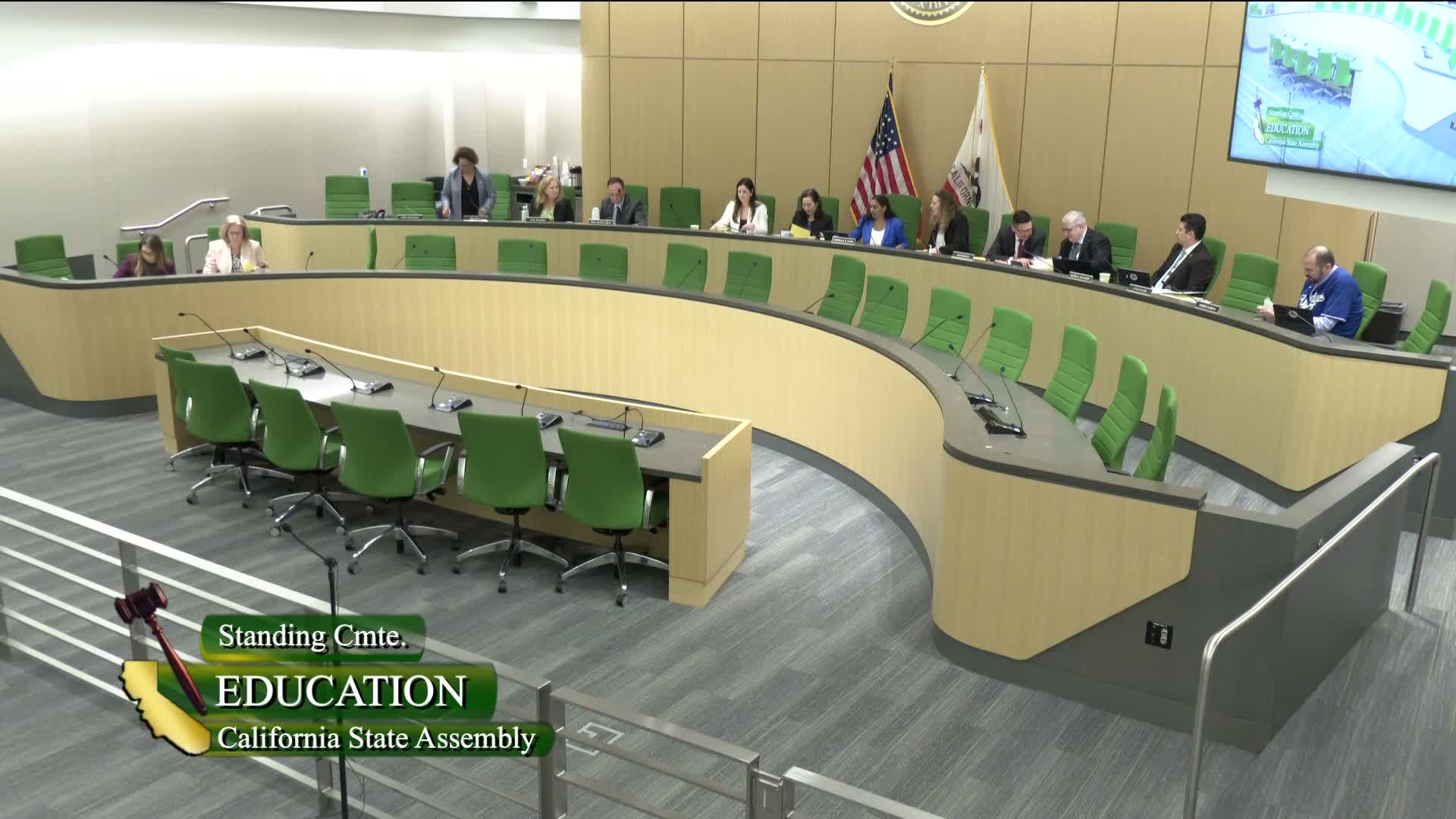
The Assembly Education Committee convened an informational hearing to examine Governor Newsom’s proposal (and related trailer‑bill language) to shift day‑to‑day management of the California Department of Education (CDE) under an appointed education commissioner while redefining the elected Superintendent of Public Instruction (SPI) to focus on independent evaluation, public representation, and advising.
The Legislative Analyst’s Office (LAO) recommended defining the SPI’s duties more clearly and preserving legislative oversight if the proposal proceeds. "We recommend that the education commissioner be senate confirmed," LAO analysts told the committee, framing confirmation as a tool for legislative oversight.
Claus von Zastrow of the Education Commission of the States placed California in a national context, noting several other states have moved toward stronger gubernatorial control of education agencies but that research has not established a clear causal link between governance structure and student outcomes. "I have not seen research that attempts to establish that correlation," he told members.
Brooks Allen, executive director of the State Board of Education and a policy advisor to the governor, said the proposal aims to eliminate a "double‑headed" structure that fragments authority and makes coherent implementation difficult. Allen argued the change would improve the state's ability to align policy with implementation and allow the elected SPI to serve more effectively as a statewide policy champion and voting member of multiple higher‑education governing bodies.
State Superintendent Tony Thurmond said he was open to discussion but repeatedly warned the committee that the proposal, as presented, primarily "lifts and shifts" functions without new resources. Thurmond said he could not point to concrete evidence in the materials showing that the structural change alone will improve student outcomes and emphasized that an elected SPI often initiates priorities that might not otherwise receive attention. "If you really wanna see impact in education, look to the things that are proven, like making sure that every single student knows how to read by third grade," he said, urging focus on funded programs and capacity building.
Members pressed witnesses on a range of trade‑offs: whether consolidating authority would clarify lines of accountability or concentrate power in the governor’s office; how the legislature could retain oversight (LAO recommended senate confirmation and stronger reporting requirements); how county offices of education would be affected; and whether the timing (a transition year for several offices) made this an opportune moment for structural change.
Several presenters (LAO and PACE) suggested that the proposal be coupled with clearer statutory duties for the SPI, explicit legislative oversight measures, and a fiscal implementation plan to evaluate costs and staffing implications. Others, particularly some local education leaders and union representatives, emphasized that capacity, timely guidance, and funding for implementation (for example for TK and expanded learning) are often the binding constraints in translating policy into classroom results.
The informational hearing produced no committee action; members and presenters agreed to additional follow‑up and urged detailed fiscal and operational planning if the legislature pursues statutory changes.
The Legislative Analyst’s Office (LAO) recommended defining the SPI’s duties more clearly and preserving legislative oversight if the proposal proceeds. "We recommend that the education commissioner be senate confirmed," LAO analysts told the committee, framing confirmation as a tool for legislative oversight.
Claus von Zastrow of the Education Commission of the States placed California in a national context, noting several other states have moved toward stronger gubernatorial control of education agencies but that research has not established a clear causal link between governance structure and student outcomes. "I have not seen research that attempts to establish that correlation," he told members.
Brooks Allen, executive director of the State Board of Education and a policy advisor to the governor, said the proposal aims to eliminate a "double‑headed" structure that fragments authority and makes coherent implementation difficult. Allen argued the change would improve the state's ability to align policy with implementation and allow the elected SPI to serve more effectively as a statewide policy champion and voting member of multiple higher‑education governing bodies.
State Superintendent Tony Thurmond said he was open to discussion but repeatedly warned the committee that the proposal, as presented, primarily "lifts and shifts" functions without new resources. Thurmond said he could not point to concrete evidence in the materials showing that the structural change alone will improve student outcomes and emphasized that an elected SPI often initiates priorities that might not otherwise receive attention. "If you really wanna see impact in education, look to the things that are proven, like making sure that every single student knows how to read by third grade," he said, urging focus on funded programs and capacity building.
Members pressed witnesses on a range of trade‑offs: whether consolidating authority would clarify lines of accountability or concentrate power in the governor’s office; how the legislature could retain oversight (LAO recommended senate confirmation and stronger reporting requirements); how county offices of education would be affected; and whether the timing (a transition year for several offices) made this an opportune moment for structural change.
Several presenters (LAO and PACE) suggested that the proposal be coupled with clearer statutory duties for the SPI, explicit legislative oversight measures, and a fiscal implementation plan to evaluate costs and staffing implications. Others, particularly some local education leaders and union representatives, emphasized that capacity, timely guidance, and funding for implementation (for example for TK and expanded learning) are often the binding constraints in translating policy into classroom results.
The informational hearing produced no committee action; members and presenters agreed to additional follow‑up and urged detailed fiscal and operational planning if the legislature pursues statutory changes.
View the Full Meeting & All Its Details
This article offers just a summary. Unlock complete video, transcripts, and insights as a Founder Member.
✓
Watch full, unedited meeting videos
✓
Search every word spoken in unlimited transcripts
✓
AI summaries & real-time alerts (all government levels)
✓
Permanent access to expanding government content
30-day money-back guarantee
