Iowa House passes bill to temporarily raise HMO tax to draw federal Medicaid funds
March 19, 2026 | 2026 House of Representatives, Legislative, Iowa
This article was created by AI summarizing key points discussed. AI makes mistakes, so for full details and context, please refer to the video of the full meeting. Please report any errors so we can fix them. Report an error »
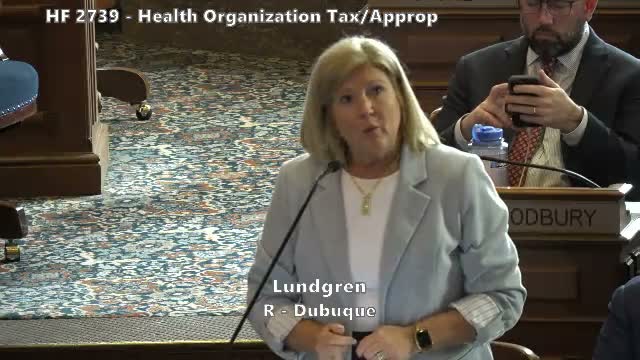
Representative Lundgren, the bill manager, secured final House passage of House File 2739 on a 53-39 vote, sending the measure to the Senate after several hours of floor debate and a string of failed amendments.
House File 2739 replaces the existing premium tax on health maintenance organizations under Iowa Code chapter 432 with a newly created health-care-related tax that the bill manager said is designed to comply with federal Medicaid managed-care rules and thereby qualify the state for additional federal matching funds. "The shift is designed to comply with federal guidelines for Medicaid managed care, ensuring the tax structures qualify for federal matching funds," Lundgren said during opening remarks. Lundgren said the bill temporarily raises the tax to 3.5% for a short period to draw down federal dollars and then reduces it to a lower rate thereafter.
The package on the floor included fiscal adjustments the bill manager described as guardrails: Lundgren said an amendment updated REC estimates, raised a one-time draw from the taxpayer relief fund to $347,000,000 and increased a Medicaid supplement by $89,000,000 to cover shortfalls. "This keeps the HMO tax unchanged using current data and prevents treating the taxpayer relief fund like an unlimited credit card," Lundgren said of the adopted amendment.
Opponents warned the new tax would raise premiums and could reduce access to care. Representative Srinivas, a sponsor of an unsuccessful amendment to remove the tax provision, argued the measure would make health care less affordable and urged colleagues to protect vulnerable Iowans. "Iowans right now . . . have been reaching out over and over again telling us that they are strapped," Srinivas said. Representative Bathe described clinical examples of patients who struggle to afford medications and care and warned that rising costs force people off coverage.
Insurance-market consequences were a key point of contention. Representative Lundgren read a letter he said came from Wellmark Blue Cross Blue Shield that warned an amendment freezing rate pass-throughs could force the insurer to withdraw from all lines of insurance, potentially affecting coverage for large numbers of Iowans. Opponents cited that warning in arguing amendments would have unintended market consequences; supporters countered that without the bill the state would forfeit federal matching dollars needed to shore up Medicaid.
Lawmakers debated whether the change was a "one-time" revenue fix or the start of recurring fiscal pressure. Representative Meyer (floor manager) confirmed recent REC numbers showing a roughly $90,000,000 shortfall and said the state expects continued deficits, while other members referenced estimates ranging higher; Meyer noted that next-year figures had not been finalized. "The 90,000,000 that just came out a few days ago," Meyer said in response to floor questioning about the size of the current shortfall.
Several roll-call attempts to suspend the rules and consider secondary or substitute amendments failed; notable failed amendments included proposals to (a) require lawmakers to pay the same 3.5% increase in their own premiums, (b) subsidize ACA marketplace enrollees, (c) require the governor to sell an executive transport plane and direct proceeds to Medicaid, and (d) various transparency measures. Two technical amendments to clarify provider-tax timing and rates were adopted.
After Lundgren's closing remarks urging passage to secure federal funds and protect Medicaid services, the House voted for final passage. The clerk recorded 53 yeas, 39 nays and 8 absent/not voting; the chair declared the bill passed by a constitutional majority. Representative Kaufman then requested and received unanimous consent to message the bill immediately to the Senate.
The House adjourned, with the body scheduled to reconvene Friday, March 20 at 9 a.m.
Sources: Floor proceedings of the House (statements and roll-call tallies as recorded on the floor).
House File 2739 replaces the existing premium tax on health maintenance organizations under Iowa Code chapter 432 with a newly created health-care-related tax that the bill manager said is designed to comply with federal Medicaid managed-care rules and thereby qualify the state for additional federal matching funds. "The shift is designed to comply with federal guidelines for Medicaid managed care, ensuring the tax structures qualify for federal matching funds," Lundgren said during opening remarks. Lundgren said the bill temporarily raises the tax to 3.5% for a short period to draw down federal dollars and then reduces it to a lower rate thereafter.
The package on the floor included fiscal adjustments the bill manager described as guardrails: Lundgren said an amendment updated REC estimates, raised a one-time draw from the taxpayer relief fund to $347,000,000 and increased a Medicaid supplement by $89,000,000 to cover shortfalls. "This keeps the HMO tax unchanged using current data and prevents treating the taxpayer relief fund like an unlimited credit card," Lundgren said of the adopted amendment.
Opponents warned the new tax would raise premiums and could reduce access to care. Representative Srinivas, a sponsor of an unsuccessful amendment to remove the tax provision, argued the measure would make health care less affordable and urged colleagues to protect vulnerable Iowans. "Iowans right now . . . have been reaching out over and over again telling us that they are strapped," Srinivas said. Representative Bathe described clinical examples of patients who struggle to afford medications and care and warned that rising costs force people off coverage.
Insurance-market consequences were a key point of contention. Representative Lundgren read a letter he said came from Wellmark Blue Cross Blue Shield that warned an amendment freezing rate pass-throughs could force the insurer to withdraw from all lines of insurance, potentially affecting coverage for large numbers of Iowans. Opponents cited that warning in arguing amendments would have unintended market consequences; supporters countered that without the bill the state would forfeit federal matching dollars needed to shore up Medicaid.
Lawmakers debated whether the change was a "one-time" revenue fix or the start of recurring fiscal pressure. Representative Meyer (floor manager) confirmed recent REC numbers showing a roughly $90,000,000 shortfall and said the state expects continued deficits, while other members referenced estimates ranging higher; Meyer noted that next-year figures had not been finalized. "The 90,000,000 that just came out a few days ago," Meyer said in response to floor questioning about the size of the current shortfall.
Several roll-call attempts to suspend the rules and consider secondary or substitute amendments failed; notable failed amendments included proposals to (a) require lawmakers to pay the same 3.5% increase in their own premiums, (b) subsidize ACA marketplace enrollees, (c) require the governor to sell an executive transport plane and direct proceeds to Medicaid, and (d) various transparency measures. Two technical amendments to clarify provider-tax timing and rates were adopted.
After Lundgren's closing remarks urging passage to secure federal funds and protect Medicaid services, the House voted for final passage. The clerk recorded 53 yeas, 39 nays and 8 absent/not voting; the chair declared the bill passed by a constitutional majority. Representative Kaufman then requested and received unanimous consent to message the bill immediately to the Senate.
The House adjourned, with the body scheduled to reconvene Friday, March 20 at 9 a.m.
Sources: Floor proceedings of the House (statements and roll-call tallies as recorded on the floor).
Don't Miss a Word: See the Full Meeting!
Go beyond summaries. Unlock every video, transcript, and key insight with a Founder Membership.
✓
Get instant access to full meeting videos
✓
Search and clip any phrase from complete transcripts
✓
Receive AI-powered summaries & custom alerts
✓
Enjoy lifetime, unrestricted access to government data
30-day money-back guarantee
