Planning Commission backs maximum lot widths to limit "super lots"
March 13, 2026 | Muskegon City, Muskegon County, Michigan
This article was created by AI summarizing key points discussed. AI makes mistakes, so for full details and context, please refer to the video of the full meeting. Please report any errors so we can fix them. Report an error »
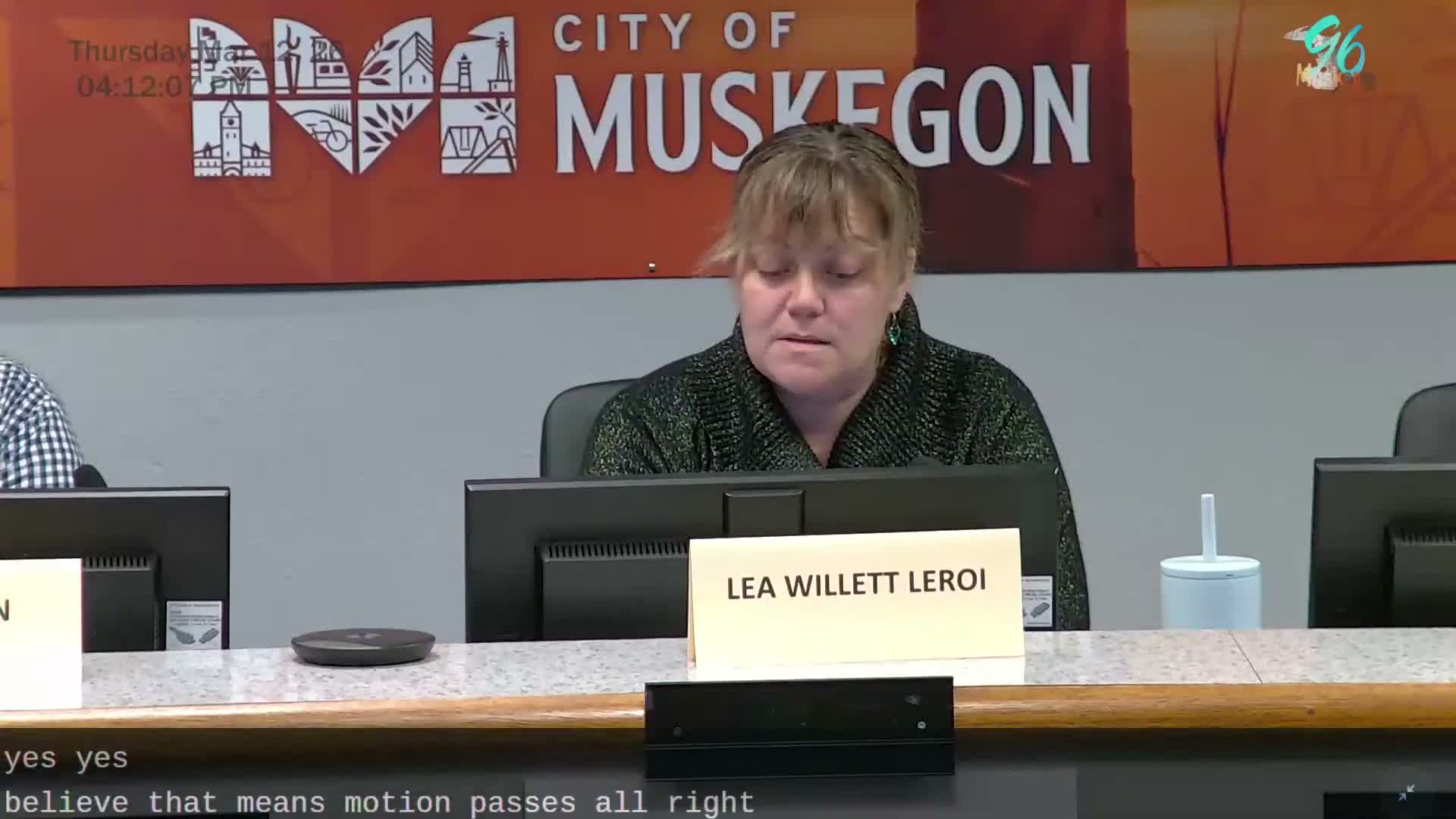
On March 12 the City of Muskegon Planning Commission voted to recommend that the City Commission adopt an amendment to establish maximum lot widths in the city’s neighborhood residential districts.
Planning staff said the city’s form‑based urban residential districts include a 60‑foot lot‑width maximum that helps prevent combining multiple small parcels into oversized 'super lots' that can hamper redevelopment. “In the form based code urban residential zoning designation, there is a lot with maximum, which works out very well at 60 feet,” planning staff said, describing the rationale for aligning neighborhood districts with that standard.
No members of the public testified at the Planning Commission public hearing. Commissioners asked questions and debated alternatives: one commissioner asked whether the city could instead levy a tax or fee to discourage large lots, and planning staff replied that property tax is tied to value and that charging a fee normally requires a service (for example, infrastructure connection fees). Commissioners noted land‑value taxation as a conceptual alternative but observed state and legal limits to implementing such tax changes locally.
A motion to recommend establishing maximum lot widths in neighborhood residential districts was moved, supported and passed by roll call; the commission’s recommendation will go to the City Commission for consideration.
If the City Commission adopts the ordinance amendment, it will change lot‑creation rules used in subdivision and parcel‑split reviews; the Planning Commission’s action is a recommendation, not a final ordinance adoption.
Planning staff said the city’s form‑based urban residential districts include a 60‑foot lot‑width maximum that helps prevent combining multiple small parcels into oversized 'super lots' that can hamper redevelopment. “In the form based code urban residential zoning designation, there is a lot with maximum, which works out very well at 60 feet,” planning staff said, describing the rationale for aligning neighborhood districts with that standard.
No members of the public testified at the Planning Commission public hearing. Commissioners asked questions and debated alternatives: one commissioner asked whether the city could instead levy a tax or fee to discourage large lots, and planning staff replied that property tax is tied to value and that charging a fee normally requires a service (for example, infrastructure connection fees). Commissioners noted land‑value taxation as a conceptual alternative but observed state and legal limits to implementing such tax changes locally.
A motion to recommend establishing maximum lot widths in neighborhood residential districts was moved, supported and passed by roll call; the commission’s recommendation will go to the City Commission for consideration.
If the City Commission adopts the ordinance amendment, it will change lot‑creation rules used in subdivision and parcel‑split reviews; the Planning Commission’s action is a recommendation, not a final ordinance adoption.
View the Full Meeting & All Its Details
This article offers just a summary. Unlock complete video, transcripts, and insights as a Founder Member.
✓
Watch full, unedited meeting videos
✓
Search every word spoken in unlimited transcripts
✓
AI summaries & real-time alerts (all government levels)
✓
Permanent access to expanding government content
30-day money-back guarantee
