City legal outlines "aggrieved party" standard and appeal path for zoning actions
March 16, 2026 | Billings, Yellowstone, Montana
This article was created by AI summarizing key points discussed. AI makes mistakes, so for full details and context, please refer to the video of the full meeting. Please report any errors so we can fix them. Report an error »
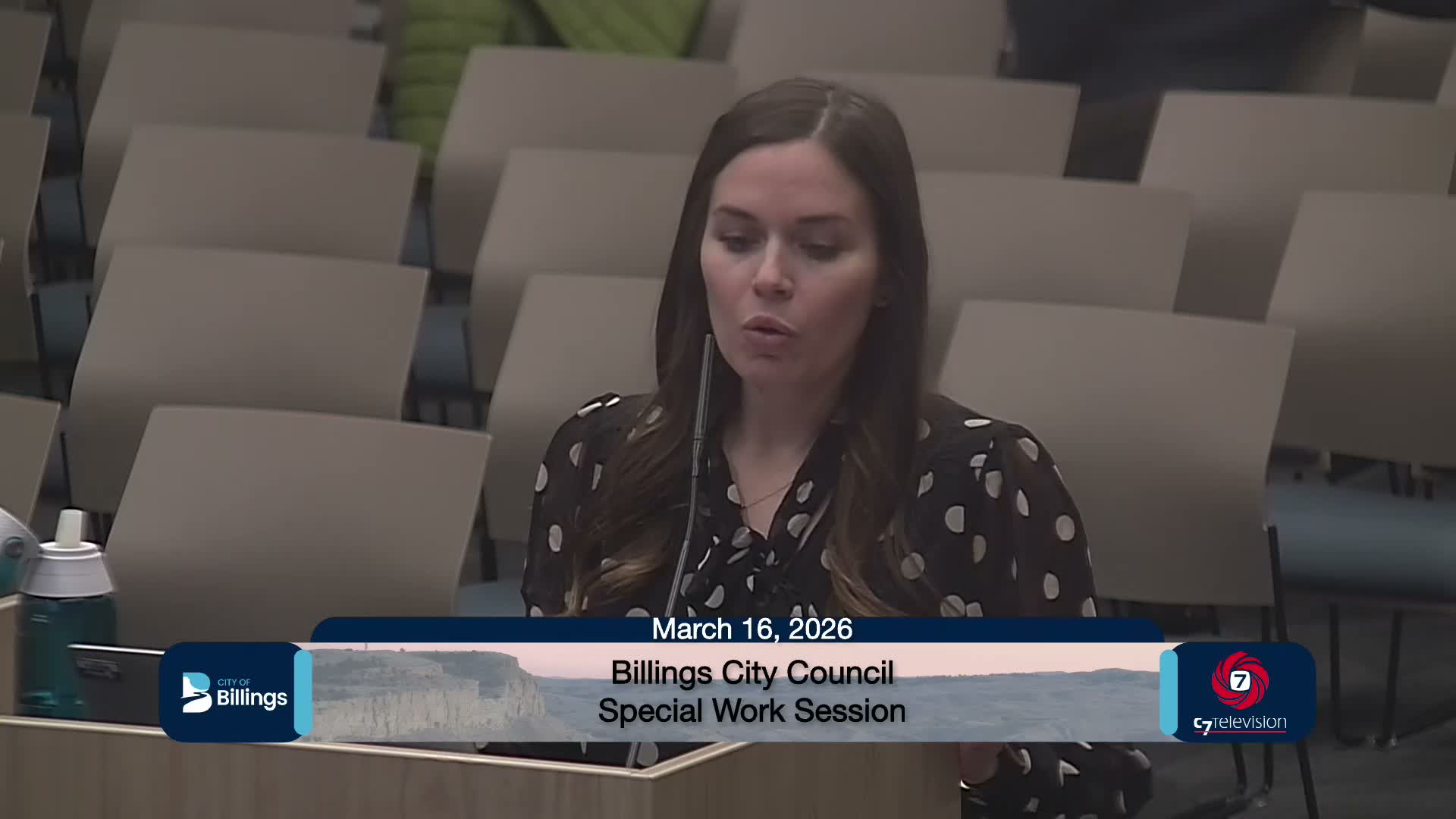
City legal counsel gave a detailed explanation of how the 'aggrieved party' standard under state law differs from routine public notice, outlining the administrative appeal path and the evidentiary burden required to succeed.
Jessica McKee of the city’s civil legal division told the council that an "aggrieved party" is distinct from someone merely entitled to public notice and comment. "If they are aggrieved under the statute, which means that they have an injury that's not just general...some specific injury they can appeal," McKee said, adding that the appeal is first to the planning commission and then may proceed to council and ultimately to district court.
McKee cautioned the council that the standard is often a fact-by-fact inquiry: "Likely to happen doesn't mean speculative," she said, and emphasized that an appellant carries the initial burden to state the facts and grounds for appeal. Another legal speaker added that appellants must be specific and produce proof when they file an appeal.
Council members raised practical concerns about how appeals would affect development timelines. One councilor asked whether routine objections—like a neighbor’s claim the project would reduce property values—would qualify; legal staff replied such claims are typically too speculative unless accompanied by concrete proof (for example, an appraisal or detailed impact analysis). Planning staff explained that the typical process includes a 15-business-day public comment period, after which staff will review comments; if staff grants a permit and someone claiming to be aggrieved files an appeal, the commission will evaluate whether the person is an aggrieved party and the appeal can put the permit decision on hold.
Councilors asked staff to produce a clear flowchart showing: the notice and comment period, criteria for being considered an aggrieved party, steps to lodge an appeal, and the stages in which a decision may be stayed. Legal and planning staff agreed to prepare that flowchart and return to council with clarifying materials.
The session included back-and-forth questions from council and planning staff about how the definition will play out in practice; staff repeatedly recommended evaluating claims case-by-case and involving legal review early in the permitting process.
Next step: legal and planning staff will prepare a flowchart of the notice/appeal process and provide it to council for review.
Jessica McKee of the city’s civil legal division told the council that an "aggrieved party" is distinct from someone merely entitled to public notice and comment. "If they are aggrieved under the statute, which means that they have an injury that's not just general...some specific injury they can appeal," McKee said, adding that the appeal is first to the planning commission and then may proceed to council and ultimately to district court.
McKee cautioned the council that the standard is often a fact-by-fact inquiry: "Likely to happen doesn't mean speculative," she said, and emphasized that an appellant carries the initial burden to state the facts and grounds for appeal. Another legal speaker added that appellants must be specific and produce proof when they file an appeal.
Council members raised practical concerns about how appeals would affect development timelines. One councilor asked whether routine objections—like a neighbor’s claim the project would reduce property values—would qualify; legal staff replied such claims are typically too speculative unless accompanied by concrete proof (for example, an appraisal or detailed impact analysis). Planning staff explained that the typical process includes a 15-business-day public comment period, after which staff will review comments; if staff grants a permit and someone claiming to be aggrieved files an appeal, the commission will evaluate whether the person is an aggrieved party and the appeal can put the permit decision on hold.
Councilors asked staff to produce a clear flowchart showing: the notice and comment period, criteria for being considered an aggrieved party, steps to lodge an appeal, and the stages in which a decision may be stayed. Legal and planning staff agreed to prepare that flowchart and return to council with clarifying materials.
The session included back-and-forth questions from council and planning staff about how the definition will play out in practice; staff repeatedly recommended evaluating claims case-by-case and involving legal review early in the permitting process.
Next step: legal and planning staff will prepare a flowchart of the notice/appeal process and provide it to council for review.
Don't Miss a Word: See the Full Meeting!
Go beyond summaries. Unlock every video, transcript, and key insight with a Founder Membership.
✓
Get instant access to full meeting videos
✓
Search and clip any phrase from complete transcripts
✓
Receive AI-powered summaries & custom alerts
✓
Enjoy lifetime, unrestricted access to government data
30-day money-back guarantee
