Agencies tell senators make‑ready work would cut EV retrofit costs as lawmakers question 25% requirement
March 18, 2026 | Senate, Legislative , Hawaii
This article was created by AI summarizing key points discussed. AI makes mistakes, so for full details and context, please refer to the video of the full meeting. Please report any errors so we can fix them. Report an error »
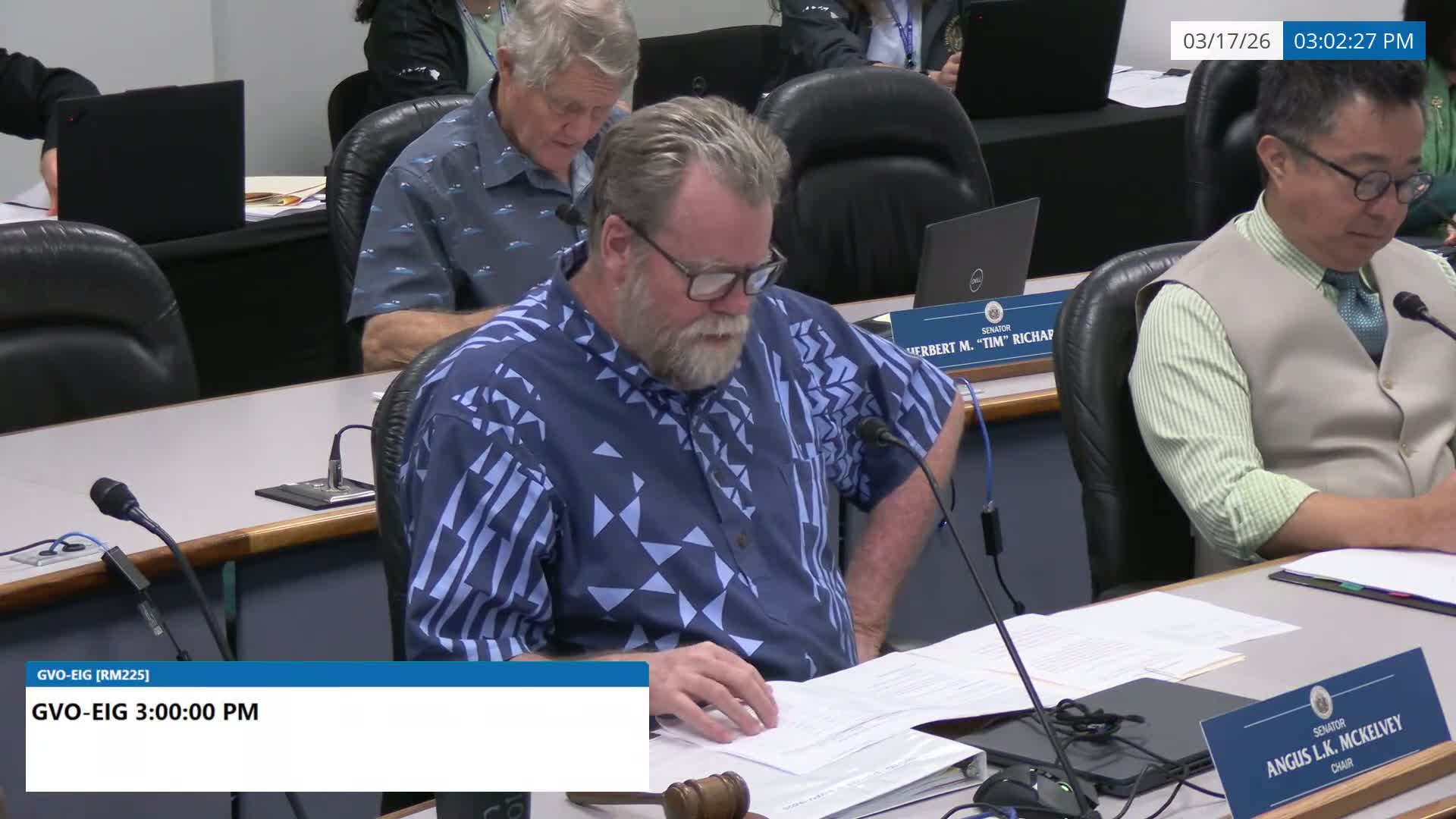
A joint Senate hearing on March 17, 2026, heard testimony from state agencies and advocates on House Bill 1980, a measure that would require electrical vehicle charging infrastructure “make‑ready” work in a portion of parking stalls at state facilities. Witnesses said the goal is to lower future retrofit costs, but senators questioned the bill’s 25% threshold, equity and funding.
Sima Suayko of the Department of Accounting and General Services’ Automotive Management Division told the committees, “We stand on our testimony and we're available for comments,” and described DAGS’ ongoing work to convert state fleets and prepare facilities. The Hawaii State Energy Office said agencies are already coordinating with DAGS and outside technical partners and are using Volkswagen settlement funds to install workplace and public chargers at state facilities.
“Housing and parking for people who cannot charge at home are equity issues,” the Energy Office told senators, arguing that workplace and public charging helps renters and multifamily residents who can’t easily charge at home.
Advocates urged a stronger standard. Ted Bolen of Climate Protectors Hawaii urged lawmakers to keep the 25% make‑ready requirement and consider stronger action, saying, “I submit that the 25% is fairly minimal when you look at where we're headed with regard to electric vehicles.” Chris Caulfield of the Moon Alliance said EV adoption is growing rapidly and workplace charging is needed so multifamily residents are not left behind.
Lawmakers pressed agencies about costs and implementation. The Energy Office estimated detailed engineering studies for four to ten sites would run roughly $25,000–$35,000 per site—about $300,000 for ten sites—saying the Volkswagen settlement can pay for charging infrastructure but not always for detailed site engineering studies. Senators also debated whether a surcharge on EV sales should fund state charging; the Energy Office cautioned that targeting EVs for a surcharge could send a counterproductive market signal and noted EVs represent only a portion of current vehicle sales.
Rural senators questioned the 25% figure’s feasibility. “That's way over the top,” said a rural senator, adding that low EV adoption and constrained electrical infrastructure outside urban corridors could leave many reserved stalls unused.
Testimony clarified the bill’s scope: the 25% provision is framed as “make‑ready” requirements for new construction to avoid future retrofit costs, not an immediate mandate to install chargers at that percentage in existing lots. DAGS said it has already installed 54 chargers and included a plan in its supplemental budget request; several senators suggested raising special fund ceilings (motor pool, parking revolving funds) as a faster way to provide capital support.
After extended questioning and agency answers, the committees agreed there is momentum on EV infrastructure and that agencies are doing planning work, but members concluded the bill in its present form was premature. The chair said the committees would support administrative steps such as raising fund ceilings and encouraged agencies to return with a targeted plan. The committee deferred HB1980 for later consideration.
Sima Suayko of the Department of Accounting and General Services’ Automotive Management Division told the committees, “We stand on our testimony and we're available for comments,” and described DAGS’ ongoing work to convert state fleets and prepare facilities. The Hawaii State Energy Office said agencies are already coordinating with DAGS and outside technical partners and are using Volkswagen settlement funds to install workplace and public chargers at state facilities.
“Housing and parking for people who cannot charge at home are equity issues,” the Energy Office told senators, arguing that workplace and public charging helps renters and multifamily residents who can’t easily charge at home.
Advocates urged a stronger standard. Ted Bolen of Climate Protectors Hawaii urged lawmakers to keep the 25% make‑ready requirement and consider stronger action, saying, “I submit that the 25% is fairly minimal when you look at where we're headed with regard to electric vehicles.” Chris Caulfield of the Moon Alliance said EV adoption is growing rapidly and workplace charging is needed so multifamily residents are not left behind.
Lawmakers pressed agencies about costs and implementation. The Energy Office estimated detailed engineering studies for four to ten sites would run roughly $25,000–$35,000 per site—about $300,000 for ten sites—saying the Volkswagen settlement can pay for charging infrastructure but not always for detailed site engineering studies. Senators also debated whether a surcharge on EV sales should fund state charging; the Energy Office cautioned that targeting EVs for a surcharge could send a counterproductive market signal and noted EVs represent only a portion of current vehicle sales.
Rural senators questioned the 25% figure’s feasibility. “That's way over the top,” said a rural senator, adding that low EV adoption and constrained electrical infrastructure outside urban corridors could leave many reserved stalls unused.
Testimony clarified the bill’s scope: the 25% provision is framed as “make‑ready” requirements for new construction to avoid future retrofit costs, not an immediate mandate to install chargers at that percentage in existing lots. DAGS said it has already installed 54 chargers and included a plan in its supplemental budget request; several senators suggested raising special fund ceilings (motor pool, parking revolving funds) as a faster way to provide capital support.
After extended questioning and agency answers, the committees agreed there is momentum on EV infrastructure and that agencies are doing planning work, but members concluded the bill in its present form was premature. The chair said the committees would support administrative steps such as raising fund ceilings and encouraged agencies to return with a targeted plan. The committee deferred HB1980 for later consideration.
View the Full Meeting & All Its Details
This article offers just a summary. Unlock complete video, transcripts, and insights as a Founder Member.
✓
Watch full, unedited meeting videos
✓
Search every word spoken in unlimited transcripts
✓
AI summaries & real-time alerts (all government levels)
✓
Permanent access to expanding government content
30-day money-back guarantee
