Officials outline Aloha Stadium dismantling, 31,000‑seat rebuild and major infrastructure costs as financing questions remain
March 12, 2026 | Senate, Legislative , Hawaii
This article was created by AI summarizing key points discussed. AI makes mistakes, so for full details and context, please refer to the video of the full meeting. Please report any errors so we can fix them. Report an error »
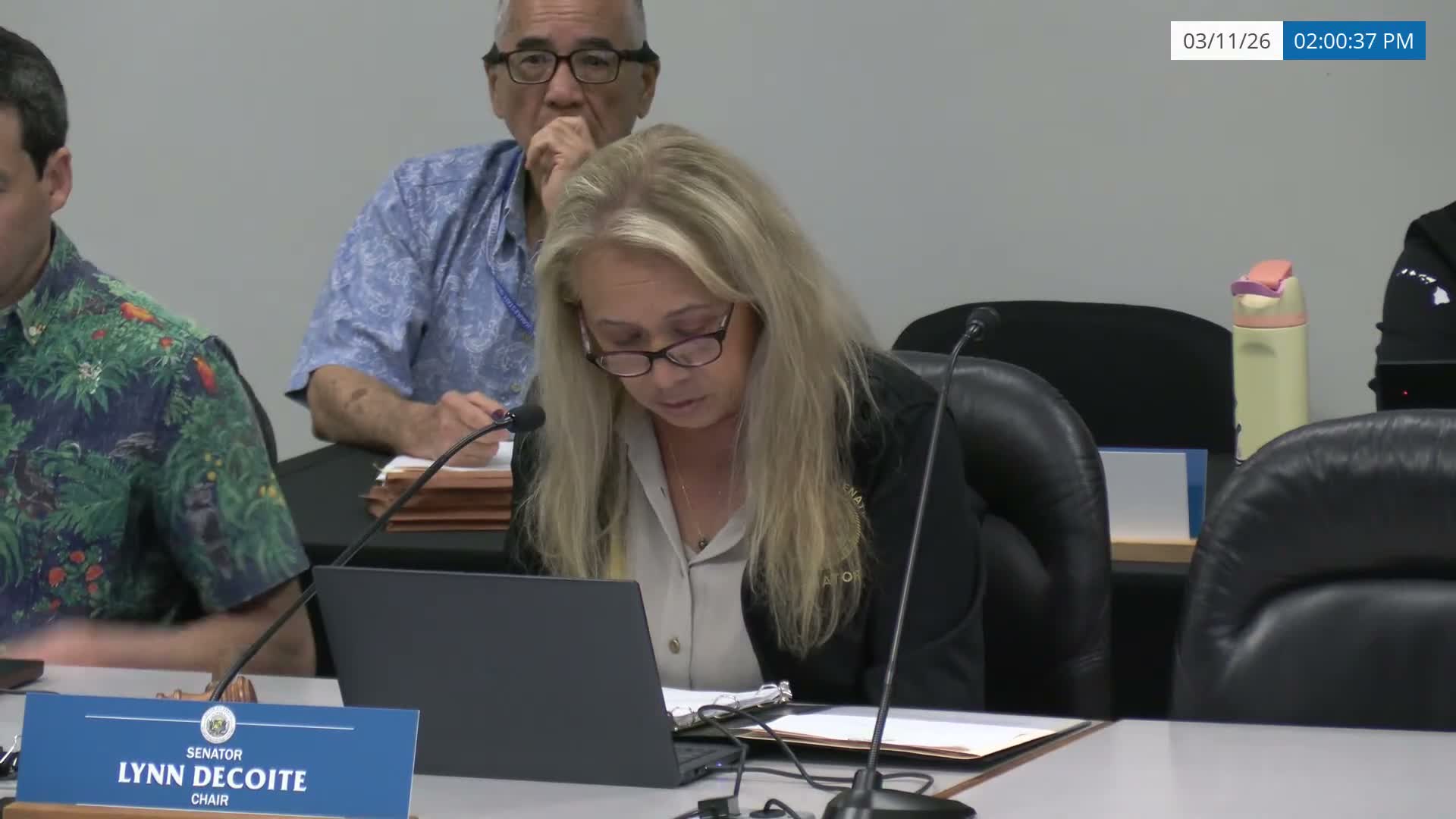
Michael Yatau, executive director of the Aloha Stadium Authority, told senators at a March 11 joint informational briefing that dismantling of the condemned Aloha Stadium has begun in earnest and that the Authority is moving toward executing the agreements needed to build a new stadium and mixed‑use district.
Yatau said crews started pulling apart parking spirals and other structures in mid‑February and that the dismantling phase is expected to continue through November 2026, weather permitting. He described the program as a transition from an operational authority to a land‑development organization and introduced a board reshaped for development work.
"We also started the actual dismantling of the stadium," Yatau said, describing a phased pull‑away approach rather than an implosion. He added that the Authority has worked to preserve site revenue streams — including swap‑meet income that averages about $150,000 a month — while moving staff and operations off site during construction.
The design and development team presented a schematic for a base stadium of about 31,000 seats with structural provisions to expand the north and south end zones to roughly 38,000–40,000 seats later if demand and financing permit. Stanford Carr of the developer team described the stadium concept and an adjacent entertainment promenade called "Aloha Live," which would integrate pre‑ and post‑game venues, club spaces and cultural attractions.
"We are currently planning what we call the base stadium for 31,000 plus or minus seats," Stanford Carr said, adding that the design allows for future tiers on either side.
Why it matters: presenters tied the stadium to a larger master plan for an Aloha Halawa Entertainment District that the team says could deliver market housing and visitor assets on a state‑owned site connected to rail and major highways. But they said the district’s viability depends on extensive utility relocation, new substations and other infrastructure that will consume land and raise costs.
Key cost and timeline figures
- Stadium construction (base 31,000 seats): approximately $650 million, per the developer team.
- Phase‑1 infrastructure relocation and installation: roughly $180 million, estimated for utilities and roadway work serving the initial build area.
- State appropriation to date: $350 million toward the stadium. Presenters said a funding gap of about $300–$400 million remains to reach the $650M stadium plus infrastructure baseline, depending on financing mixes.
- Project schedule: the team presented an August 2029 target for stadium readiness, but cautioned the date depends on securing remaining financing and completing complex infrastructure work.
Infrastructure and entitlement challenges
The presenters stressed that the site hides decades of buried utilities and legal encumbrances. They said there are about 88 encumbrances across multiple TMKs and that utilities — including live fuel lines, water and sewer — will need careful relocation. The team’s legal counsel recommended condemning non‑Department of Defense easements to clear rights‑of‑way more quickly.
Stanford Carr warned that power capacity is a binding constraint: HECO likely lacks sufficient capacity for the stadium and surrounding build, so one or two new substations may be necessary. "Where that substation goes," he said, "is a little bit up in the air, but you can see a footprint of approximately how big a substation lot would have to be," noting that substations take developable land out of the housing equation.
Housing, density and community feedback
The project team urged a planning target of roughly 4,500 housing units across the district, arguing that scale is necessary to amortize infrastructure costs while preserving mixed‑use retail and green space. Presenters showed higher‑density visualizations (10,000 and 20,000 units) and said neighborhood boards and town halls consistently opposed those larger scenarios.
"What we've seen is a 4,500 number with mixed use retail and a vibrant stadium with green space," Michael Yatau said, noting that the figure reflects coordination with utility providers and prior studies.
HCDA role and financing options
Craig (representing the Hawaii Community Development Authority) told senators that a bill under consideration (referred to in testimony as Senate Bill 2599, part 1) would assign HCDA zoning and regulatory authority for the Stadium Development District if enacted. HCDA staff said promulgating rules and taking on that role would likely take about two years.
The briefing reviewed potential financing tools: HCDA has a bond ceiling cap authorized in a recent act (discussed in testimony as Act 252/HB 1007) that could support up to $180 million in bonds subject to underwriting and repayment sources; presenters also discussed community facilities district (CFD) financing, tax‑increment financing (TIF) and private fundraising or philanthropy as possible ways to close the remaining gap.
Questions from senators focused on capacity, triggers for adding tiers, the allocation of risk between taxpayers and private developers, and whether the project team could meet the August 2029 target if financing is not fully secured soon. Presenters said a practical deadline to firm up financing is roughly one year from the briefing to avoid missing key schedule milestones.
What’s next
Presenters offered to provide senators with supporting studies and additional cost estimates for higher density scenarios and a written timeline for HCDA’s proposed rule‑making and permitting steps. The committee did not take formal votes during the briefing; the session concluded with requests for more detailed cost breakdowns and a written HCDA timeline.
Sources and attributions
This article draws on presentations and question‑and‑answer exchanges at the March 11, 2026 joint informational briefing, including on‑record remarks by Michael Yatau (executive director, Aloha Stadium Authority), Stanford Carr (developer/presenter), Koloa Robinson (Aloha Halawa District Partners) and Craig (HCDA representative).
Yatau said crews started pulling apart parking spirals and other structures in mid‑February and that the dismantling phase is expected to continue through November 2026, weather permitting. He described the program as a transition from an operational authority to a land‑development organization and introduced a board reshaped for development work.
"We also started the actual dismantling of the stadium," Yatau said, describing a phased pull‑away approach rather than an implosion. He added that the Authority has worked to preserve site revenue streams — including swap‑meet income that averages about $150,000 a month — while moving staff and operations off site during construction.
The design and development team presented a schematic for a base stadium of about 31,000 seats with structural provisions to expand the north and south end zones to roughly 38,000–40,000 seats later if demand and financing permit. Stanford Carr of the developer team described the stadium concept and an adjacent entertainment promenade called "Aloha Live," which would integrate pre‑ and post‑game venues, club spaces and cultural attractions.
"We are currently planning what we call the base stadium for 31,000 plus or minus seats," Stanford Carr said, adding that the design allows for future tiers on either side.
Why it matters: presenters tied the stadium to a larger master plan for an Aloha Halawa Entertainment District that the team says could deliver market housing and visitor assets on a state‑owned site connected to rail and major highways. But they said the district’s viability depends on extensive utility relocation, new substations and other infrastructure that will consume land and raise costs.
Key cost and timeline figures
- Stadium construction (base 31,000 seats): approximately $650 million, per the developer team.
- Phase‑1 infrastructure relocation and installation: roughly $180 million, estimated for utilities and roadway work serving the initial build area.
- State appropriation to date: $350 million toward the stadium. Presenters said a funding gap of about $300–$400 million remains to reach the $650M stadium plus infrastructure baseline, depending on financing mixes.
- Project schedule: the team presented an August 2029 target for stadium readiness, but cautioned the date depends on securing remaining financing and completing complex infrastructure work.
Infrastructure and entitlement challenges
The presenters stressed that the site hides decades of buried utilities and legal encumbrances. They said there are about 88 encumbrances across multiple TMKs and that utilities — including live fuel lines, water and sewer — will need careful relocation. The team’s legal counsel recommended condemning non‑Department of Defense easements to clear rights‑of‑way more quickly.
Stanford Carr warned that power capacity is a binding constraint: HECO likely lacks sufficient capacity for the stadium and surrounding build, so one or two new substations may be necessary. "Where that substation goes," he said, "is a little bit up in the air, but you can see a footprint of approximately how big a substation lot would have to be," noting that substations take developable land out of the housing equation.
Housing, density and community feedback
The project team urged a planning target of roughly 4,500 housing units across the district, arguing that scale is necessary to amortize infrastructure costs while preserving mixed‑use retail and green space. Presenters showed higher‑density visualizations (10,000 and 20,000 units) and said neighborhood boards and town halls consistently opposed those larger scenarios.
"What we've seen is a 4,500 number with mixed use retail and a vibrant stadium with green space," Michael Yatau said, noting that the figure reflects coordination with utility providers and prior studies.
HCDA role and financing options
Craig (representing the Hawaii Community Development Authority) told senators that a bill under consideration (referred to in testimony as Senate Bill 2599, part 1) would assign HCDA zoning and regulatory authority for the Stadium Development District if enacted. HCDA staff said promulgating rules and taking on that role would likely take about two years.
The briefing reviewed potential financing tools: HCDA has a bond ceiling cap authorized in a recent act (discussed in testimony as Act 252/HB 1007) that could support up to $180 million in bonds subject to underwriting and repayment sources; presenters also discussed community facilities district (CFD) financing, tax‑increment financing (TIF) and private fundraising or philanthropy as possible ways to close the remaining gap.
Questions from senators focused on capacity, triggers for adding tiers, the allocation of risk between taxpayers and private developers, and whether the project team could meet the August 2029 target if financing is not fully secured soon. Presenters said a practical deadline to firm up financing is roughly one year from the briefing to avoid missing key schedule milestones.
What’s next
Presenters offered to provide senators with supporting studies and additional cost estimates for higher density scenarios and a written timeline for HCDA’s proposed rule‑making and permitting steps. The committee did not take formal votes during the briefing; the session concluded with requests for more detailed cost breakdowns and a written HCDA timeline.
Sources and attributions
This article draws on presentations and question‑and‑answer exchanges at the March 11, 2026 joint informational briefing, including on‑record remarks by Michael Yatau (executive director, Aloha Stadium Authority), Stanford Carr (developer/presenter), Koloa Robinson (Aloha Halawa District Partners) and Craig (HCDA representative).
View the Full Meeting & All Its Details
This article offers just a summary. Unlock complete video, transcripts, and insights as a Founder Member.
✓
Watch full, unedited meeting videos
✓
Search every word spoken in unlimited transcripts
✓
AI summaries & real-time alerts (all government levels)
✓
Permanent access to expanding government content
30-day money-back guarantee
