Committee advances bill to make pre‑arrival emergency medical dispatch standards part of CEDNA eligibility
March 25, 2026 | California State Assembly, House, Legislative, California
This article was created by AI summarizing key points discussed. AI makes mistakes, so for full details and context, please refer to the video of the full meeting. Please report any errors so we can fix them. Report an error »
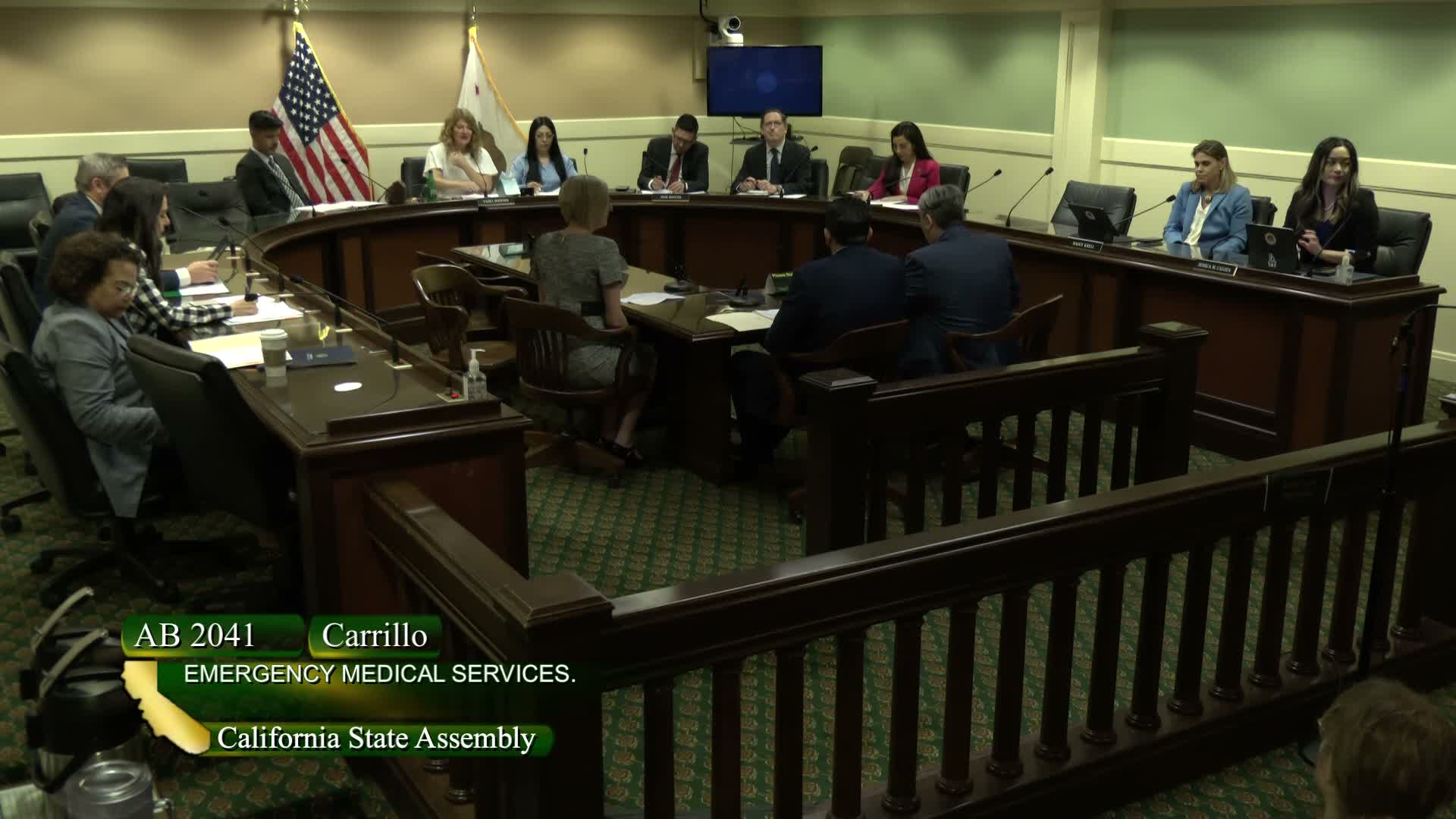
The Assembly Communications and Conveyance Committee voted to recommend AB 2041 by Assemblymember Juan Carrillo and referred the measure to the Committee on Emergency Management for further consideration.
Carrillo said AB 2041 builds on last year’s AB 645 by incorporating required emergency medical dispatch protocols and training into the minimum standards that public safety answering points (PSAPs) must meet to qualify for the state emergency telephone number account (CEDNA). "Dispatchers are often the first voice a person hears in a life or death emergency," Carrillo said, arguing the bill would ensure consistent, statewide pre‑arrival instructions for 911 callers.
Katharina McNulty, who said she has 23 years of emergency medical dispatch experience, and James Pearson, president of Medic Ambulance, described instances where pre‑arrival instructions by trained dispatchers had directly contributed to lives being saved. McNulty said protocol‑driven instructions "turn a bystander into instant help" and urged investment in validated protocols and training. Pearson testified that inconsistent practices across neighboring jurisdictions — citing cities in Solano County as examples — result in different levels of care depending on where a caller dials.
Opponents including Mark Smith of the California chapter of the National Emergency Number Association supported the goal of pre‑arrival instructions but warned the bill’s enforcement mechanism is premature. Smith said AB 645 is not yet in effect (he cited an effective date of 01/01/2027 for implementation) and urged an education campaign before using CEDNA withholding as a penalty, arguing that denying PSAPs CEDNA funds could harm staffing and technical infrastructure.
Carrillo and witnesses said they had collected lists of PSAPs they believe lack confirmed pre‑arrival protocols (examples cited in committee discussion included the City of Bishop, Palm Springs, Hemet, Blythe, parts of Imperial County, Vallejo and Fairfield) and agreed to share that information with opposition groups so the committee could evaluate compliance and alternatives.
After discussion about timing, enforcement, and potential unintended funding impacts on local PSAP operations, the committee voted to send AB 2041 to the Emergency Management Committee with a do‑pass recommendation. The clerk’s roll call recorded eight yes votes, zero no votes, and one member not voting.
Carrillo said AB 2041 builds on last year’s AB 645 by incorporating required emergency medical dispatch protocols and training into the minimum standards that public safety answering points (PSAPs) must meet to qualify for the state emergency telephone number account (CEDNA). "Dispatchers are often the first voice a person hears in a life or death emergency," Carrillo said, arguing the bill would ensure consistent, statewide pre‑arrival instructions for 911 callers.
Katharina McNulty, who said she has 23 years of emergency medical dispatch experience, and James Pearson, president of Medic Ambulance, described instances where pre‑arrival instructions by trained dispatchers had directly contributed to lives being saved. McNulty said protocol‑driven instructions "turn a bystander into instant help" and urged investment in validated protocols and training. Pearson testified that inconsistent practices across neighboring jurisdictions — citing cities in Solano County as examples — result in different levels of care depending on where a caller dials.
Opponents including Mark Smith of the California chapter of the National Emergency Number Association supported the goal of pre‑arrival instructions but warned the bill’s enforcement mechanism is premature. Smith said AB 645 is not yet in effect (he cited an effective date of 01/01/2027 for implementation) and urged an education campaign before using CEDNA withholding as a penalty, arguing that denying PSAPs CEDNA funds could harm staffing and technical infrastructure.
Carrillo and witnesses said they had collected lists of PSAPs they believe lack confirmed pre‑arrival protocols (examples cited in committee discussion included the City of Bishop, Palm Springs, Hemet, Blythe, parts of Imperial County, Vallejo and Fairfield) and agreed to share that information with opposition groups so the committee could evaluate compliance and alternatives.
After discussion about timing, enforcement, and potential unintended funding impacts on local PSAP operations, the committee voted to send AB 2041 to the Emergency Management Committee with a do‑pass recommendation. The clerk’s roll call recorded eight yes votes, zero no votes, and one member not voting.
Don't Miss a Word: See the Full Meeting!
Go beyond summaries. Unlock every video, transcript, and key insight with a Founder Membership.
✓
Get instant access to full meeting videos
✓
Search and clip any phrase from complete transcripts
✓
Receive AI-powered summaries & custom alerts
✓
Enjoy lifetime, unrestricted access to government data
30-day money-back guarantee
