Senate committee advances referral to let voters decide whether to enshrine right to refuse medical mandates
March 25, 2026 | 2026 Legislature Arizona, Arizona
This article was created by AI summarizing key points discussed. AI makes mistakes, so for full details and context, please refer to the video of the full meeting. Please report any errors so we can fix them. Report an error »
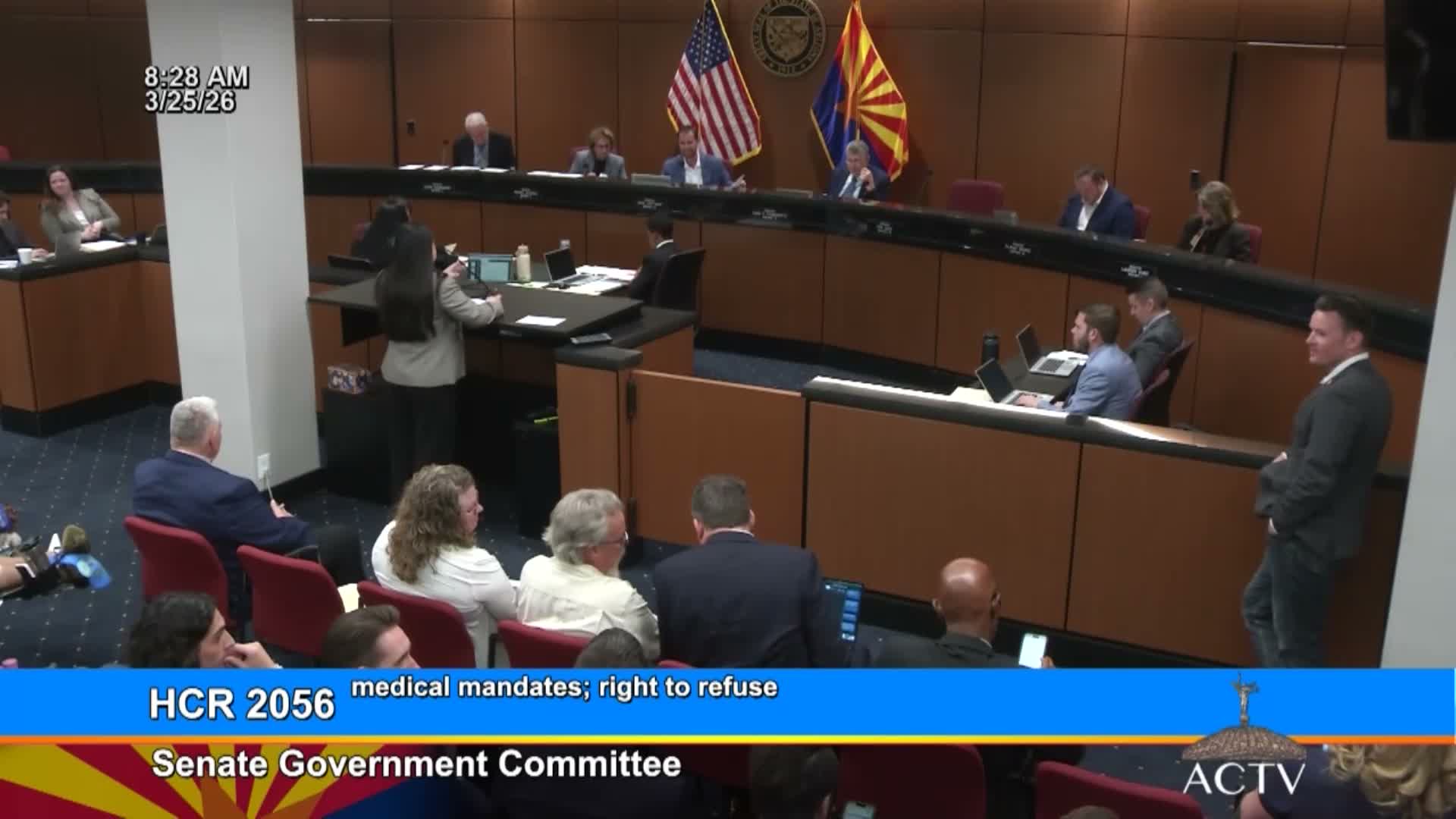
The Senate Government Committee on Wednesday voted to give HCR 2056 a due-pass recommendation, sending a proposed constitutional referral to the ballot that would recognize a broad right to refuse medical mandates.
Representative Nick Cover, sponsor of the referral, told the panel the measure "simply says you can't mandate what you medically put into your body or what you medically put on your body," and urged colleagues to let voters decide. He framed the proposal as an extension of personal autonomy and said it would allow Arizonans to protect bodily-choice rights at the ballot box.
Supporters who spoke during the hearing described personal stories and health concerns. Marissa Caldwell, a member of a stakeholder group in favor of the referral, said the measure would protect "people with compromised immune systems" and guard conscience rights for taxpayers who oppose abortion or other medical procedures funded or promoted by public institutions.
Medical professionals and public-health advocates opposed the referral, arguing it would limit tools used during outbreaks. Dr. Darlene Melk, a pediatrician who said she treats children in rural Cochise County, warned that the amendment would "reverse years of sound policy that has enabled our schools to require vaccines and other basic public-health protections" and could lead to more preventable illness among vulnerable children.
Committee debate focused on two fault lines: supporters emphasized autonomy and voter choice, while opponents emphasized public-health risk and the inflexibility of embedding restrictions in the state constitution. Several senators used their "explain my vote" time to cite concerns about the potential inability of schools and health officials to exclude unvaccinated children during outbreaks, and about tying lawmakers' hands in future emergencies.
By the committee tally, HCR 2056 received a due-pass recommendation (4 ayes, 2 nays, 1 not voting) and will move forward as a referral that, if placed on a general-election ballot and approved by voters, would change the Arizona Constitution.
The next procedural step is placement of the referral on a ballot (if the legislative referral process is completed).
Representative Nick Cover, sponsor of the referral, told the panel the measure "simply says you can't mandate what you medically put into your body or what you medically put on your body," and urged colleagues to let voters decide. He framed the proposal as an extension of personal autonomy and said it would allow Arizonans to protect bodily-choice rights at the ballot box.
Supporters who spoke during the hearing described personal stories and health concerns. Marissa Caldwell, a member of a stakeholder group in favor of the referral, said the measure would protect "people with compromised immune systems" and guard conscience rights for taxpayers who oppose abortion or other medical procedures funded or promoted by public institutions.
Medical professionals and public-health advocates opposed the referral, arguing it would limit tools used during outbreaks. Dr. Darlene Melk, a pediatrician who said she treats children in rural Cochise County, warned that the amendment would "reverse years of sound policy that has enabled our schools to require vaccines and other basic public-health protections" and could lead to more preventable illness among vulnerable children.
Committee debate focused on two fault lines: supporters emphasized autonomy and voter choice, while opponents emphasized public-health risk and the inflexibility of embedding restrictions in the state constitution. Several senators used their "explain my vote" time to cite concerns about the potential inability of schools and health officials to exclude unvaccinated children during outbreaks, and about tying lawmakers' hands in future emergencies.
By the committee tally, HCR 2056 received a due-pass recommendation (4 ayes, 2 nays, 1 not voting) and will move forward as a referral that, if placed on a general-election ballot and approved by voters, would change the Arizona Constitution.
The next procedural step is placement of the referral on a ballot (if the legislative referral process is completed).
Don't Miss a Word: See the Full Meeting!
Go beyond summaries. Unlock every video, transcript, and key insight with a Founder Membership.
✓
Get instant access to full meeting videos
✓
Search and clip any phrase from complete transcripts
✓
Receive AI-powered summaries & custom alerts
✓
Enjoy lifetime, unrestricted access to government data
30-day money-back guarantee
