Senate panel approves strict guardrails and voter review for government mass‑surveillance systems
March 25, 2026 | 2026 Legislature Arizona, Arizona
This article was created by AI summarizing key points discussed. AI makes mistakes, so for full details and context, please refer to the video of the full meeting. Please report any errors so we can fix them. Report an error »
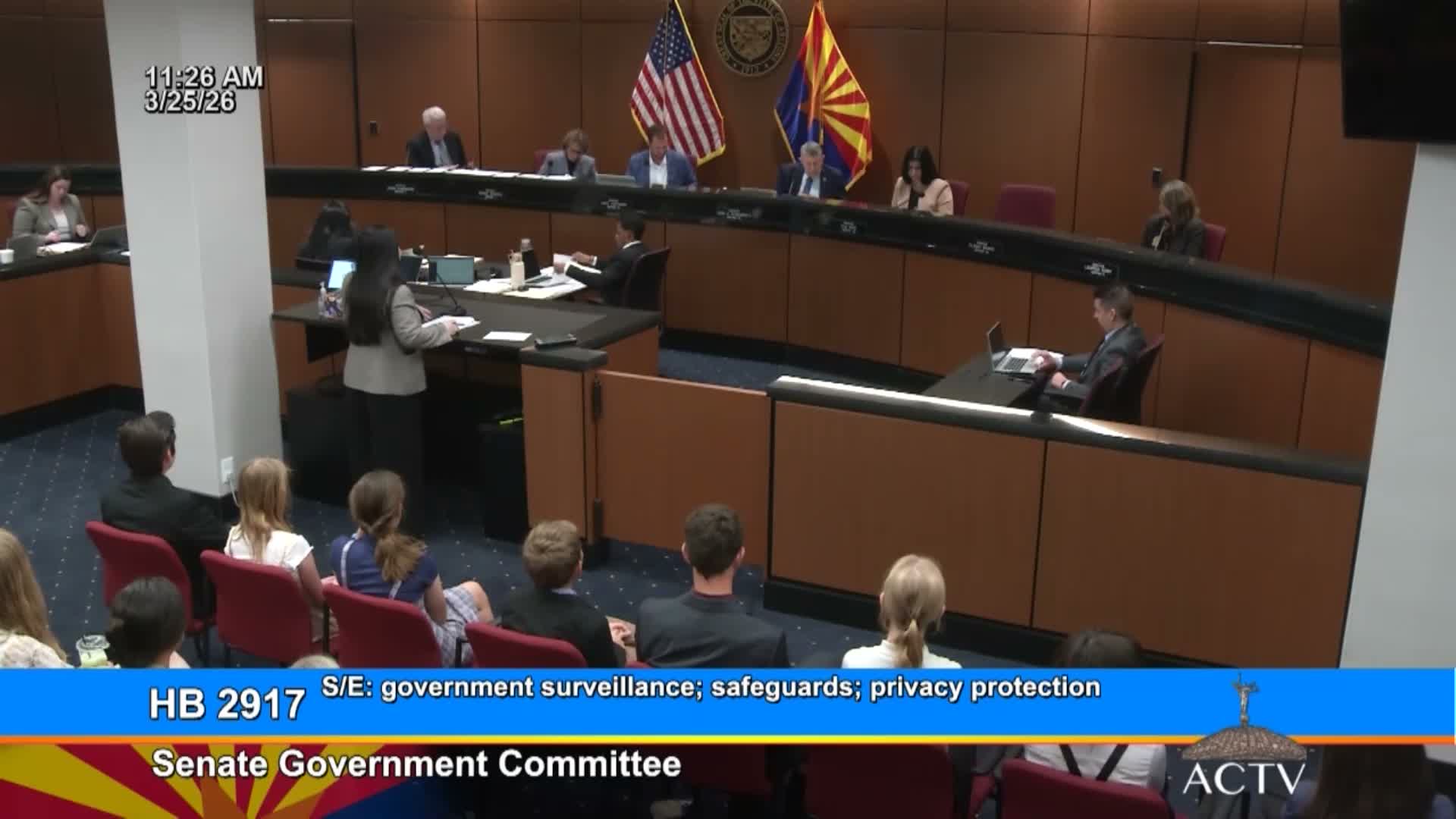
The Senate Government Committee voted to advance HB 2917 as amended, adopting a wide-ranging statute that treats automated license-plate readers and related systems as "government mass‑surveillance networks" and imposes layered public-notice, hearing and voter‑approval requirements before deployment.
Chair opened debate by saying, "I am a no surveillance guy," and framed the amendment as a way to balance public-safety uses with civil‑liberties protections. The strike‑everything amendment requires local public notice and multiple hearings, a governing-body roll-call vote to put a deployment on the ballot, and a supermajority (65%) voter approval at the next general election to allow deployment.
Key operational limits in the amended proposal include an extremely short retention window for live comparisons (three minutes) unless matched to a live warrant/alert, strict prohibitions on retroactive searches and pattern-of-life building, protections for constitutionally protected activities (for example, protests and medical visits), limits on data sharing with federal agencies or third parties, and annual transparency reporting.
Civil‑liberties groups and survivors framed the measure as a necessary check on a surveillance model they say has been deployed without adequate public oversight. "When citizens get a vote on surveillance, they reject it," said Eric Fowler (read into the record) and Marissa Caldwell—one of several privacy stakeholders—urged committee members to give voters the right to approve deployment.
Law-enforcement representatives urged more targeted language and stakeholder engagement, saying the technology has aided missing-person and homicide investigations. Apache Junction Police Chief Mike Pooley said the tools had helped locate suspects and missing children, while urging that guardrails be realistic for operational needs.
Committee members said they will continue stakeholder meetings to refine clarifying language ahead of the floor and next steps. The panel adopted the amendment and forwarded HB 2917 as amended with a due-pass recommendation.
Chair opened debate by saying, "I am a no surveillance guy," and framed the amendment as a way to balance public-safety uses with civil‑liberties protections. The strike‑everything amendment requires local public notice and multiple hearings, a governing-body roll-call vote to put a deployment on the ballot, and a supermajority (65%) voter approval at the next general election to allow deployment.
Key operational limits in the amended proposal include an extremely short retention window for live comparisons (three minutes) unless matched to a live warrant/alert, strict prohibitions on retroactive searches and pattern-of-life building, protections for constitutionally protected activities (for example, protests and medical visits), limits on data sharing with federal agencies or third parties, and annual transparency reporting.
Civil‑liberties groups and survivors framed the measure as a necessary check on a surveillance model they say has been deployed without adequate public oversight. "When citizens get a vote on surveillance, they reject it," said Eric Fowler (read into the record) and Marissa Caldwell—one of several privacy stakeholders—urged committee members to give voters the right to approve deployment.
Law-enforcement representatives urged more targeted language and stakeholder engagement, saying the technology has aided missing-person and homicide investigations. Apache Junction Police Chief Mike Pooley said the tools had helped locate suspects and missing children, while urging that guardrails be realistic for operational needs.
Committee members said they will continue stakeholder meetings to refine clarifying language ahead of the floor and next steps. The panel adopted the amendment and forwarded HB 2917 as amended with a due-pass recommendation.
View the Full Meeting & All Its Details
This article offers just a summary. Unlock complete video, transcripts, and insights as a Founder Member.
✓
Watch full, unedited meeting videos
✓
Search every word spoken in unlimited transcripts
✓
AI summaries & real-time alerts (all government levels)
✓
Permanent access to expanding government content
30-day money-back guarantee
