Senate commerce committee defers bill to ban crypto kiosks after split over fraud risk and regulation
March 19, 2026 | Senate, Legislative , Hawaii
This article was created by AI summarizing key points discussed. AI makes mistakes, so for full details and context, please refer to the video of the full meeting. Please report any errors so we can fix them. Report an error »
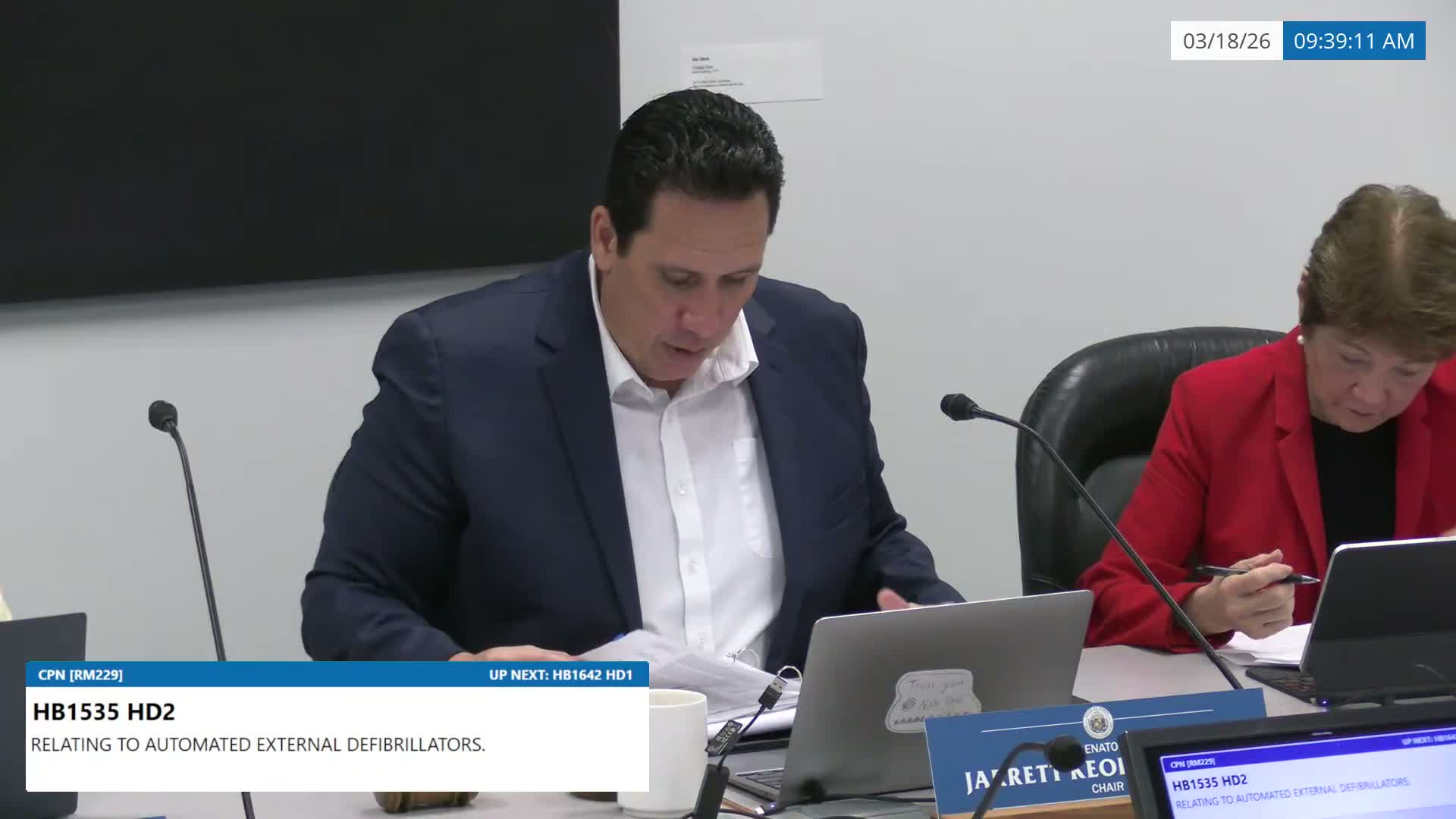
The Hawaii State Senate Committee on Commerce and Consumer Protection on March 18 deferred action on HB1642, HD1, a proposal that would prohibit the ownership, operation or management of digital financial asset kiosks (crypto kiosks) that accept U.S. currency.
Attorney General’s Office representative James Page told the committee that “these type of kiosks are being increasingly used by criminals to defraud vulnerable consumers, especially seniors,” and said victims often have little chance of recovering money once it is deposited. Audrey Suga Nakagawa of AARP Hawaii urged the committee to act, saying kupuna are disproportionately targeted by kiosk scams and that consumer protections are needed now.
Operators and industry representatives pushed back. Luis Myers, who testified for Hilt Ventures (a Hawaii kiosk operator), warned that “a ban is gonna drive legitimate operators out of business” and urged exemptions for operators with clean compliance records. Larry Lipka, general counsel for CoinFlip, said regulatory alternatives — including mandatory refund policies for scam victims, cooling-off periods and live customer service for older customers — can reduce harm without removing legitimate services. “With a full refund for a scam victim, that means that there is no harm to any consumers in this state,” Lipka said.
Staff from the Department of Commerce and Consumer Affairs’ Office of Consumer Protection referenced a Financial Crimes Enforcement Network (FinCEN) report and described noncompliant operators as “especially vulnerable to abuse by scammers,” arguing the ecosystem cannot rely on voluntary self-policing.
Committee members pressed witnesses about federal preemption and implementation logistics. One senator raised the concern that forthcoming federal market-structure legislation or executive action could preempt state regulation; witnesses said that possibility exists but that no parallel federal standard is finalized. OCP staff and others warned that a state licensure regime would require staff and resources to be effective; proponents of licensing said a surcharge or fee-based model might fund enforcement.
After extended testimony and Q&A, the committee voted to defer HB1642 to Tuesday, March 24, 2026, to allow time for drafting amendments and clarifying whether the committee should pursue a ban, a licensure/regulatory approach, or a moratorium/sunset while federal action develops.
The committee did not take a final vote on the substance during the March 18 meeting; members asked that the record reflect both the urgency of consumer-protection concerns and the operational questions about implementation and potential federal preemption.
Attorney General’s Office representative James Page told the committee that “these type of kiosks are being increasingly used by criminals to defraud vulnerable consumers, especially seniors,” and said victims often have little chance of recovering money once it is deposited. Audrey Suga Nakagawa of AARP Hawaii urged the committee to act, saying kupuna are disproportionately targeted by kiosk scams and that consumer protections are needed now.
Operators and industry representatives pushed back. Luis Myers, who testified for Hilt Ventures (a Hawaii kiosk operator), warned that “a ban is gonna drive legitimate operators out of business” and urged exemptions for operators with clean compliance records. Larry Lipka, general counsel for CoinFlip, said regulatory alternatives — including mandatory refund policies for scam victims, cooling-off periods and live customer service for older customers — can reduce harm without removing legitimate services. “With a full refund for a scam victim, that means that there is no harm to any consumers in this state,” Lipka said.
Staff from the Department of Commerce and Consumer Affairs’ Office of Consumer Protection referenced a Financial Crimes Enforcement Network (FinCEN) report and described noncompliant operators as “especially vulnerable to abuse by scammers,” arguing the ecosystem cannot rely on voluntary self-policing.
Committee members pressed witnesses about federal preemption and implementation logistics. One senator raised the concern that forthcoming federal market-structure legislation or executive action could preempt state regulation; witnesses said that possibility exists but that no parallel federal standard is finalized. OCP staff and others warned that a state licensure regime would require staff and resources to be effective; proponents of licensing said a surcharge or fee-based model might fund enforcement.
After extended testimony and Q&A, the committee voted to defer HB1642 to Tuesday, March 24, 2026, to allow time for drafting amendments and clarifying whether the committee should pursue a ban, a licensure/regulatory approach, or a moratorium/sunset while federal action develops.
The committee did not take a final vote on the substance during the March 18 meeting; members asked that the record reflect both the urgency of consumer-protection concerns and the operational questions about implementation and potential federal preemption.
Don't Miss a Word: See the Full Meeting!
Go beyond summaries. Unlock every video, transcript, and key insight with a Founder Membership.
✓
Get instant access to full meeting videos
✓
Search and clip any phrase from complete transcripts
✓
Receive AI-powered summaries & custom alerts
✓
Enjoy lifetime, unrestricted access to government data
30-day money-back guarantee
