City staff seeks early design input, new environmental rules and land‑use limits in Unified Development Code update
March 24, 2026 | Boerne, Kendall County, Texas
This article was created by AI summarizing key points discussed. AI makes mistakes, so for full details and context, please refer to the video of the full meeting. Please report any errors so we can fix them. Report an error »
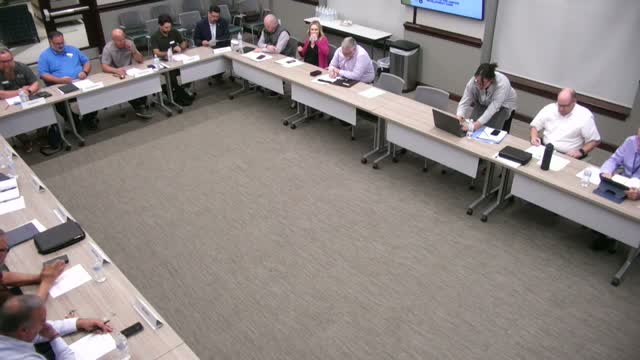
City planning staff presented a broad package of proposed changes to the city’s Unified Development Code at a joint City Council and Planning & Zoning Commission workshop on March 24, 2026, asking elected and appointed members to prioritize early‑design review, environmental clarifications and specific land‑use restrictions.
The presentation, led by planning staff, emphasized reinstating a preliminary or “master development plan” for developments that proceed in multiple phases and discussed administrative delegation to speed minor plat and final plat approvals. Staff framed the change as a way to secure tree preservation, drainage and layout issues earlier in the process rather than after engineers and infrastructure plans are already finalized.
Staff repeatedly described the proposed threshold as two or more phases or roughly 20 acres as a draft discussion point, and said the administration will benchmark prior cases to refine any numerical cutoff rather than adopt a fixed size immediately. Commissioners warned that large infill sites inside Boerne are rare and urged the administration to consider alternatives such as phase‑count, lot count or impervious‑cover thresholds.
On process, staff proposed expanding administrative site‑plan review so design work happens earlier and recommended permitting foundation permits, concurrent reviews and temporary certificates of occupancy in some cases to reduce schedule pressure. Staff said variances and waivers would remain with the Planning & Zoning Commission while staff would handle minor plats and administrative approvals.
Environmental items drew sustained attention. Staff described the need to reconcile xeriscape and impervious‑cover calculations (noting how installation methods affect perviousness), to clarify rules for artificial turf and to require rainwater capture for nonresidential buildings while encouraging residential capture through incentives (utility rebates or modest density bonuses). The presentation also proposed requiring HVAC condensation capture for many nonresidential projects, with staff favoring tonnage‑based calculations for multi‑unit projects so owners cannot circumvent requirements by splitting capacity across smaller units.
Commissioners pressed staff on downtown exceptions, noting limited landscape areas and the higher costs of treatment systems. Staff pointed to pilot installations (the new fire station and other recent projects) and said incentives would be considered where capture is costly or infeasible downtown.
Land‑use proposals included creating distinct categories for vape shops, CBD stores, dispensaries and tattoo studios and restricting many of those uses to heavier commercial districts (C3/C4) through special‑use permits. Commissioners raised state preemption concerns for tobacco and liquor regulation and urged careful drafting of separation and proximity standards. Staff compared the approach to existing SUP treatment of pawn shops and emphasized SUP conditions and site‑plan conformance as tools to limit unintended uses when approvals transfer to future owners.
Staff also summarized two recent state legislative changes (as discussed at the meeting): HB 3699, which limits the use of plat review as a bargaining tool and clarifies when a plat is required, and HB 24, which raised the protest threshold for zoning changes (as described in the presentation) and affects local notice and protest procedures. Staff said the UDC will need editing to remove conflicted local provisions and to align definitions with the state standards.
Other items covered included an effort to align lighting rules with Dark Sky International standards to pursue dark‑sky community certification, potential changes to fence and sign rules (including a cap on total sign area per property), telecommunication‑site planning standards and clarifications of parking, cross‑access and service‑vehicle thresholds.
No formal motions or votes were taken; staff asked commissioners for concept‑level comfort so the administration can draft ordinance language for subsequent P&Z and Council hearings. Staff noted the UDC limits the city to two comprehensive amendments per year and said the administration proposes prioritizing plat review, xeriscape/HVAC/drainage calculations and land‑use changes for the next amendment cycle.
The meeting closed with questions about tree‑mitigation fee use and a request from commissioners that staff present clearer draft language on SUP expirations, site‑plan conformance and any super‑majority protections for Council action on unanimous P&Z recommendations.
The city staff said it will circulate slides and follow up with additional detail before formal hearings.
The presentation, led by planning staff, emphasized reinstating a preliminary or “master development plan” for developments that proceed in multiple phases and discussed administrative delegation to speed minor plat and final plat approvals. Staff framed the change as a way to secure tree preservation, drainage and layout issues earlier in the process rather than after engineers and infrastructure plans are already finalized.
Staff repeatedly described the proposed threshold as two or more phases or roughly 20 acres as a draft discussion point, and said the administration will benchmark prior cases to refine any numerical cutoff rather than adopt a fixed size immediately. Commissioners warned that large infill sites inside Boerne are rare and urged the administration to consider alternatives such as phase‑count, lot count or impervious‑cover thresholds.
On process, staff proposed expanding administrative site‑plan review so design work happens earlier and recommended permitting foundation permits, concurrent reviews and temporary certificates of occupancy in some cases to reduce schedule pressure. Staff said variances and waivers would remain with the Planning & Zoning Commission while staff would handle minor plats and administrative approvals.
Environmental items drew sustained attention. Staff described the need to reconcile xeriscape and impervious‑cover calculations (noting how installation methods affect perviousness), to clarify rules for artificial turf and to require rainwater capture for nonresidential buildings while encouraging residential capture through incentives (utility rebates or modest density bonuses). The presentation also proposed requiring HVAC condensation capture for many nonresidential projects, with staff favoring tonnage‑based calculations for multi‑unit projects so owners cannot circumvent requirements by splitting capacity across smaller units.
Commissioners pressed staff on downtown exceptions, noting limited landscape areas and the higher costs of treatment systems. Staff pointed to pilot installations (the new fire station and other recent projects) and said incentives would be considered where capture is costly or infeasible downtown.
Land‑use proposals included creating distinct categories for vape shops, CBD stores, dispensaries and tattoo studios and restricting many of those uses to heavier commercial districts (C3/C4) through special‑use permits. Commissioners raised state preemption concerns for tobacco and liquor regulation and urged careful drafting of separation and proximity standards. Staff compared the approach to existing SUP treatment of pawn shops and emphasized SUP conditions and site‑plan conformance as tools to limit unintended uses when approvals transfer to future owners.
Staff also summarized two recent state legislative changes (as discussed at the meeting): HB 3699, which limits the use of plat review as a bargaining tool and clarifies when a plat is required, and HB 24, which raised the protest threshold for zoning changes (as described in the presentation) and affects local notice and protest procedures. Staff said the UDC will need editing to remove conflicted local provisions and to align definitions with the state standards.
Other items covered included an effort to align lighting rules with Dark Sky International standards to pursue dark‑sky community certification, potential changes to fence and sign rules (including a cap on total sign area per property), telecommunication‑site planning standards and clarifications of parking, cross‑access and service‑vehicle thresholds.
No formal motions or votes were taken; staff asked commissioners for concept‑level comfort so the administration can draft ordinance language for subsequent P&Z and Council hearings. Staff noted the UDC limits the city to two comprehensive amendments per year and said the administration proposes prioritizing plat review, xeriscape/HVAC/drainage calculations and land‑use changes for the next amendment cycle.
The meeting closed with questions about tree‑mitigation fee use and a request from commissioners that staff present clearer draft language on SUP expirations, site‑plan conformance and any super‑majority protections for Council action on unanimous P&Z recommendations.
The city staff said it will circulate slides and follow up with additional detail before formal hearings.
View the Full Meeting & All Its Details
This article offers just a summary. Unlock complete video, transcripts, and insights as a Founder Member.
✓
Watch full, unedited meeting videos
✓
Search every word spoken in unlimited transcripts
✓
AI summaries & real-time alerts (all government levels)
✓
Permanent access to expanding government content
30-day money-back guarantee
