Rep. Donna Mears seeks fix to preserve certificate‑of‑fitness exemption for rural utilities
March 25, 2026 | 2026 Legislature Alaska, Alaska
This article was created by AI summarizing key points discussed. AI makes mistakes, so for full details and context, please refer to the video of the full meeting. Please report any errors so we can fix them. Report an error »
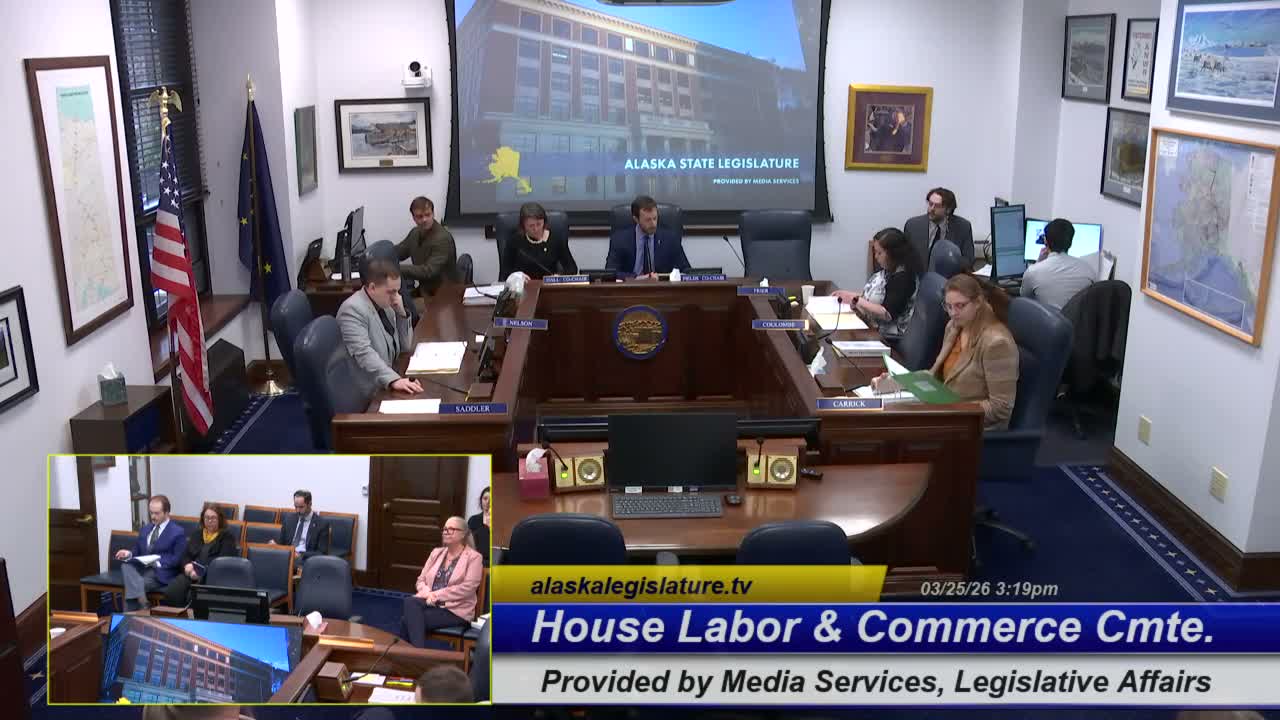
Rep. Donna Mears on behalf of the House Community and Regional Affairs Committee presented House Bill 329 to the House Labor and Commerce Committee, saying the bill would clarify an existing certificate‑of‑fitness exemption for electrical work performed in communities with populations under 2,500 so multi‑community utilities can continue to use locally trained workers for routine maintenance and rapid response.
The bill would amend AS 18.62.010, Mears’ staff said, to ensure the exemption applies to portions of service areas that are not electrically interconnected and to municipal or tribal employees working on behalf of the utility; it also adds a definition of “qualified employee” modeled on Occupational Safety and Health Administration standards.
Bill Stamm, president and CEO of the Alaska Village Electric Cooperative (AVEC), told the committee AVEC is a member‑owned nonprofit serving 58 largely road‑isolated communities and employing local part‑time power plant operators and linemen as a first line of response. “We have 46 power plants serving 58 communities,” Stamm said, describing widely varying plant sizes and noting Bethel is an outlier among AVEC communities. He said a Department of Labor interpretation requiring certificates across AVEC’s service area forced the cooperative to pause use of locally trained operators for some tasks, increasing response time and cost.
Ted Swanson, business representative for IBEW Local 1547, said the union values the certificate‑of‑fitness as a safety‑focused credential that typically requires extensive training and competency exams, and urged that any statutory exception be narrow and well‑defined. Swanson testified the bill’s narrower language fits that standard.
Scott Damrow, chief of mechanical inspection at the Department of Labor and Workforce Development, explained the department’s action came after reviewing AVEC employee certificate applications and AVEC’s expanded service area; once AVEC added Bethel to its service territory, the department concluded the statutory exemption no longer applied under a strict reading. Damrow said his office would supply the committee with relevant communications if requested.
Committee members asked about which specific tasks should still require certificated linemen, how utilities would verify individual qualifications, whether non‑electrical trades would be affected, and whether AVEC maintains rosters and training records. Stamm said AVEC maintains training records for its power plant operators and that employers would be responsible for verifying competence; Damrow said he did not see additional public‑safety risk from the proposed clarification because the statute already contemplates this work for smaller utilities.
No action was taken on HB 329 at this hearing; members requested follow‑up from AVEC and DOL (dates of the service‑area changes and copies of related communications) and asked sponsors to confirm outreach to other building trades. The committee set an amendment deadline that was later noted in the record.
The bill would amend AS 18.62.010, Mears’ staff said, to ensure the exemption applies to portions of service areas that are not electrically interconnected and to municipal or tribal employees working on behalf of the utility; it also adds a definition of “qualified employee” modeled on Occupational Safety and Health Administration standards.
Bill Stamm, president and CEO of the Alaska Village Electric Cooperative (AVEC), told the committee AVEC is a member‑owned nonprofit serving 58 largely road‑isolated communities and employing local part‑time power plant operators and linemen as a first line of response. “We have 46 power plants serving 58 communities,” Stamm said, describing widely varying plant sizes and noting Bethel is an outlier among AVEC communities. He said a Department of Labor interpretation requiring certificates across AVEC’s service area forced the cooperative to pause use of locally trained operators for some tasks, increasing response time and cost.
Ted Swanson, business representative for IBEW Local 1547, said the union values the certificate‑of‑fitness as a safety‑focused credential that typically requires extensive training and competency exams, and urged that any statutory exception be narrow and well‑defined. Swanson testified the bill’s narrower language fits that standard.
Scott Damrow, chief of mechanical inspection at the Department of Labor and Workforce Development, explained the department’s action came after reviewing AVEC employee certificate applications and AVEC’s expanded service area; once AVEC added Bethel to its service territory, the department concluded the statutory exemption no longer applied under a strict reading. Damrow said his office would supply the committee with relevant communications if requested.
Committee members asked about which specific tasks should still require certificated linemen, how utilities would verify individual qualifications, whether non‑electrical trades would be affected, and whether AVEC maintains rosters and training records. Stamm said AVEC maintains training records for its power plant operators and that employers would be responsible for verifying competence; Damrow said he did not see additional public‑safety risk from the proposed clarification because the statute already contemplates this work for smaller utilities.
No action was taken on HB 329 at this hearing; members requested follow‑up from AVEC and DOL (dates of the service‑area changes and copies of related communications) and asked sponsors to confirm outreach to other building trades. The committee set an amendment deadline that was later noted in the record.
View the Full Meeting & All Its Details
This article offers just a summary. Unlock complete video, transcripts, and insights as a Founder Member.
✓
Watch full, unedited meeting videos
✓
Search every word spoken in unlimited transcripts
✓
AI summaries & real-time alerts (all government levels)
✓
Permanent access to expanding government content
30-day money-back guarantee
