Uber and Lyft oppose 90% driver take‑rate cap as committee seeks data and alternatives
March 25, 2026 | 2026 Legislature Alaska, Alaska
This article was created by AI summarizing key points discussed. AI makes mistakes, so for full details and context, please refer to the video of the full meeting. Please report any errors so we can fix them. Report an error »
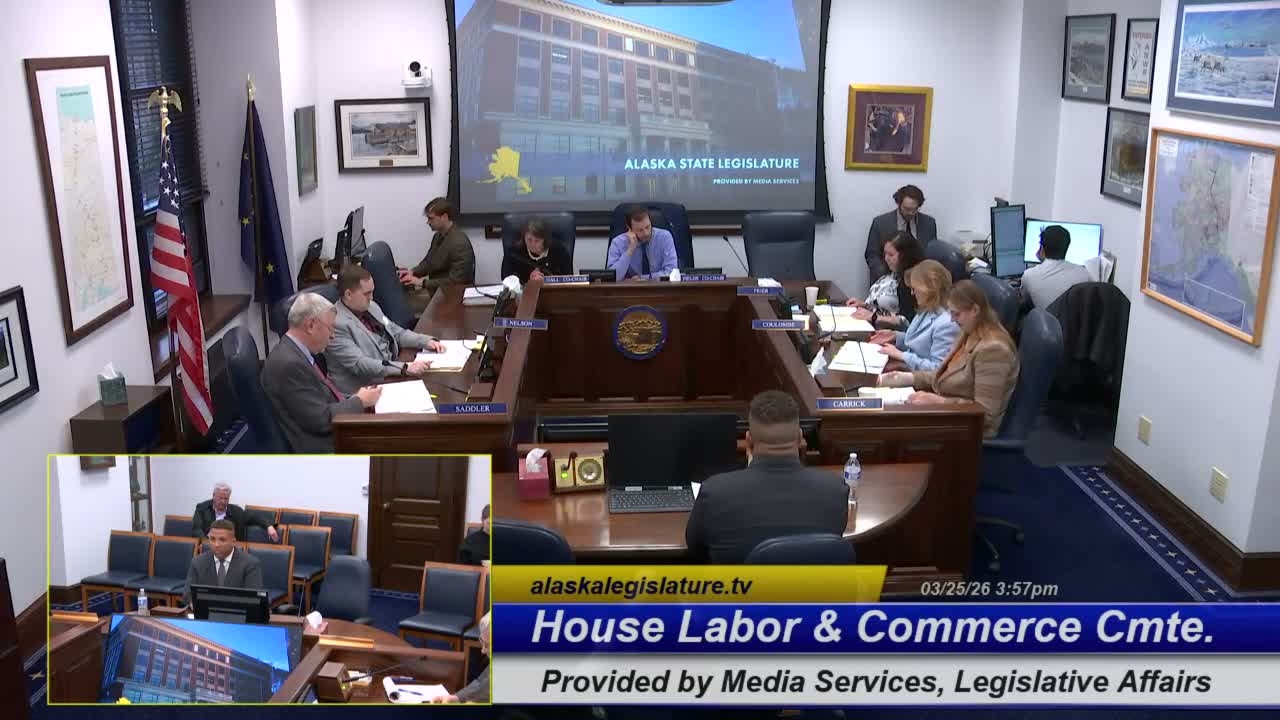
House Bill 305 (transportation network company driver pay) drew extensive testimony and questioning as the committee considered whether a per‑ride take‑rate limit would raise driver pay or unintentionally reduce access and earnings.
John Finley, senior policy and communications manager at Uber, testified the company is in respectful opposition to the bill as drafted because a 90% driver take‑rate cap (a 10% company recoupment limit) does not reflect platform economics and risks raising fares and reducing demand. Finley described California’s Proposition 22 as a different model — a 120% of minimum wage floor plus a per‑mile guarantee — that the company considers worth examining as an alternative. "We're currently in in respectful opposition to the bill, as it as it's currently written," Finley said, and he warned that an overly high take‑rate cap could force fares up and reduce driver opportunity.
Francisco Avila, senior public policy manager with Lyft, also urged the committee to reject a take‑rate cap, telling members that artificial per‑ride limits can compress margins and drive fares higher, citing Alaska’s elevated external costs (state‑mandated insurance, taxes, fees and processing costs) that mean a 90% requirement could operate at a loss on many rides. Lyft said Alaska drivers have some of the highest engaged‑hour earnings in national rankings and cautioned that constraining platform revenues per ride could reduce overall rides and driver income.
Members repeatedly pressed both companies for Alaska‑specific data. Committee members asked for average and modal engaged‑hour earnings, pre‑ and post‑policy comparisons (for jurisdictions such as California), and city‑level breakdowns (Anchorage, Fairbanks, Juneau). Uber cited an average engaged‑hour figure of about $40 in 2025 for Alaska and agreed to follow up with more granular data; Lyft likewise agreed to return with additional analysis.
Questions also covered operational details: both companies described onboarding and safety requirements (vehicle age limits, background checks), and confirmed that company‑purchased commercial insurance applies from the moment a driver accepts a dispatch until trip completion. Representatives raised concerns about self‑employment taxes and after‑expense take‑home pay; company witnesses acknowledged those factors and said they would confirm whether self‑employment tax calculations were included in their internal earnings metrics.
Several members described driver anecdotes suggesting lower effective take‑home pay on some trips and urged further empirical review. The committee signalled it will draft a committee substitute (CS) incorporating feedback, requested the companies provide the requested data (average and mode of engaged‑hour pay, and community breakdowns), and left HB 305 pending further analysis rather than taking a vote.
Representative Fields said staff would prepare a CS for members to consider that takes into account the range of feedback; the committee adjourned after scheduling its next meeting.
John Finley, senior policy and communications manager at Uber, testified the company is in respectful opposition to the bill as drafted because a 90% driver take‑rate cap (a 10% company recoupment limit) does not reflect platform economics and risks raising fares and reducing demand. Finley described California’s Proposition 22 as a different model — a 120% of minimum wage floor plus a per‑mile guarantee — that the company considers worth examining as an alternative. "We're currently in in respectful opposition to the bill, as it as it's currently written," Finley said, and he warned that an overly high take‑rate cap could force fares up and reduce driver opportunity.
Francisco Avila, senior public policy manager with Lyft, also urged the committee to reject a take‑rate cap, telling members that artificial per‑ride limits can compress margins and drive fares higher, citing Alaska’s elevated external costs (state‑mandated insurance, taxes, fees and processing costs) that mean a 90% requirement could operate at a loss on many rides. Lyft said Alaska drivers have some of the highest engaged‑hour earnings in national rankings and cautioned that constraining platform revenues per ride could reduce overall rides and driver income.
Members repeatedly pressed both companies for Alaska‑specific data. Committee members asked for average and modal engaged‑hour earnings, pre‑ and post‑policy comparisons (for jurisdictions such as California), and city‑level breakdowns (Anchorage, Fairbanks, Juneau). Uber cited an average engaged‑hour figure of about $40 in 2025 for Alaska and agreed to follow up with more granular data; Lyft likewise agreed to return with additional analysis.
Questions also covered operational details: both companies described onboarding and safety requirements (vehicle age limits, background checks), and confirmed that company‑purchased commercial insurance applies from the moment a driver accepts a dispatch until trip completion. Representatives raised concerns about self‑employment taxes and after‑expense take‑home pay; company witnesses acknowledged those factors and said they would confirm whether self‑employment tax calculations were included in their internal earnings metrics.
Several members described driver anecdotes suggesting lower effective take‑home pay on some trips and urged further empirical review. The committee signalled it will draft a committee substitute (CS) incorporating feedback, requested the companies provide the requested data (average and mode of engaged‑hour pay, and community breakdowns), and left HB 305 pending further analysis rather than taking a vote.
Representative Fields said staff would prepare a CS for members to consider that takes into account the range of feedback; the committee adjourned after scheduling its next meeting.
View the Full Meeting & All Its Details
This article offers just a summary. Unlock complete video, transcripts, and insights as a Founder Member.
✓
Watch full, unedited meeting videos
✓
Search every word spoken in unlimited transcripts
✓
AI summaries & real-time alerts (all government levels)
✓
Permanent access to expanding government content
30-day money-back guarantee
