House Education Committee reviews Carl Perkins allocation and CTE gaps in Alaska
March 25, 2026 | 2026 Legislature Alaska, Alaska
This article was created by AI summarizing key points discussed. AI makes mistakes, so for full details and context, please refer to the video of the full meeting. Please report any errors so we can fix them. Report an error »
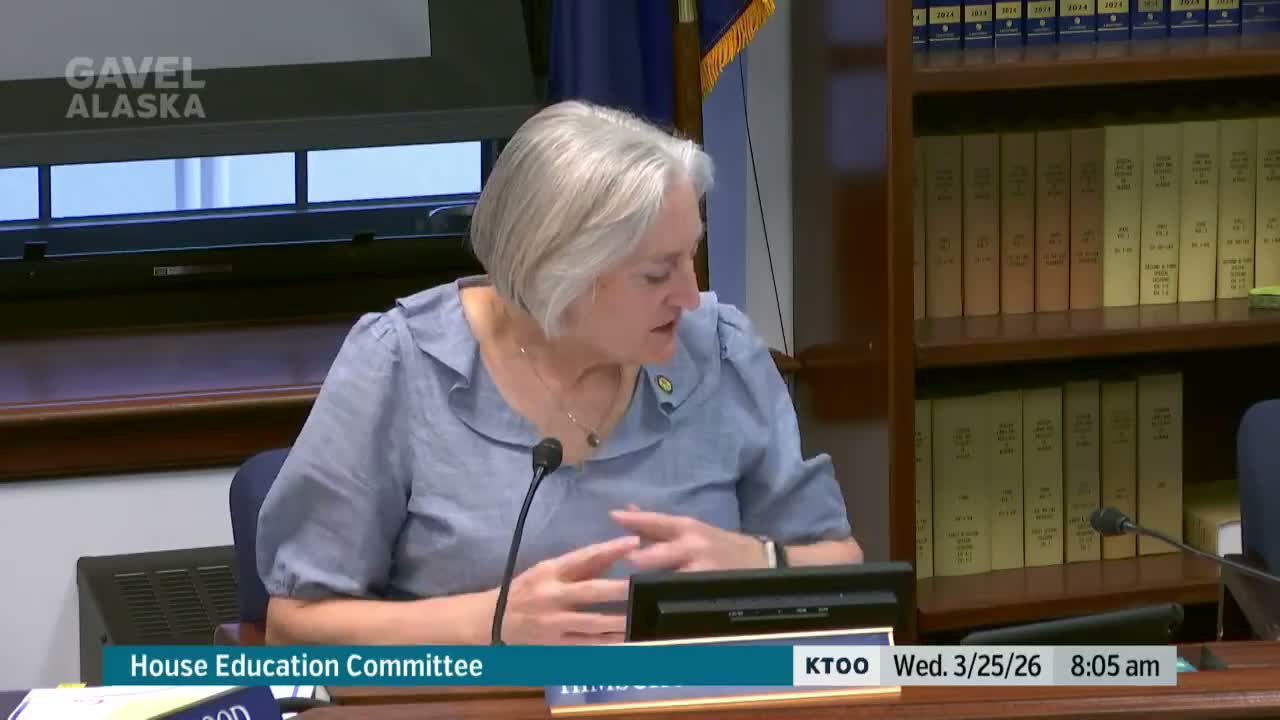
On March 25, 2026, members of the Alaska House Education Committee in Juneau heard a briefing from the Department of Education and Early Development on the state’s Carl Perkins Career and Technical Education allocation and how those federal funds are used.
Brad Billings, administrator for career and technical education at DEED, said Alaska’s Perkins allocation for the year is "just over $5,900,000," and that federal law requires roughly 85% of those funds be distributed to subgrantees such as school districts and postsecondary institutions. "We have 45 school districts applied for the funds," Billings said, and he described a $20,000 minimum allocation for 22 smaller districts (DEED set that floor above the Perkins statutory minimum they cited).
The presentation walked lawmakers through how the money is parceled out: most flows to secondary and postsecondary grantees; the state keeps up to 5% for administrative costs (DEED said the state matches that with about $295,000) and uses roughly 8%–10% for leadership activities, including statewide professional development conferences and student organization events. Billings said four University of Alaska campuses receive $150,000 grants each on a three‑year cycle.
Why it matters: committee members pressed DEED on whether the data it reports captures the full scope of CTE activity across Alaska. Kelly Manning, deputy director for the division of innovation and education excellence, told the panel the department relies on Perkins reporting for program-level data but "we do not have a data collection on how the CTE factor in the formula is being used by districts," limiting the department’s ability to identify true "CTE deserts."
Lawmakers asked whether culturally specific arts programs (for example, carving or traditional crafts) can be supported by Perkins money; Billings said DEED is trying to honor "cultural entrepreneurship" within Perkins’ focus on high-need, high-skill occupations and that such activities can be eligible when framed as career-technical programming. Members also questioned the burden of Perkins reporting for very small districts and why some districts decline the minimum allocation; Billings said reporting requirements and limited local capacity sometimes make the paperwork not worth pursuing for very small districts.
Committee members asked about a move of Perkins payments to a Department of Labor payment-management system; Manning and Billings said the switch made payments reimbursable and has been managed administratively. Lawmakers signaled interest in seeing example CLNAs (comprehensive local needs assessments) and the department agreed to share samples.
The committee heard no motions or votes on Perkins at this meeting. DEED officials told members they will continue to supply maps and CLNA examples and work with districts and partners to refine data so policymakers can better track where CTE programming is and where gaps remain.
This briefing set the stage for follow-up questions from legislators about incentives, reporting burdens and possible changes to how the department collects and displays CTE data.
Brad Billings, administrator for career and technical education at DEED, said Alaska’s Perkins allocation for the year is "just over $5,900,000," and that federal law requires roughly 85% of those funds be distributed to subgrantees such as school districts and postsecondary institutions. "We have 45 school districts applied for the funds," Billings said, and he described a $20,000 minimum allocation for 22 smaller districts (DEED set that floor above the Perkins statutory minimum they cited).
The presentation walked lawmakers through how the money is parceled out: most flows to secondary and postsecondary grantees; the state keeps up to 5% for administrative costs (DEED said the state matches that with about $295,000) and uses roughly 8%–10% for leadership activities, including statewide professional development conferences and student organization events. Billings said four University of Alaska campuses receive $150,000 grants each on a three‑year cycle.
Why it matters: committee members pressed DEED on whether the data it reports captures the full scope of CTE activity across Alaska. Kelly Manning, deputy director for the division of innovation and education excellence, told the panel the department relies on Perkins reporting for program-level data but "we do not have a data collection on how the CTE factor in the formula is being used by districts," limiting the department’s ability to identify true "CTE deserts."
Lawmakers asked whether culturally specific arts programs (for example, carving or traditional crafts) can be supported by Perkins money; Billings said DEED is trying to honor "cultural entrepreneurship" within Perkins’ focus on high-need, high-skill occupations and that such activities can be eligible when framed as career-technical programming. Members also questioned the burden of Perkins reporting for very small districts and why some districts decline the minimum allocation; Billings said reporting requirements and limited local capacity sometimes make the paperwork not worth pursuing for very small districts.
Committee members asked about a move of Perkins payments to a Department of Labor payment-management system; Manning and Billings said the switch made payments reimbursable and has been managed administratively. Lawmakers signaled interest in seeing example CLNAs (comprehensive local needs assessments) and the department agreed to share samples.
The committee heard no motions or votes on Perkins at this meeting. DEED officials told members they will continue to supply maps and CLNA examples and work with districts and partners to refine data so policymakers can better track where CTE programming is and where gaps remain.
This briefing set the stage for follow-up questions from legislators about incentives, reporting burdens and possible changes to how the department collects and displays CTE data.
View the Full Meeting & All Its Details
This article offers just a summary. Unlock complete video, transcripts, and insights as a Founder Member.
✓
Watch full, unedited meeting videos
✓
Search every word spoken in unlimited transcripts
✓
AI summaries & real-time alerts (all government levels)
✓
Permanent access to expanding government content
30-day money-back guarantee
