AWIB tells lawmakers Alaska needs tighter alignment between training and employers to fill vacancies
March 25, 2026 | 2026 Legislature Alaska, Alaska
This article was created by AI summarizing key points discussed. AI makes mistakes, so for full details and context, please refer to the video of the full meeting. Please report any errors so we can fix them. Report an error »
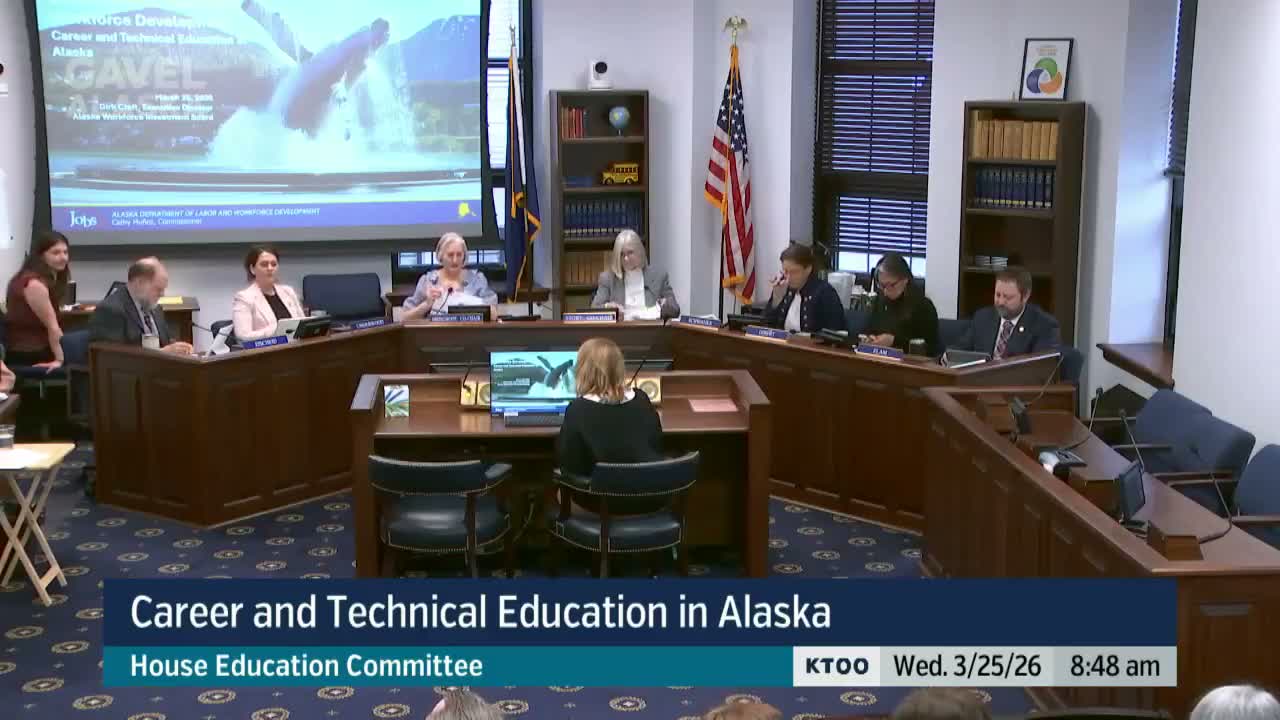
Dirk Craft, executive director of the Alaska Workforce Investment Board, told the House Education Committee on March 25 that the board’s work is focused on aligning education, training and employer demand so training investments translate into employment outcomes.
Craft said AWIB administers roughly $25 million in state and federal grants for FY 2026 and oversees multiple workforce programs, including state training and competitive apprenticeship expansion grants. "We have very strong programs all across the state, but they can often operate in kind of disconnected pockets rather than a coordinated system," Craft said, summing up a convening the board held with industry and education partners.
Craft and AWIB staff said employers repeatedly told them they need industry‑specific training connected to real jobs, expanded apprenticeships and better visibility into the pipeline of trained workers. He listed geographic barriers—housing, childcare and transportation—as problems that raise the cost of filling vacancies in Alaska. Craft pointed to AVTEC as an example where direct recruitment from a training provider leads to strong employer handoffs.
Sheena Marcel, AWIB program coordinator, said AWIB is working to build a contact database of training providers and current CTE instructors so employers and educators can find what exists locally. When asked about instructor shortages, Craft said maintaining a pipeline of qualified CTE instructors is a major challenge; AWIB is updating its workforce plan to include better inventories of training providers and instructor skills.
Why it matters: AWIB’s recommendations shape how state and local partners prioritize training investments. Committee members asked practical questions about how to improve career awareness and how AWIB’s guidance gets translated into district-level program offerings. Craft said AWIB’s role is to provide policy oversight and planning advice; implementing changes will require coordination among DEED, the Department of Labor, districts and industry partners.
No formal committee actions were taken on AWIB recommendations during the hearing. Craft said AWIB will continue to refine its Alaska Workforce Future report and pursue data-driven tools to track outcomes and regional needs.
Craft said AWIB administers roughly $25 million in state and federal grants for FY 2026 and oversees multiple workforce programs, including state training and competitive apprenticeship expansion grants. "We have very strong programs all across the state, but they can often operate in kind of disconnected pockets rather than a coordinated system," Craft said, summing up a convening the board held with industry and education partners.
Craft and AWIB staff said employers repeatedly told them they need industry‑specific training connected to real jobs, expanded apprenticeships and better visibility into the pipeline of trained workers. He listed geographic barriers—housing, childcare and transportation—as problems that raise the cost of filling vacancies in Alaska. Craft pointed to AVTEC as an example where direct recruitment from a training provider leads to strong employer handoffs.
Sheena Marcel, AWIB program coordinator, said AWIB is working to build a contact database of training providers and current CTE instructors so employers and educators can find what exists locally. When asked about instructor shortages, Craft said maintaining a pipeline of qualified CTE instructors is a major challenge; AWIB is updating its workforce plan to include better inventories of training providers and instructor skills.
Why it matters: AWIB’s recommendations shape how state and local partners prioritize training investments. Committee members asked practical questions about how to improve career awareness and how AWIB’s guidance gets translated into district-level program offerings. Craft said AWIB’s role is to provide policy oversight and planning advice; implementing changes will require coordination among DEED, the Department of Labor, districts and industry partners.
No formal committee actions were taken on AWIB recommendations during the hearing. Craft said AWIB will continue to refine its Alaska Workforce Future report and pursue data-driven tools to track outcomes and regional needs.
View the Full Meeting & All Its Details
This article offers just a summary. Unlock complete video, transcripts, and insights as a Founder Member.
✓
Watch full, unedited meeting videos
✓
Search every word spoken in unlimited transcripts
✓
AI summaries & real-time alerts (all government levels)
✓
Permanent access to expanding government content
30-day money-back guarantee
