Senate subcommittee hears DEED update on data warehouse, dashboards and timeline
March 25, 2026 | 2026 Legislature Alaska, Alaska
This article was created by AI summarizing key points discussed. AI makes mistakes, so for full details and context, please refer to the video of the full meeting. Please report any errors so we can fix them. Report an error »
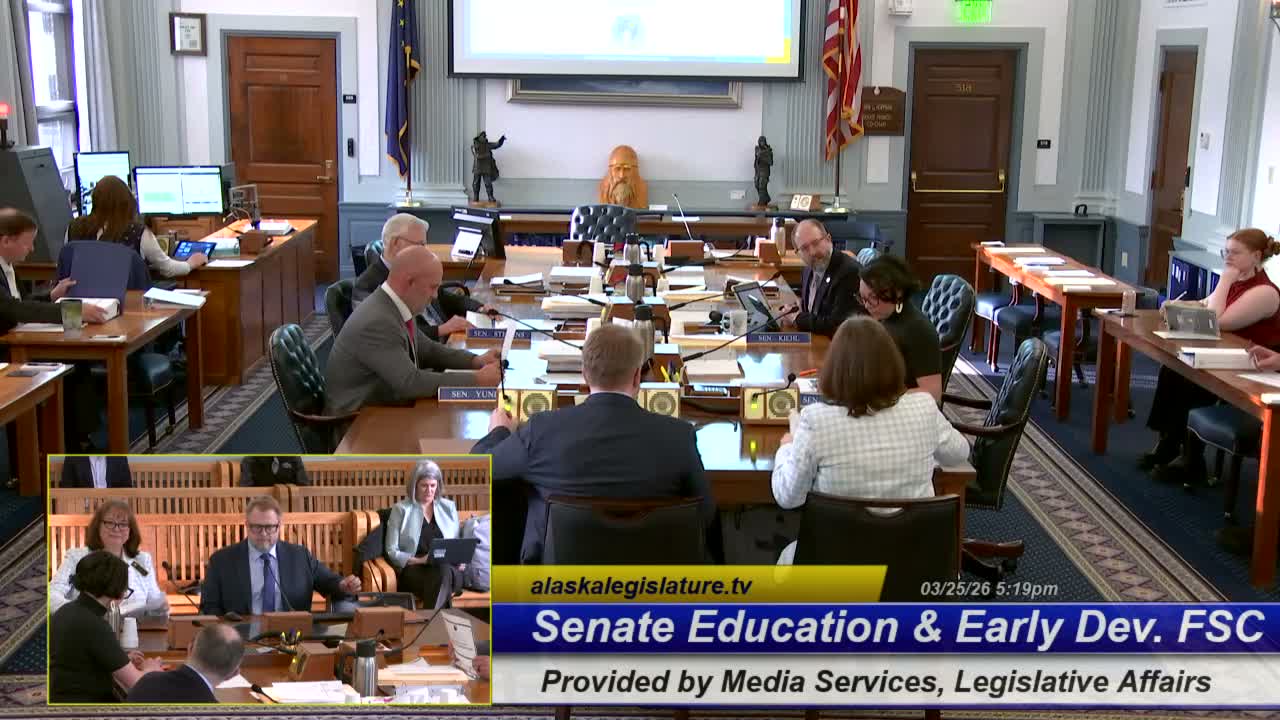
Don Hanish, Administrative Services Director for the Alaska Department of Education and Early Development, and Ryan Stanley, the department’s IT manager, told the Senate Finance Subcommittee on March 25 that DEED has built a cloud-based data warehouse and launched several public dashboards and a DEED portal to standardize data collection and reduce manual work.
The project began in fiscal year 2024, Hanish said. "The project is structured around three core components: transparency, predictive capabilities and ad hoc reporting," he told the committee, framing the dashboards as a public-facing way to show statewide student outcomes and workforce trends. Stanley demonstrated the first dashboards and described the technical work behind them: "We've built this warehouse structure out in the cloud in Microsoft Azure," he said, and the team has populated it with the clean aggregate data already posted on DEED’s public site.
Why it matters: committee members pressed that dashboard numbers require context. Senator Tobin warned that headline averages — such as per-pupil spending — can mislead if viewers do not see that some students require intensive, high-cost services. DEED said raw spreadsheets will remain available for deeper analysis and that the department’s data team and research partners (including ISER) are advising on presentation and suppression rules.
Key facts: Hanish said legislators have invested approximately $2,700,000 in the project since FY24 to support analysis, the warehouse, dashboards and the DEED portal; that figure covers contractor and system costs but does not include DEED staff time. The department anticipates that after the buildout it will sustain the platform for about $300,000 per fiscal year and is planning the project through FY31, with hosting costs expected to be the primary recurring expense thereafter.
Timeline and dependencies: Stanley said DEED aims to add student-level assessment data to the warehouse by the end of FY27 and to migrate most routine collections through the new in-house collection app by FY28, but both steps depend on cooperation from 53 school districts, many of which use different student information systems and have limited windows to change local workflows. "If we had the data in the warehouse, a two- to three-month process" can produce a new dashboard, Stanley said; if data are unclean or require districts to change practice, timelines can extend to a year or longer.
Technical and governance issues: DEED explained it separates an operational warehouse (staff access) from a public presentation warehouse to apply suppression rules for small counts and protect privacy. Stanley said the team found 16 different formats for first names across incoming files, highlighting the need for naming conventions and data standards; the department is discussing alignment with the Common Educational Data Standard (SEDS) to reduce conversion steps.
AK STAR and assessments: Senators also asked about the AK STAR assessment timeline. Monica (self‑identified as Director of Innovation and Education Excellence) told the panel that assessment results typically arrive to DEED in August, are validated and released to districts in September, and that written-response scoring contributes to the longer turnaround. She said DEED has discussed expediting some scoring with its vendor, which could yield some results months earlier at additional cost.
What’s next: DEED asked subcommittee members for priorities and said it will return follow-up materials and a prioritized order of work. Chair Kiel invited members to submit additional questions through legislative liaisons and said the subcommittee will set a closeout date before forwarding recommendations to the full finance committee. The subcommittee adjourned at 6:19 p.m.
The project began in fiscal year 2024, Hanish said. "The project is structured around three core components: transparency, predictive capabilities and ad hoc reporting," he told the committee, framing the dashboards as a public-facing way to show statewide student outcomes and workforce trends. Stanley demonstrated the first dashboards and described the technical work behind them: "We've built this warehouse structure out in the cloud in Microsoft Azure," he said, and the team has populated it with the clean aggregate data already posted on DEED’s public site.
Why it matters: committee members pressed that dashboard numbers require context. Senator Tobin warned that headline averages — such as per-pupil spending — can mislead if viewers do not see that some students require intensive, high-cost services. DEED said raw spreadsheets will remain available for deeper analysis and that the department’s data team and research partners (including ISER) are advising on presentation and suppression rules.
Key facts: Hanish said legislators have invested approximately $2,700,000 in the project since FY24 to support analysis, the warehouse, dashboards and the DEED portal; that figure covers contractor and system costs but does not include DEED staff time. The department anticipates that after the buildout it will sustain the platform for about $300,000 per fiscal year and is planning the project through FY31, with hosting costs expected to be the primary recurring expense thereafter.
Timeline and dependencies: Stanley said DEED aims to add student-level assessment data to the warehouse by the end of FY27 and to migrate most routine collections through the new in-house collection app by FY28, but both steps depend on cooperation from 53 school districts, many of which use different student information systems and have limited windows to change local workflows. "If we had the data in the warehouse, a two- to three-month process" can produce a new dashboard, Stanley said; if data are unclean or require districts to change practice, timelines can extend to a year or longer.
Technical and governance issues: DEED explained it separates an operational warehouse (staff access) from a public presentation warehouse to apply suppression rules for small counts and protect privacy. Stanley said the team found 16 different formats for first names across incoming files, highlighting the need for naming conventions and data standards; the department is discussing alignment with the Common Educational Data Standard (SEDS) to reduce conversion steps.
AK STAR and assessments: Senators also asked about the AK STAR assessment timeline. Monica (self‑identified as Director of Innovation and Education Excellence) told the panel that assessment results typically arrive to DEED in August, are validated and released to districts in September, and that written-response scoring contributes to the longer turnaround. She said DEED has discussed expediting some scoring with its vendor, which could yield some results months earlier at additional cost.
What’s next: DEED asked subcommittee members for priorities and said it will return follow-up materials and a prioritized order of work. Chair Kiel invited members to submit additional questions through legislative liaisons and said the subcommittee will set a closeout date before forwarding recommendations to the full finance committee. The subcommittee adjourned at 6:19 p.m.
View the Full Meeting & All Its Details
This article offers just a summary. Unlock complete video, transcripts, and insights as a Founder Member.
✓
Watch full, unedited meeting videos
✓
Search every word spoken in unlimited transcripts
✓
AI summaries & real-time alerts (all government levels)
✓
Permanent access to expanding government content
30-day money-back guarantee
