Senate committee weighs bill to license respiratory therapists — Alaska the last state without licensure
March 25, 2026 | 2026 Legislature Alaska, Alaska
This article was created by AI summarizing key points discussed. AI makes mistakes, so for full details and context, please refer to the video of the full meeting. Please report any errors so we can fix them. Report an error »
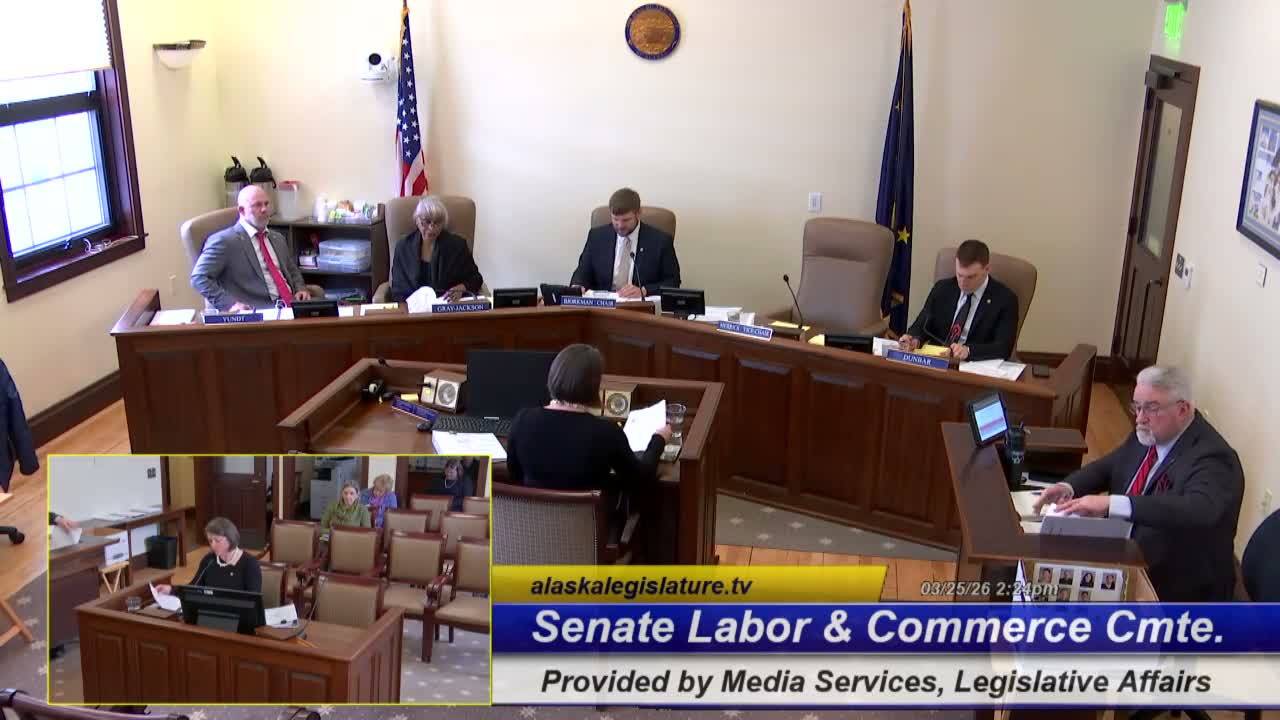
Juneau — Senators on the Labor and Commerce Committee heard proponents urge adoption of respiratory care licensure language included in the committee substitute for House Bill 110. Representative Carolyn Hall said the provision (derived from HB362) creates a licensing pathway for respiratory care practitioners and would bring Alaska into alignment with the rest of the United States.
"Alaska is the only state in The United States that does not professionally license respiratory care practitioners," Representative Carolyn Hall said, arguing that licensure would close a regulatory gap and improve patient safety. Hall said the bill would require credential verification, biannual renewals, and continuing education while grandfathering currently practicing certified respiratory therapists.
Angela Oiler, a registered respiratory therapist and president of the Alaska Society for Respiratory Care, told senators the proposal formalizes national best practices and includes protections to allow existing practitioners to continue working. "State licensure is an important step toward ensuring consistent standards in education, competency, accountability, and professional oversight," Oiler said.
Miriam O'Day of the American Association for Respiratory Care said Alaska likely has about 700–800 practicing respiratory therapists, many serving geographically isolated communities, and that licensure would standardize minimum education and disciplinary mechanisms. Director Sylvain Robb from the Division of Corporations, Business and Professional Licensing explained the mechanics of implementing licensure and cited a fiscal note for the respiratory care portion of the CS of roughly $46,100 in the first year and $41,600 thereafter, funded by licensing fees.
Committee members asked how licensure would affect costs and whether a new board was needed; Robb said the division would absorb the program as one of its fee‑supported licensing programs and add an examiner position funded by fees. The committee set the CS aside for further consideration and did not take a vote.
"Alaska is the only state in The United States that does not professionally license respiratory care practitioners," Representative Carolyn Hall said, arguing that licensure would close a regulatory gap and improve patient safety. Hall said the bill would require credential verification, biannual renewals, and continuing education while grandfathering currently practicing certified respiratory therapists.
Angela Oiler, a registered respiratory therapist and president of the Alaska Society for Respiratory Care, told senators the proposal formalizes national best practices and includes protections to allow existing practitioners to continue working. "State licensure is an important step toward ensuring consistent standards in education, competency, accountability, and professional oversight," Oiler said.
Miriam O'Day of the American Association for Respiratory Care said Alaska likely has about 700–800 practicing respiratory therapists, many serving geographically isolated communities, and that licensure would standardize minimum education and disciplinary mechanisms. Director Sylvain Robb from the Division of Corporations, Business and Professional Licensing explained the mechanics of implementing licensure and cited a fiscal note for the respiratory care portion of the CS of roughly $46,100 in the first year and $41,600 thereafter, funded by licensing fees.
Committee members asked how licensure would affect costs and whether a new board was needed; Robb said the division would absorb the program as one of its fee‑supported licensing programs and add an examiner position funded by fees. The committee set the CS aside for further consideration and did not take a vote.
View the Full Meeting & All Its Details
This article offers just a summary. Unlock complete video, transcripts, and insights as a Founder Member.
✓
Watch full, unedited meeting videos
✓
Search every word spoken in unlimited transcripts
✓
AI summaries & real-time alerts (all government levels)
✓
Permanent access to expanding government content
30-day money-back guarantee
