House Resources Committee hears HB 381 to replace property tax for Alaska LNG with volumetric levy
March 25, 2026 | 2026 Legislature Alaska, Alaska
This article was created by AI summarizing key points discussed. AI makes mistakes, so for full details and context, please refer to the video of the full meeting. Please report any errors so we can fix them. Report an error »
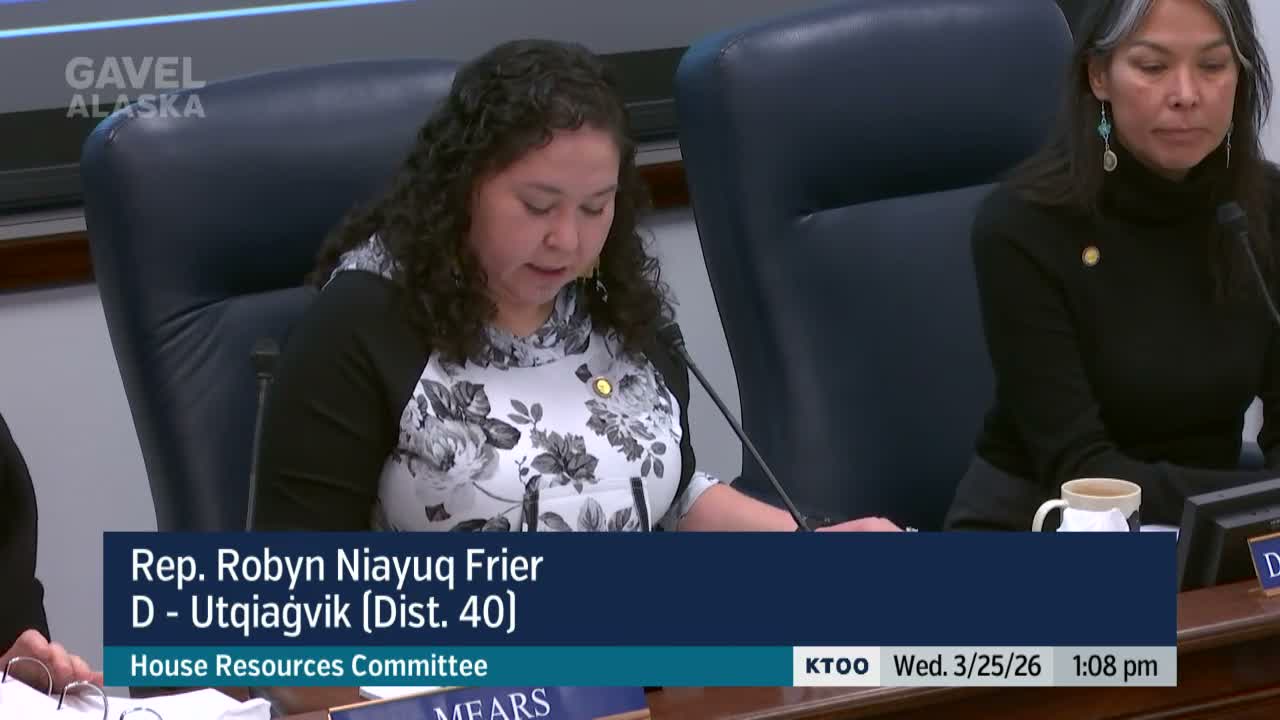
The Alaska House Resources Committee on Wednesday heard an introductory presentation on HB 381, a bill to replace property taxation for the Alaska LNG project with an alternative volumetric tax (AVT) set initially at six cents per thousand cubic feet and rising by 1% annually, officials and developers said.
Department of Revenue (DOR) officials and project developers told the committee that the AVT is designed to make project revenue more predictable, reduce litigation over property valuation and lower modeled break-even prices for in-state and export gas. "This alternative tax proposal is a key element in doing that," said Adam Prestige, president of Glenfarn Alaska LNG LLC. "Anytime you have a major cost associated with a project, that cost is ultimately borne by those who pay for the gas." Prestige said the current property tax structure could make project-delivered gas as much as 25% more expensive than under the proposed tax.
Why it matters: DOR presented a fiscal note and 30-year modeling showing the bill would shift revenue streams. Dan Stickel, chief economist with DOR, said the fiscal note shows the state would receive roughly 12% of the AVT revenue and that the state share at full operations is modeled at about $9 million per year. Under DOR's baseline through 2062, the state would receive about $22.5 billion with the AVT compared with about $30 billion under current law; municipal revenues were modeled to fall from roughly $17 billion to about $4 billion over the same period.
How the AVT would work: Brandon Spanos, acting director of the tax division at DOR, explained the bill would exempt the project from state-level property tax for up to 10 years or until the project's 30‑day average pipeline throughput exceeds 1,000,000,000 cubic feet per day, whichever occurs first. Once the ramp-up ends, the AVT would be 6¢ per thousand cubic feet and increase 1% each year thereafter, with the levy allocated to local governments based on where project infrastructure sits; sections within the unorganized borough would flow to the state.
Modeling and risks: Stickel said DOR used AGDC-provided project assumptions and ran sensitivity scenarios on capital cost, producer purchase price and financing costs. The department modeled a baseline capital cost of about $46 billion (inflated to 2026 dollars) and a $1.50 per thousand cubic feet purchase price to upstream producers. Under those assumptions DOR showed in-state breakeven sales prices falling from $4.86/Mcf under current law to $4.43/Mcf with the AVT and LNG export breakevens falling from $9.07/Mcf to $8.48/Mcf. Stickel cautioned capital-cost overruns and higher producer prices materially raise required break-even prices.
Developer and municipal engagement: Matt Kissinger, commercial director for the Alaska Gasline Development Corporation (AGDC), and Sen. Mark Begich said developers and state officials have conducted extensive outreach to affected borough mayors and are discussing mitigation measures such as municipal equity stakes or other arrangements. "We are working very closely with the mayors of the boroughs," Kissinger said. Begich said mayors have generally supported the concept of a volumetric tax but raised concerns about a bill 'floor' and inflation adjustments.
Questions from lawmakers: Committee members pressed for more detail on municipal impacts, timing risks, cost-overrun scenarios and alternative policy levers. Rep. Mears said other fiscal options exist and asked whether those levers had been fully considered; Stickel replied they had modeled many scenarios but the AVT is one policy path. Members from the North Slope raised concerns that boroughs near producers may not receive direct in‑kind gas benefits while facing large property-tax revenue reductions; developers responded that construction jobs, upstream development and other economic activity would benefit local communities.
Next steps: No action was taken; the committee ended the hearing after extensive questioning and said it expects to continue consideration of HB 381 at follow-up meetings. The committee’s next scheduled meeting is 03/27/2026.
Department of Revenue (DOR) officials and project developers told the committee that the AVT is designed to make project revenue more predictable, reduce litigation over property valuation and lower modeled break-even prices for in-state and export gas. "This alternative tax proposal is a key element in doing that," said Adam Prestige, president of Glenfarn Alaska LNG LLC. "Anytime you have a major cost associated with a project, that cost is ultimately borne by those who pay for the gas." Prestige said the current property tax structure could make project-delivered gas as much as 25% more expensive than under the proposed tax.
Why it matters: DOR presented a fiscal note and 30-year modeling showing the bill would shift revenue streams. Dan Stickel, chief economist with DOR, said the fiscal note shows the state would receive roughly 12% of the AVT revenue and that the state share at full operations is modeled at about $9 million per year. Under DOR's baseline through 2062, the state would receive about $22.5 billion with the AVT compared with about $30 billion under current law; municipal revenues were modeled to fall from roughly $17 billion to about $4 billion over the same period.
How the AVT would work: Brandon Spanos, acting director of the tax division at DOR, explained the bill would exempt the project from state-level property tax for up to 10 years or until the project's 30‑day average pipeline throughput exceeds 1,000,000,000 cubic feet per day, whichever occurs first. Once the ramp-up ends, the AVT would be 6¢ per thousand cubic feet and increase 1% each year thereafter, with the levy allocated to local governments based on where project infrastructure sits; sections within the unorganized borough would flow to the state.
Modeling and risks: Stickel said DOR used AGDC-provided project assumptions and ran sensitivity scenarios on capital cost, producer purchase price and financing costs. The department modeled a baseline capital cost of about $46 billion (inflated to 2026 dollars) and a $1.50 per thousand cubic feet purchase price to upstream producers. Under those assumptions DOR showed in-state breakeven sales prices falling from $4.86/Mcf under current law to $4.43/Mcf with the AVT and LNG export breakevens falling from $9.07/Mcf to $8.48/Mcf. Stickel cautioned capital-cost overruns and higher producer prices materially raise required break-even prices.
Developer and municipal engagement: Matt Kissinger, commercial director for the Alaska Gasline Development Corporation (AGDC), and Sen. Mark Begich said developers and state officials have conducted extensive outreach to affected borough mayors and are discussing mitigation measures such as municipal equity stakes or other arrangements. "We are working very closely with the mayors of the boroughs," Kissinger said. Begich said mayors have generally supported the concept of a volumetric tax but raised concerns about a bill 'floor' and inflation adjustments.
Questions from lawmakers: Committee members pressed for more detail on municipal impacts, timing risks, cost-overrun scenarios and alternative policy levers. Rep. Mears said other fiscal options exist and asked whether those levers had been fully considered; Stickel replied they had modeled many scenarios but the AVT is one policy path. Members from the North Slope raised concerns that boroughs near producers may not receive direct in‑kind gas benefits while facing large property-tax revenue reductions; developers responded that construction jobs, upstream development and other economic activity would benefit local communities.
Next steps: No action was taken; the committee ended the hearing after extensive questioning and said it expects to continue consideration of HB 381 at follow-up meetings. The committee’s next scheduled meeting is 03/27/2026.
Don't Miss a Word: See the Full Meeting!
Go beyond summaries. Unlock every video, transcript, and key insight with a Founder Membership.
✓
Get instant access to full meeting videos
✓
Search and clip any phrase from complete transcripts
✓
Receive AI-powered summaries & custom alerts
✓
Enjoy lifetime, unrestricted access to government data
30-day money-back guarantee
