Airport officials tell Senate subcommittee Anchorage, Fairbanks strong as leaders plan cargo expansion and monitor jet-fuel supply
March 25, 2026 | 2026 Legislature Alaska, Alaska
This article was created by AI summarizing key points discussed. AI makes mistakes, so for full details and context, please refer to the video of the full meeting. Please report any errors so we can fix them. Report an error »
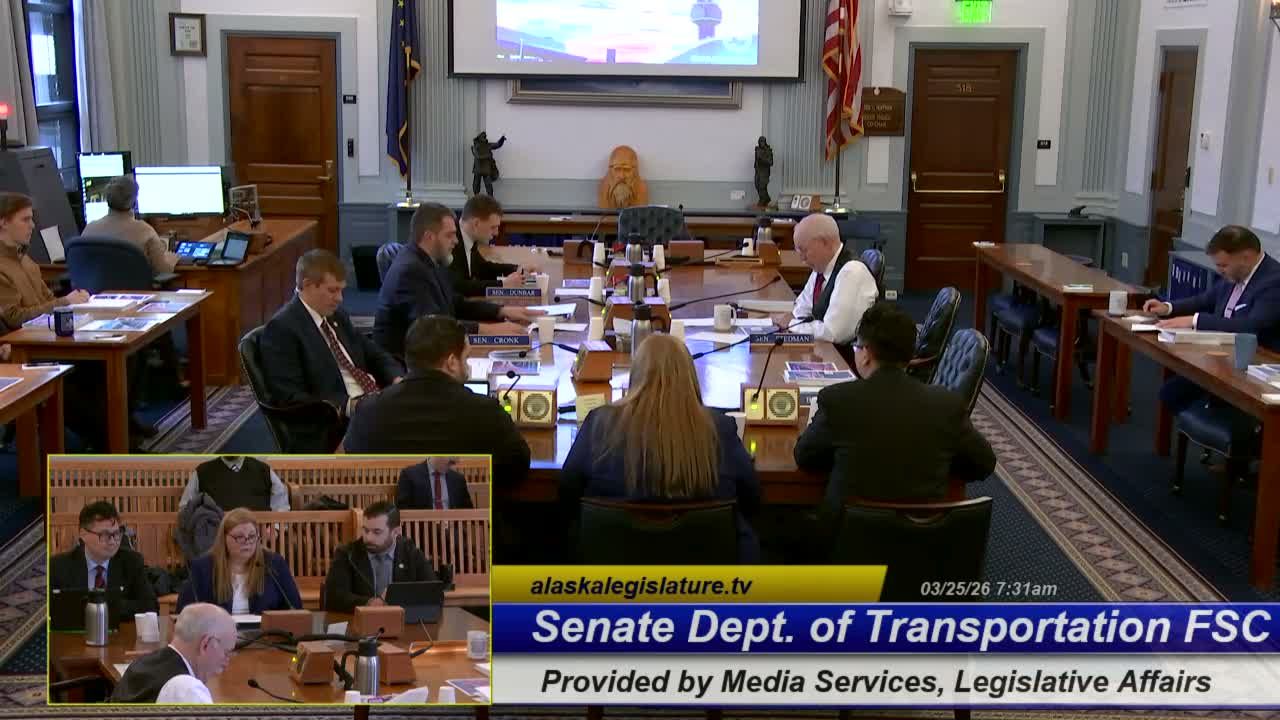
Susan Ault, controller for the Alaska International Airport System, told the Senate DOT Finance Subcommittee that the airport system is self-sustaining and reported operating revenues of roughly $193 million in 2025, driven largely by cargo activity.
Ault said the system’s net position rose about $51 million from 2024 to 2025, that operating expenditures and debt service rose about 10 percent year-over-year, and that the system used roughly $104 million in pandemic relief grants. She said a 2016 A/B bond refunding flattened annual debt service to about $23 million through 2036 and removed variable-rate bond exposure.
Ault described a planned cargo-capacity expansion: the capital spend plan includes an initial phase to construct four additional hard stands and a later phase adding four more, for a total of eight new hard stands, with those phases expected to come online in 2029 and 2031. She said the project is part of the federal capital spend plan and that the airport’s signatory carriers are aware and on board; committee members asked whether budget language or receipt authority might be needed to enable any public–private arrangements.
“Through the operating agreement and passenger terminal lease agreement, we’re fully residual,” Ault said, explaining that airport revenues come from rates and fees rather than general-fund support.
The subcommittee asked about audit timing and late financial statements. Ault said the airport system was included this year in the state’s annual comprehensive financial report and that the office has implemented monthly and quarterly reconciliations and internal training with contractors to avoid year-end processing backlogs.
Fuel supply and jet fuel distribution were a focus of committee questioning. Angela Spear, director of the Alaska International Airport System, said she and Commissioner Anderson have been monitoring supplies closely and emphasized that the system has not experienced a service outage. “We had never ever lost our ability to serve our carriers or gone to any sort of critical level,” Spear said, adding that a temporary waiver of the Jones Act has helped relieve short-term concerns by allowing airlines and the fuel consortium to pursue additional domestic suppliers.
Spear said Marathon supplies roughly 30–40 percent of jet fuel through Anchorage and that “they do not do that on their own.” She said the airport and third-party fuel handlers are coordinating to improve turnaround — for example, by offering space for ancillary supplies so refueling trucks can reload faster during heavy operations — and that the airport will continue to monitor the situation and report back to the committee if additional budget authority or other measures are needed.
On staffing and equipment, Spear said the international airports have some vacancies but not at a critical level; she described a new pipeline program that hires equipment operators without a commercial driver’s license and supports CDL training, and said the airports are fully utilizing available federal funds to replace and maintain equipment on a prescribed schedule.
The meeting record shows committee members welcomed the airport’s fiscal position and asked DOT to follow up on whether specific budget language is needed to facilitate the cargo-hard-stand construction or receipt authority for potential partnerships. The subcommittee requested additional enplanement and cargo data for statewide and rural airports to supplement the international-system presentation.
The committee adjourned at 8:33 a.m. with follow-ups requested on expansion logistics, fuel-monitoring plans and any budget language that would facilitate timely construction.
Ault said the system’s net position rose about $51 million from 2024 to 2025, that operating expenditures and debt service rose about 10 percent year-over-year, and that the system used roughly $104 million in pandemic relief grants. She said a 2016 A/B bond refunding flattened annual debt service to about $23 million through 2036 and removed variable-rate bond exposure.
Ault described a planned cargo-capacity expansion: the capital spend plan includes an initial phase to construct four additional hard stands and a later phase adding four more, for a total of eight new hard stands, with those phases expected to come online in 2029 and 2031. She said the project is part of the federal capital spend plan and that the airport’s signatory carriers are aware and on board; committee members asked whether budget language or receipt authority might be needed to enable any public–private arrangements.
“Through the operating agreement and passenger terminal lease agreement, we’re fully residual,” Ault said, explaining that airport revenues come from rates and fees rather than general-fund support.
The subcommittee asked about audit timing and late financial statements. Ault said the airport system was included this year in the state’s annual comprehensive financial report and that the office has implemented monthly and quarterly reconciliations and internal training with contractors to avoid year-end processing backlogs.
Fuel supply and jet fuel distribution were a focus of committee questioning. Angela Spear, director of the Alaska International Airport System, said she and Commissioner Anderson have been monitoring supplies closely and emphasized that the system has not experienced a service outage. “We had never ever lost our ability to serve our carriers or gone to any sort of critical level,” Spear said, adding that a temporary waiver of the Jones Act has helped relieve short-term concerns by allowing airlines and the fuel consortium to pursue additional domestic suppliers.
Spear said Marathon supplies roughly 30–40 percent of jet fuel through Anchorage and that “they do not do that on their own.” She said the airport and third-party fuel handlers are coordinating to improve turnaround — for example, by offering space for ancillary supplies so refueling trucks can reload faster during heavy operations — and that the airport will continue to monitor the situation and report back to the committee if additional budget authority or other measures are needed.
On staffing and equipment, Spear said the international airports have some vacancies but not at a critical level; she described a new pipeline program that hires equipment operators without a commercial driver’s license and supports CDL training, and said the airports are fully utilizing available federal funds to replace and maintain equipment on a prescribed schedule.
The meeting record shows committee members welcomed the airport’s fiscal position and asked DOT to follow up on whether specific budget language is needed to facilitate the cargo-hard-stand construction or receipt authority for potential partnerships. The subcommittee requested additional enplanement and cargo data for statewide and rural airports to supplement the international-system presentation.
The committee adjourned at 8:33 a.m. with follow-ups requested on expansion logistics, fuel-monitoring plans and any budget language that would facilitate timely construction.
Don't Miss a Word: See the Full Meeting!
Go beyond summaries. Unlock every video, transcript, and key insight with a Founder Membership.
✓
Get instant access to full meeting videos
✓
Search and clip any phrase from complete transcripts
✓
Receive AI-powered summaries & custom alerts
✓
Enjoy lifetime, unrestricted access to government data
30-day money-back guarantee
