Statewide aviation and facilities chiefs warn of deferred-maintenance backlog; Mount Edgecumbe conditions draw sharp criticism
March 25, 2026 | 2026 Legislature Alaska, Alaska
This article was created by AI summarizing key points discussed. AI makes mistakes, so for full details and context, please refer to the video of the full meeting. Please report any errors so we can fix them. Report an error »
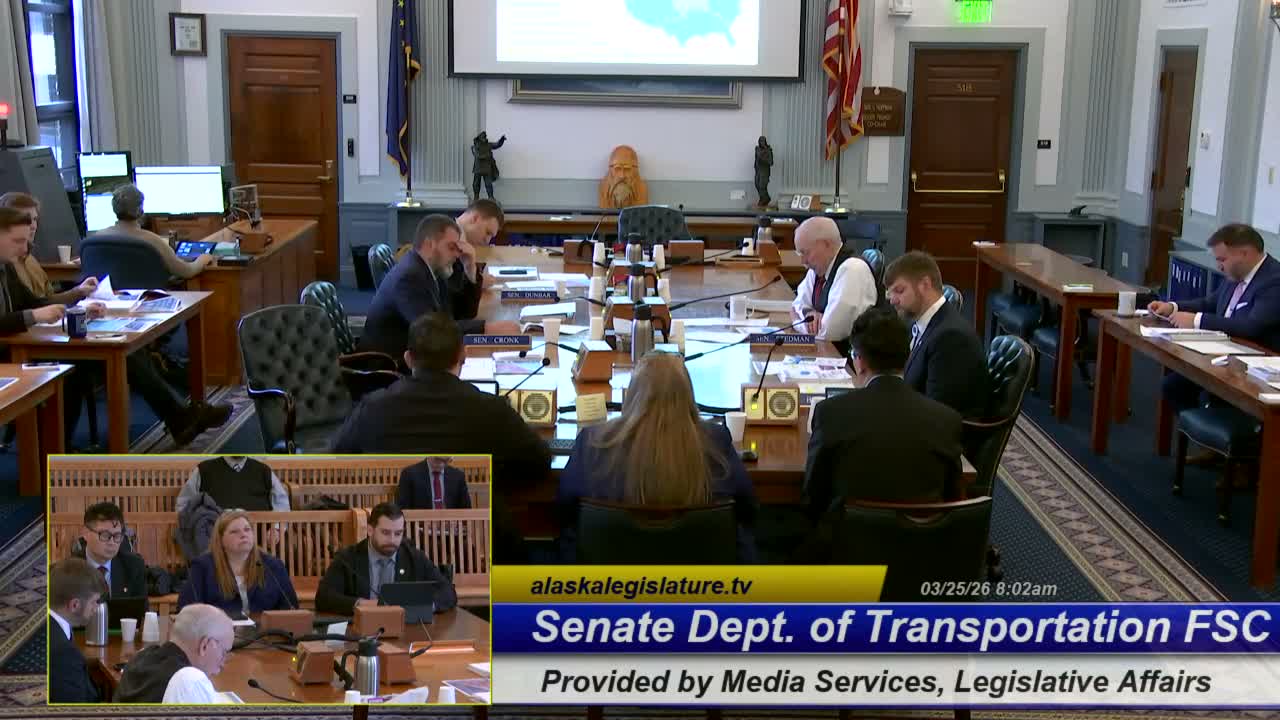
Rebecca Douglas, aviation planning chief for the Alaska Department of Transportation’s Statewide Aviation Division, told the subcommittee that the statewide rural airport system includes 235 airports and faces challenges including higher project bid costs, aging airfield lighting systems and a need to prioritize maintenance projects.
Douglas said Statewide Aviation has about 31 staff and proposed a roughly $5 million FY27 division budget; she noted unusual leasing revenue in 2025 after a competitive sale in Utqiagvik and reminded members that FAA requires airport-generated revenue be spent on airport activity. She described a recent demolition bid (Kodiak/Utqiagvik) with a low bid around $86,000 and said the division is seeking a FY27 line item to continue removing abandoned buildings to free up revenue-generating space.
On federal grants, Douglas said fiscal 2025–26 have a temporary 5 percent state match that will largely revert to a typical 6.25 percent match in 2027 except for central air service airports. She said that change modestly affects capital-program planning but that federal conversations and recent FAA guidance are allowing more maintenance-eligible activity into capital programs.
Committee members raised concerns about project prioritization after noting the Aviation Project Evaluation Board (APEB) has not met in roughly two years. Douglas acknowledged the backlog of large projects and high cost escalation in recent years, said the department is reviewing and updating prioritization criteria to focus on maintaining existing assets, and pledged to provide follow-up on who is scoring and advancing projects and when APEB will next meet.
Christopher Hodgen of the Division of Facility Services described the division’s portfolio of roughly 706 facilities across about 233 locations, with an estimated deferred-maintenance backlog of about $373 million. He said the FY27 proposed budget includes about $26.3 million from the Alaska Capital Income Fund and $6 million from the Public Building Fund for deferred maintenance, and that top projects will be prioritized via the State Facilities Council.
The committee pressed the department on Mount Edgecumbe school facilities. Chair Steadman said that after touring the site he found conditions “deplorable,” listing leaking roofs, vermin and aging World War II–era buildings with failing systems. Hodgen said the Department of Education submits prioritized projects for Mount Edgecumbe to the State Facilities Council and that construction work is planned this summer on the boys’ dorm ventilation and window projects and a roof project is in design.
Members requested copies of recent and prior deferred-maintenance ranking lists and clarification on how the $26 million allocation will be structured and distributed. DOT staff agreed to provide the committee with the requested project lists and additional written responses on project scoring, APEB status and enplanement statistics for the rural system.
The subcommittee concluded the item with a direction to follow up on deferred-maintenance priorities and Mount Edgecumbe repairs before finalizing capital budget deliberations.
Douglas said Statewide Aviation has about 31 staff and proposed a roughly $5 million FY27 division budget; she noted unusual leasing revenue in 2025 after a competitive sale in Utqiagvik and reminded members that FAA requires airport-generated revenue be spent on airport activity. She described a recent demolition bid (Kodiak/Utqiagvik) with a low bid around $86,000 and said the division is seeking a FY27 line item to continue removing abandoned buildings to free up revenue-generating space.
On federal grants, Douglas said fiscal 2025–26 have a temporary 5 percent state match that will largely revert to a typical 6.25 percent match in 2027 except for central air service airports. She said that change modestly affects capital-program planning but that federal conversations and recent FAA guidance are allowing more maintenance-eligible activity into capital programs.
Committee members raised concerns about project prioritization after noting the Aviation Project Evaluation Board (APEB) has not met in roughly two years. Douglas acknowledged the backlog of large projects and high cost escalation in recent years, said the department is reviewing and updating prioritization criteria to focus on maintaining existing assets, and pledged to provide follow-up on who is scoring and advancing projects and when APEB will next meet.
Christopher Hodgen of the Division of Facility Services described the division’s portfolio of roughly 706 facilities across about 233 locations, with an estimated deferred-maintenance backlog of about $373 million. He said the FY27 proposed budget includes about $26.3 million from the Alaska Capital Income Fund and $6 million from the Public Building Fund for deferred maintenance, and that top projects will be prioritized via the State Facilities Council.
The committee pressed the department on Mount Edgecumbe school facilities. Chair Steadman said that after touring the site he found conditions “deplorable,” listing leaking roofs, vermin and aging World War II–era buildings with failing systems. Hodgen said the Department of Education submits prioritized projects for Mount Edgecumbe to the State Facilities Council and that construction work is planned this summer on the boys’ dorm ventilation and window projects and a roof project is in design.
Members requested copies of recent and prior deferred-maintenance ranking lists and clarification on how the $26 million allocation will be structured and distributed. DOT staff agreed to provide the committee with the requested project lists and additional written responses on project scoring, APEB status and enplanement statistics for the rural system.
The subcommittee concluded the item with a direction to follow up on deferred-maintenance priorities and Mount Edgecumbe repairs before finalizing capital budget deliberations.
View the Full Meeting & All Its Details
This article offers just a summary. Unlock complete video, transcripts, and insights as a Founder Member.
✓
Watch full, unedited meeting videos
✓
Search every word spoken in unlimited transcripts
✓
AI summaries & real-time alerts (all government levels)
✓
Permanent access to expanding government content
30-day money-back guarantee
