UAA professor outlines Alaska Comprehensive Forensic Training Academy to broaden trauma-informed care
March 25, 2026 | 2026 Legislature Alaska, Alaska
This article was created by AI summarizing key points discussed. AI makes mistakes, so for full details and context, please refer to the video of the full meeting. Please report any errors so we can fix them. Report an error »
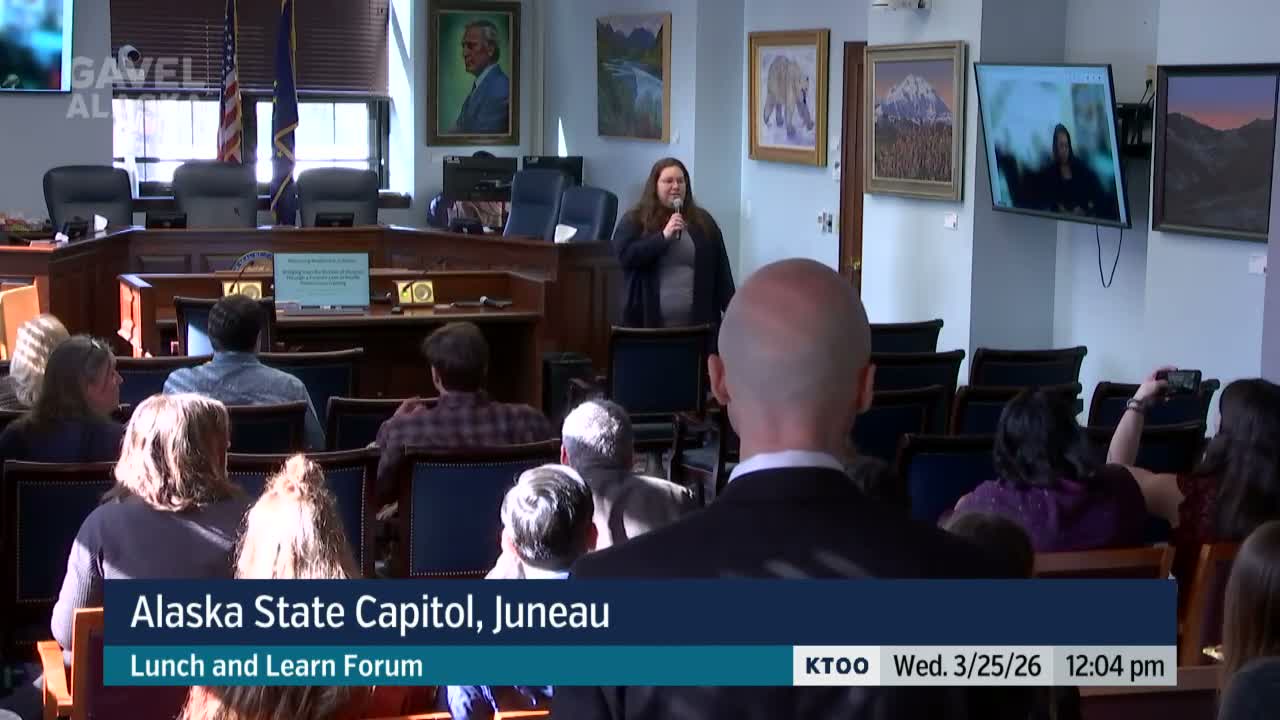
Angelia Trujillo, a professor at the School of Nursing at the University of Alaska Anchorage, outlined the Alaska Comprehensive Forensic Training Academy during a UAA lunch-and-learn, saying the program is designed to give health-care workers foundational and skills-based training to respond to victims of violence across the lifespan.
Trujillo, who described herself as a sexual-assault nurse examiner, child-abuse examiner and public-health nurse, said the academy grew from a 2018 request by the Council on Domestic Violence and Sexual Assault to widen training beyond specialized SART (Sexual Assault Response Team) nurses. "And we call this the Alaska Comprehensive Forensic Training Academy," she said, framing the program as a partnership with CDVSA, the UAA College of Health and the Alaska Nurses Association.
The two-part curriculum begins with a free, online asynchronous Part 1 of 20 modules (each about 30–75 minutes). After completing Part 1, participants may enroll in Part 2, a live three-day virtual session that emphasizes hands-on skill building. Trujillo described mailed toolkits for Part 2 (mannequin heads, rulers, swabs and practice forms) and actor-based role plays to practice interviewing, photo-documentation and evidence-collection techniques.
Trujillo argued the approach addresses gaps in pre-licensure training that leave many providers without the skills to recognize or document violence: "we have some communities in our state that actually have 1 in 2 women are victimized by violence," she said, using that prevalence to underline training needs in rural and hub communities. She added the program teaches documentation practices intended to support possible law-enforcement or prosecutorial uses of medical records.
To date, Trujillo reported about 540 people had completed Part 1 and about 185 had completed Part 2. In 2024 the project received an appropriations grant through Senator Lisa Murkowski's office and used a Bureau of Justice Assistance grant project called "Listening to Alaska" to hold outreach sessions: Trujillo said the team visited 24 communities, ran roughly 44 sessions and heard from approximately 533 providers and community members.
Participants and communities told project staff they want broader access to Part 1 beyond clinicians — including front-desk staff, advocates, tribal and city officials and even nonclinical community members — and more tailoring to local resources. Trujillo said the academy recently secured CME and continuing-education credits for social work and mental-health providers to support interdisciplinary participation.
She emphasized the academy is not intended to replace SART or domestic-violence specialty training: it is meant to strengthen existing SART teams, broaden equitable access to forensic-level care and help sustain programs by increasing the number of trained providers in more communities. Trujillo noted barriers remain, including the time required for a roughly 20-hour Part 1 and a roughly 24-hour Part 2, limited local internet in some rural sites, and Part 2 currently being offered only three times a year.
During a brief question-and-answer session, Trujillo said the training supports child-advocacy work and that UAA nursing seniors receive mandatory-reporting training through local programs; the academy reviews and clarifies mandatory-reporting requirements within both parts of its curriculum. The session concluded with the presenter offering to mail handouts to attendees and noting a QR code on the final slide for additional resources.
Trujillo, who described herself as a sexual-assault nurse examiner, child-abuse examiner and public-health nurse, said the academy grew from a 2018 request by the Council on Domestic Violence and Sexual Assault to widen training beyond specialized SART (Sexual Assault Response Team) nurses. "And we call this the Alaska Comprehensive Forensic Training Academy," she said, framing the program as a partnership with CDVSA, the UAA College of Health and the Alaska Nurses Association.
The two-part curriculum begins with a free, online asynchronous Part 1 of 20 modules (each about 30–75 minutes). After completing Part 1, participants may enroll in Part 2, a live three-day virtual session that emphasizes hands-on skill building. Trujillo described mailed toolkits for Part 2 (mannequin heads, rulers, swabs and practice forms) and actor-based role plays to practice interviewing, photo-documentation and evidence-collection techniques.
Trujillo argued the approach addresses gaps in pre-licensure training that leave many providers without the skills to recognize or document violence: "we have some communities in our state that actually have 1 in 2 women are victimized by violence," she said, using that prevalence to underline training needs in rural and hub communities. She added the program teaches documentation practices intended to support possible law-enforcement or prosecutorial uses of medical records.
To date, Trujillo reported about 540 people had completed Part 1 and about 185 had completed Part 2. In 2024 the project received an appropriations grant through Senator Lisa Murkowski's office and used a Bureau of Justice Assistance grant project called "Listening to Alaska" to hold outreach sessions: Trujillo said the team visited 24 communities, ran roughly 44 sessions and heard from approximately 533 providers and community members.
Participants and communities told project staff they want broader access to Part 1 beyond clinicians — including front-desk staff, advocates, tribal and city officials and even nonclinical community members — and more tailoring to local resources. Trujillo said the academy recently secured CME and continuing-education credits for social work and mental-health providers to support interdisciplinary participation.
She emphasized the academy is not intended to replace SART or domestic-violence specialty training: it is meant to strengthen existing SART teams, broaden equitable access to forensic-level care and help sustain programs by increasing the number of trained providers in more communities. Trujillo noted barriers remain, including the time required for a roughly 20-hour Part 1 and a roughly 24-hour Part 2, limited local internet in some rural sites, and Part 2 currently being offered only three times a year.
During a brief question-and-answer session, Trujillo said the training supports child-advocacy work and that UAA nursing seniors receive mandatory-reporting training through local programs; the academy reviews and clarifies mandatory-reporting requirements within both parts of its curriculum. The session concluded with the presenter offering to mail handouts to attendees and noting a QR code on the final slide for additional resources.
View the Full Meeting & All Its Details
This article offers just a summary. Unlock complete video, transcripts, and insights as a Founder Member.
✓
Watch full, unedited meeting videos
✓
Search every word spoken in unlimited transcripts
✓
AI summaries & real-time alerts (all government levels)
✓
Permanent access to expanding government content
30-day money-back guarantee
