Major Jenny Temple tells subcommittee SLED fusion center handles thousands of requests, needs staff and sustained funding
March 24, 2026 | 2026 Legislative Meetings, South Carolina
This article was created by AI summarizing key points discussed. AI makes mistakes, so for full details and context, please refer to the video of the full meeting. Please report any errors so we can fix them. Report an error »
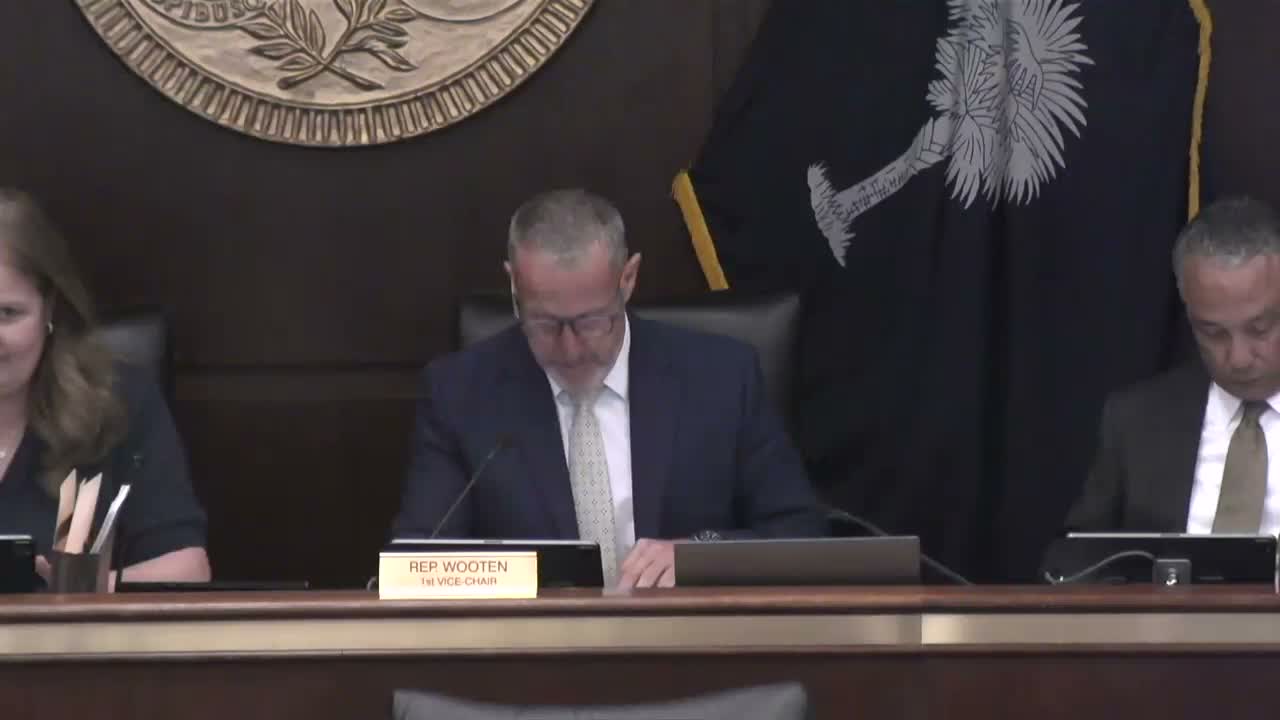
Major Jenny Temple, the major over the South Carolina Law Enforcement Division (SLED) Fusion Center, told the House Law Enforcement and Criminal Justice Subcommittee on June 19 that the center fields thousands of analytic and operational requests each year and needs sustained staffing and funding to maintain a 24/7 capability.
Temple said the fusion center has "about 70 employees" and outlined units that include an operations desk (OD), a criminal analytic team (CAT), a threat analysis cell (TAC) and a state surveillance and intelligence (SSI) fugitive unit. "We have about 70 employees that work in the fusion center," she said, describing a mix of sworn officers, non-sworn analysts and part-time college-student operators who staff the watch desk.
The fusion center’s work ranges from vetting suspicious-activity reports and issuing advisories to producing state threat assessments and assisting with multiagency fugitive investigations. Temple told members the center produced an annual state threat assessment, sent 427 bulletins and advisories in 2025 and that analysts handled "a little over, almost 10,000 requests" last year. She also said the TAC handled about 850 requests and performed 149 special-event threat assessments.
Why it matters: committee members pressed the panel on whether cuts to federal homeland-security grant money would jeopardize operations. Temple said losing federal funding would hurt but added that much of the fusion center’s sustainment is currently supported by state appropriations. A SLED official described the broader grant picture: "we receive about $4,300,000 in homeland security money every year," the official said, and noted a $12,000 minimum DHS grant requirement tied to fusion centers.
Lieutenant Corey Wilson, who oversees the OD, described OD’s duties and staffing model. He said OD has processed more than 20,700 photo lineups since January 2021 and that the unit now includes a mix of full-time employees and college-student hires paid starting at $15 an hour. Wilson said a recent dispatch software rollout improved recordkeeping and searchable case files, and that OD handled more than 6,700 requests in calendar-year 2025.
Captain Al Stuckey and Lieutenants Jesse Adams and Chris Johnson gave complementary briefings on daily operations, the new fusion-center facility at 4416 Broad River Road, the TAC’s counterterrorism work and SSI fugitive operations. Captain Stuckey said the fusion center completed between roughly 13,000 and 17,000 requests per year depending on how tasks are counted and described the center’s role supporting large events and command posts.
Gang intelligence: Special Agent David Rivera described the gang-intelligence unit’s statewide coverage (four agents) and GangNet, the state gang-validation database. Rivera said about 1,700 validated members have been entered into GangNet and described current trends including hybrid juvenile gangs and outlaw motorcycle gangs. He referenced a proposed state gang bill that he said would add prosecutorial tools and asset-forfeiture authority and offered to provide the bill number to staff for review.
Missing persons and alerts: Special Agent Alex Shelbelle said the Missing Person Information Center (MEPIC) coordinates AMBER alerts, endangered-person notifications and other statewide alerts. He reported 3,349 juveniles and 3,155 adults entered into NCIC in 2025 and said the center had 24 unidentified remains active in the system.
What’s next: The committee approved the meeting minutes from Jan. 29 before the presentation; staff committed to follow up on outstanding questions, including the referenced gang-related legislation. The chair adjourned the subcommittee after closing remarks praising the fusion-center staff.
Representative questions and follow-ups were part of the record; officials offered to provide additional materials (including the gang-bill citation) to committee staff. The subcommittee did not take further legislative action at the hearing.
Temple said the fusion center has "about 70 employees" and outlined units that include an operations desk (OD), a criminal analytic team (CAT), a threat analysis cell (TAC) and a state surveillance and intelligence (SSI) fugitive unit. "We have about 70 employees that work in the fusion center," she said, describing a mix of sworn officers, non-sworn analysts and part-time college-student operators who staff the watch desk.
The fusion center’s work ranges from vetting suspicious-activity reports and issuing advisories to producing state threat assessments and assisting with multiagency fugitive investigations. Temple told members the center produced an annual state threat assessment, sent 427 bulletins and advisories in 2025 and that analysts handled "a little over, almost 10,000 requests" last year. She also said the TAC handled about 850 requests and performed 149 special-event threat assessments.
Why it matters: committee members pressed the panel on whether cuts to federal homeland-security grant money would jeopardize operations. Temple said losing federal funding would hurt but added that much of the fusion center’s sustainment is currently supported by state appropriations. A SLED official described the broader grant picture: "we receive about $4,300,000 in homeland security money every year," the official said, and noted a $12,000 minimum DHS grant requirement tied to fusion centers.
Lieutenant Corey Wilson, who oversees the OD, described OD’s duties and staffing model. He said OD has processed more than 20,700 photo lineups since January 2021 and that the unit now includes a mix of full-time employees and college-student hires paid starting at $15 an hour. Wilson said a recent dispatch software rollout improved recordkeeping and searchable case files, and that OD handled more than 6,700 requests in calendar-year 2025.
Captain Al Stuckey and Lieutenants Jesse Adams and Chris Johnson gave complementary briefings on daily operations, the new fusion-center facility at 4416 Broad River Road, the TAC’s counterterrorism work and SSI fugitive operations. Captain Stuckey said the fusion center completed between roughly 13,000 and 17,000 requests per year depending on how tasks are counted and described the center’s role supporting large events and command posts.
Gang intelligence: Special Agent David Rivera described the gang-intelligence unit’s statewide coverage (four agents) and GangNet, the state gang-validation database. Rivera said about 1,700 validated members have been entered into GangNet and described current trends including hybrid juvenile gangs and outlaw motorcycle gangs. He referenced a proposed state gang bill that he said would add prosecutorial tools and asset-forfeiture authority and offered to provide the bill number to staff for review.
Missing persons and alerts: Special Agent Alex Shelbelle said the Missing Person Information Center (MEPIC) coordinates AMBER alerts, endangered-person notifications and other statewide alerts. He reported 3,349 juveniles and 3,155 adults entered into NCIC in 2025 and said the center had 24 unidentified remains active in the system.
What’s next: The committee approved the meeting minutes from Jan. 29 before the presentation; staff committed to follow up on outstanding questions, including the referenced gang-related legislation. The chair adjourned the subcommittee after closing remarks praising the fusion-center staff.
Representative questions and follow-ups were part of the record; officials offered to provide additional materials (including the gang-bill citation) to committee staff. The subcommittee did not take further legislative action at the hearing.
View the Full Meeting & All Its Details
This article offers just a summary. Unlock complete video, transcripts, and insights as a Founder Member.
✓
Watch full, unedited meeting videos
✓
Search every word spoken in unlimited transcripts
✓
AI summaries & real-time alerts (all government levels)
✓
Permanent access to expanding government content
30-day money-back guarantee
