Panel moves bill to waive municipal permit fees for disabled veterans to ease home accessibility work
March 25, 2026 | 2026 Legislature MN, Minnesota
This article was created by AI summarizing key points discussed. AI makes mistakes, so for full details and context, please refer to the video of the full meeting. Please report any errors so we can fix them. Report an error »
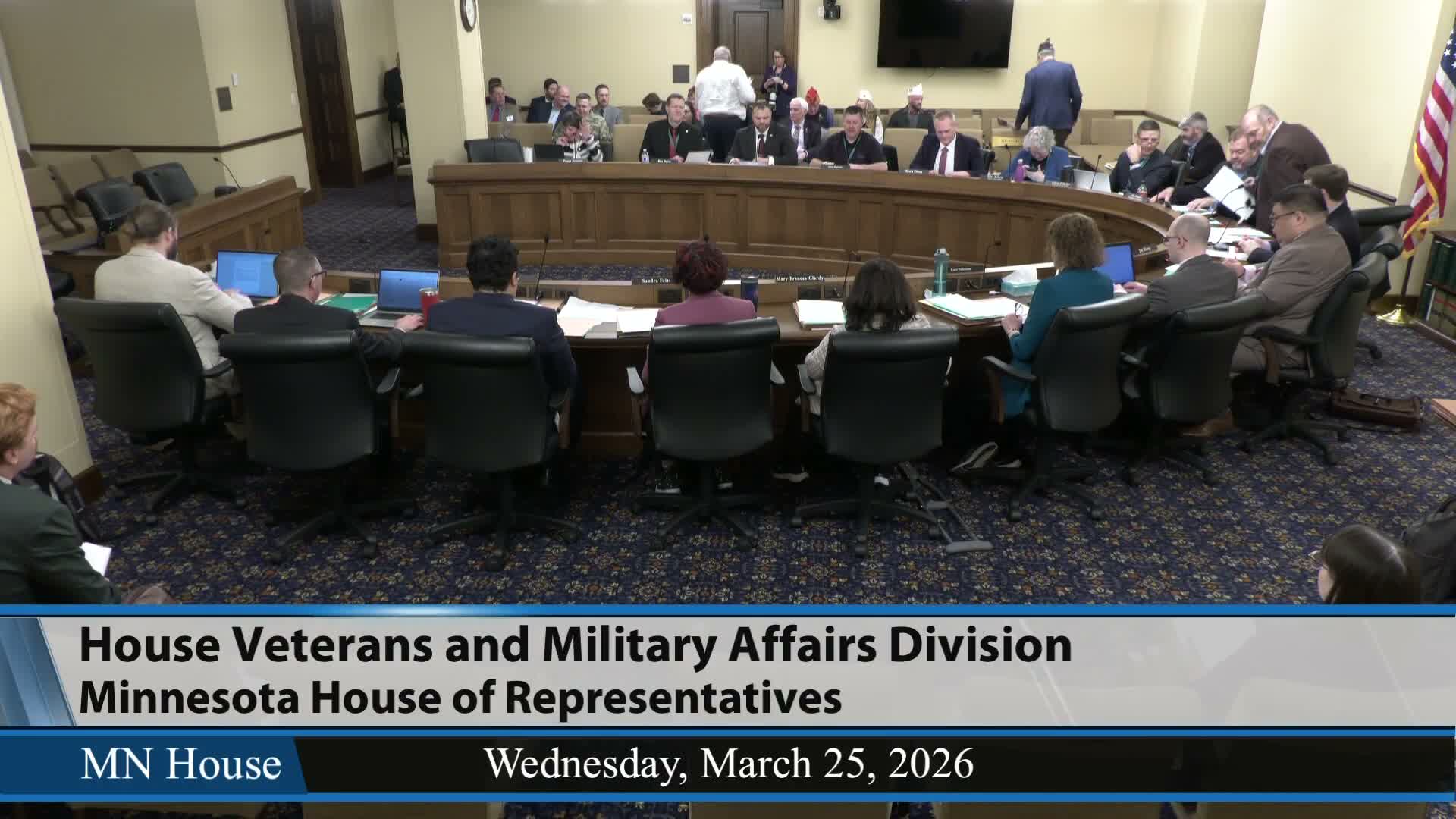
House File 41‑71, recommended to the committee on Elections and Local Government, would waive municipal residential‑improvement permit fees for veterans who have a federally recognized disability rating, lowering a financial barrier to home accessibility modifications.
Mark Foster, vice president of legislative and political affairs for Housing First Minnesota, testified the building industry supports the bill as a targeted fix. He described industry projects serving veterans — including 15 single‑family "Housing for Heroes" homes and a 22‑unit veteran village in Eagan — and said permit fees often generate municipal surpluses. "With this bill, we are talking about a small number of projects for individuals who have given back to this country," Foster said, urging local governments to absorb the minimal costs.
Representative Peggy Bennett asked whether the bill's reference to mental impairments could lead to abuse and whether local governments had weighed in on fiscal effects. Representative Ray Brower and MDVA staff responded that proof of service‑connected disability would be required, similar to other state benefits, and that committee discussion estimated a relatively small statewide cost (a figure cited in committee discussion was about $63,000 spread across municipalities).
John Kelly, director of government affairs for MDVA, noted the U.S. Department of Veterans Affairs' Home Improvements and Structural Alterations (HISA) program — a lifetime, one‑time benefit that can pay up to $6,800 for improvements — and said the committee viewed HF 41‑71 as a way to stretch those dollars and reduce permit barriers for eligible veterans.
Representative Feist raised whether SGU/SKU veterans should be included; MDVA said SGU/SKU veterans are not eligible for service‑connected disability under current federal rules and therefore would generally not qualify for a waiver tied to federal disability proof. After discussion, the division voted by voice to re‑refer HF 41‑71 to the House Elections and Local Government Committee.
Mark Foster, vice president of legislative and political affairs for Housing First Minnesota, testified the building industry supports the bill as a targeted fix. He described industry projects serving veterans — including 15 single‑family "Housing for Heroes" homes and a 22‑unit veteran village in Eagan — and said permit fees often generate municipal surpluses. "With this bill, we are talking about a small number of projects for individuals who have given back to this country," Foster said, urging local governments to absorb the minimal costs.
Representative Peggy Bennett asked whether the bill's reference to mental impairments could lead to abuse and whether local governments had weighed in on fiscal effects. Representative Ray Brower and MDVA staff responded that proof of service‑connected disability would be required, similar to other state benefits, and that committee discussion estimated a relatively small statewide cost (a figure cited in committee discussion was about $63,000 spread across municipalities).
John Kelly, director of government affairs for MDVA, noted the U.S. Department of Veterans Affairs' Home Improvements and Structural Alterations (HISA) program — a lifetime, one‑time benefit that can pay up to $6,800 for improvements — and said the committee viewed HF 41‑71 as a way to stretch those dollars and reduce permit barriers for eligible veterans.
Representative Feist raised whether SGU/SKU veterans should be included; MDVA said SGU/SKU veterans are not eligible for service‑connected disability under current federal rules and therefore would generally not qualify for a waiver tied to federal disability proof. After discussion, the division voted by voice to re‑refer HF 41‑71 to the House Elections and Local Government Committee.
View the Full Meeting & All Its Details
This article offers just a summary. Unlock complete video, transcripts, and insights as a Founder Member.
✓
Watch full, unedited meeting videos
✓
Search every word spoken in unlimited transcripts
✓
AI summaries & real-time alerts (all government levels)
✓
Permanent access to expanding government content
30-day money-back guarantee
