Committee hears testimony on HB 3876, a bill to change who remits short‑term rental taxes
March 25, 2026 | 2026 Legislative Meetings, South Carolina
This article was created by AI summarizing key points discussed. AI makes mistakes, so for full details and context, please refer to the video of the full meeting. Please report any errors so we can fix them. Report an error »
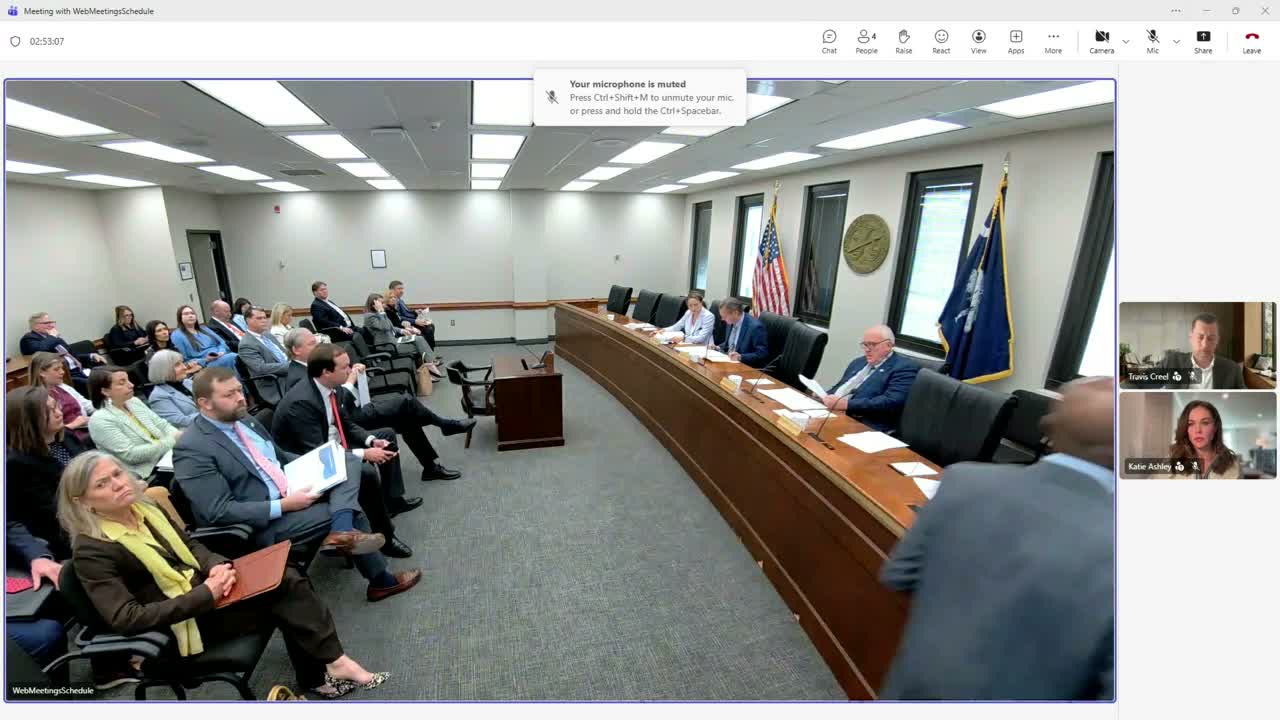
The Senate committee reviewed House Bill 3876, a proposal that would clarify who is responsible for collecting and remitting accommodations and short‑term rental taxes—including transactions arranged through online platforms such as Airbnb and Vrbo. Airbnb representatives said the bill, as drafted, would force platforms to change their business model and create administrative burdens for small property managers and hosts.
Katie Ashley, policy manager for Airbnb, told the committee: "If passed, this bill would legislate changing our business model." She said the platform currently collects payments and the associated taxes at booking and remits them to the Department of Revenue (DOR) on a monthly return; the bill’s merchant‑of‑record language would shift that responsibility in some transactions to licensed professional property managers. "It seeks to legislate Airbnb to send the guest payment directly upon booking rather than when our policy is to send the payment upon guest check‑in," Ashley said, arguing that requirement would disadvantage smaller managers and increase audit complexity.
The bill would explicitly include online booking platforms in the definition of retailer, remove certain small‑host exemptions, require timely data sharing and annual reporting of rental activity, and create schedules for remittance of both state and local accommodations taxes. Travis Creel, a principal in Airbnb’s indirect tax group, urged centralizing administration with the DOR, saying decentralized local remittances "exponentially increases the number of taxpayers, the number of returns, and the number of audits necessary to collect the tax." He cautioned that decentralization has been the subject of constitutional litigation in other states and pointed to the Wayfair line of cases when arguing for a single point of administration.
Licensed property managers and some hosts pushed back on Airbnb’s characterization. Brandon Cox, a CEO of a licensed property management company, said professional managers are already bound by state licensing rules that require escrow accounting and property‑level records, and he argued the lack of property‑level accountability from platforms has frustrated local tax enforcement. "Not all bulk remittance is auditable at the property level," Cox said, and he urged clearer statutory responsibility so DOR can assign tax dollars to the correct properties during audits.
Individual hosts who testified said the current, automated platform collection is largely trouble‑free for them. Host Michael Thacker described the existing system as "hands off" and said he worried a change could reduce compliance and collections by making the process harder for small hosts.
The committee questioned platform witnesses on when taxes are collected and when they are remitted. Airbnb said it collects taxes at the time a guest pays and files monthly returns to the DOR; statutory remittance deadlines mean there can be up to roughly 50 days between collection and the state's receipt of funds, and platforms provide transaction‑level detail to tax authorities under audit. Committee members pressed whether hosts and municipalities receive property‑level accounting; witnesses said hosts can download monthly host earnings reports and platforms supply transaction data to DOR during audits, but the publicly filed returns are typically jurisdiction‑level sums.
After extended questioning and public testimony from hosts and property managers, the chair moved to carry HB 3876 over to the committee’s next meeting so lawmakers could hear additional testimony and review technical details. The motion carried and the bill was deferred.
What happens next: the committee carried HB 3876 to a later date for further consideration and invited additional witnesses and state officials to return with clarifications on auditability, trust accounting, and the practical effect of merchant‑of‑record language.
Katie Ashley, policy manager for Airbnb, told the committee: "If passed, this bill would legislate changing our business model." She said the platform currently collects payments and the associated taxes at booking and remits them to the Department of Revenue (DOR) on a monthly return; the bill’s merchant‑of‑record language would shift that responsibility in some transactions to licensed professional property managers. "It seeks to legislate Airbnb to send the guest payment directly upon booking rather than when our policy is to send the payment upon guest check‑in," Ashley said, arguing that requirement would disadvantage smaller managers and increase audit complexity.
The bill would explicitly include online booking platforms in the definition of retailer, remove certain small‑host exemptions, require timely data sharing and annual reporting of rental activity, and create schedules for remittance of both state and local accommodations taxes. Travis Creel, a principal in Airbnb’s indirect tax group, urged centralizing administration with the DOR, saying decentralized local remittances "exponentially increases the number of taxpayers, the number of returns, and the number of audits necessary to collect the tax." He cautioned that decentralization has been the subject of constitutional litigation in other states and pointed to the Wayfair line of cases when arguing for a single point of administration.
Licensed property managers and some hosts pushed back on Airbnb’s characterization. Brandon Cox, a CEO of a licensed property management company, said professional managers are already bound by state licensing rules that require escrow accounting and property‑level records, and he argued the lack of property‑level accountability from platforms has frustrated local tax enforcement. "Not all bulk remittance is auditable at the property level," Cox said, and he urged clearer statutory responsibility so DOR can assign tax dollars to the correct properties during audits.
Individual hosts who testified said the current, automated platform collection is largely trouble‑free for them. Host Michael Thacker described the existing system as "hands off" and said he worried a change could reduce compliance and collections by making the process harder for small hosts.
The committee questioned platform witnesses on when taxes are collected and when they are remitted. Airbnb said it collects taxes at the time a guest pays and files monthly returns to the DOR; statutory remittance deadlines mean there can be up to roughly 50 days between collection and the state's receipt of funds, and platforms provide transaction‑level detail to tax authorities under audit. Committee members pressed whether hosts and municipalities receive property‑level accounting; witnesses said hosts can download monthly host earnings reports and platforms supply transaction data to DOR during audits, but the publicly filed returns are typically jurisdiction‑level sums.
After extended questioning and public testimony from hosts and property managers, the chair moved to carry HB 3876 over to the committee’s next meeting so lawmakers could hear additional testimony and review technical details. The motion carried and the bill was deferred.
What happens next: the committee carried HB 3876 to a later date for further consideration and invited additional witnesses and state officials to return with clarifications on auditability, trust accounting, and the practical effect of merchant‑of‑record language.
View the Full Meeting & All Its Details
This article offers just a summary. Unlock complete video, transcripts, and insights as a Founder Member.
✓
Watch full, unedited meeting videos
✓
Search every word spoken in unlimited transcripts
✓
AI summaries & real-time alerts (all government levels)
✓
Permanent access to expanding government content
30-day money-back guarantee
