Clean Water Council outlines funding framework; lawmakers press on PFAS, treatment limits and metro priorities
March 25, 2026 | 2026 Legislature MN, Minnesota
This article was created by AI summarizing key points discussed. AI makes mistakes, so for full details and context, please refer to the video of the full meeting. Please report any errors so we can fix them. Report an error »
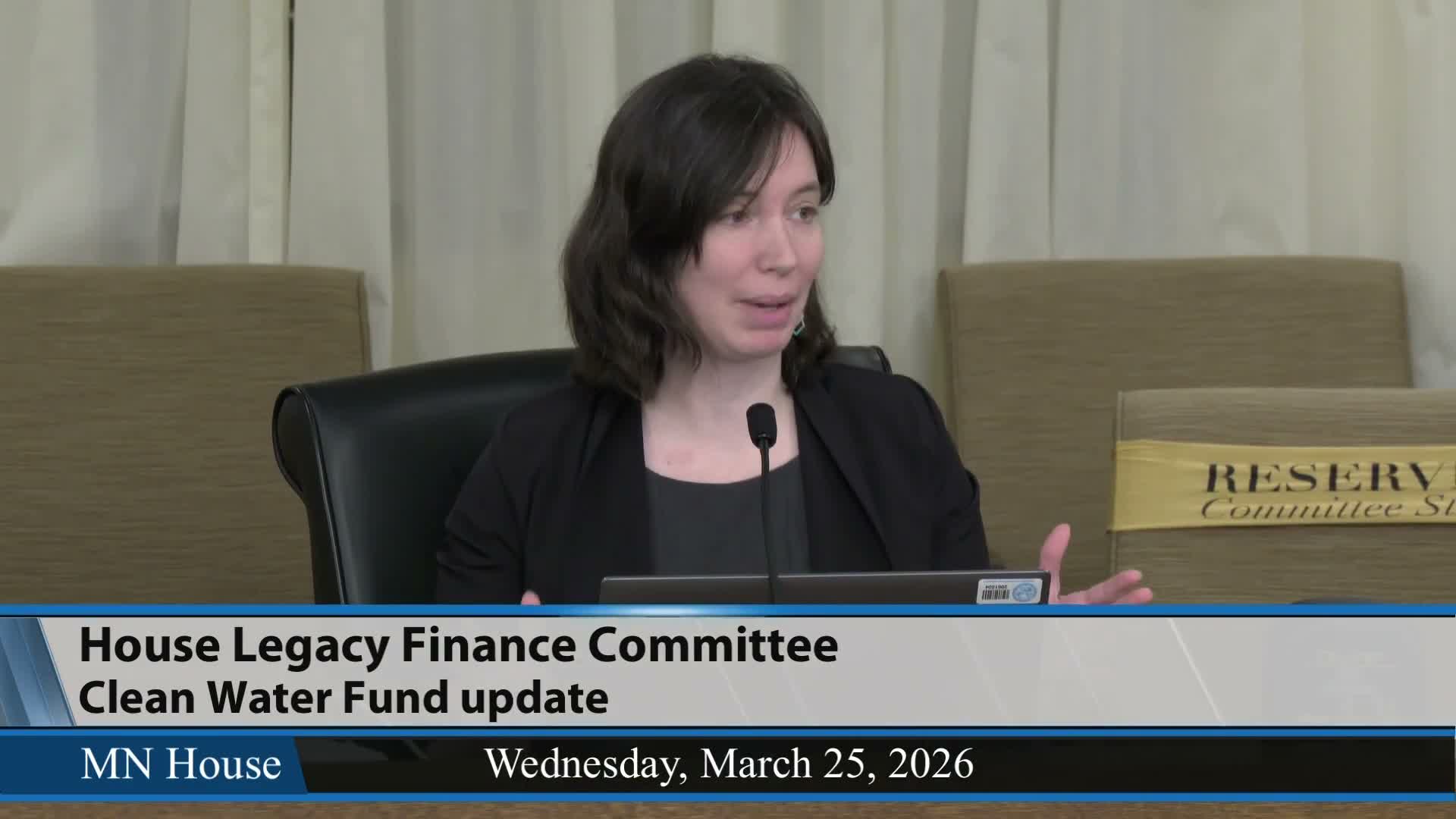
Jen Kader, administrator for the Clean Water Council, told the Legacy Finance Committee the Clean Water Fund uses an adaptive management framework—monitoring and assessment, problem investigation and applied research, strategy development, comprehensive planning, implementation, and continuing monitoring—to prioritize investments that protect and restore water quality across the state.
Kader highlighted program outcomes including completed monitoring cycles, delisting progress (presenter cited 95 delistings as of the recent report), and a communications tool and fact sheets describing Clean Water Fund impacts. She said the council is reviewing proposals for the FY28–29 biennium and mentioned a forecast of about $330,000,000 for the next biennium.
Committee members focused on PFAS contamination in the east metro and whether Clean Water Fund dollars can be used for remediation. Glenn Scuta, watershed division director at the Pollution Control Agency, said large‑scale groundwater remediation raises policy and funding questions and that “polluter pays” approaches have typically led remediation efforts. Tanya Eschneur of the Minnesota Department of Health described how Clean Water Fund dollars have been used for PFAS‑related programs that are source‑focused and preventive—sampling, health guidance development, fish consumption advisories, and statewide PFAS evaluations—while noting the fund is generally not used to supplant existing infrastructure obligations such as building community treatment systems.
Nonpartisan staff and presenters emphasized the constitutional and statutory language directing that Clean Water Fund dollars be used to protect, enhance and restore water quality and protect drinking water sources; that statutory frame led the council to prioritize source protection, monitoring and targeted implementation rather than broad infrastructure supplantation. Kader said the council will continue to examine policy choices and develop recommendations, and she committed to follow up with members on specific metro mitigation work and administrative expenditures (including questions about the cost of external communications work).
Kader highlighted program outcomes including completed monitoring cycles, delisting progress (presenter cited 95 delistings as of the recent report), and a communications tool and fact sheets describing Clean Water Fund impacts. She said the council is reviewing proposals for the FY28–29 biennium and mentioned a forecast of about $330,000,000 for the next biennium.
Committee members focused on PFAS contamination in the east metro and whether Clean Water Fund dollars can be used for remediation. Glenn Scuta, watershed division director at the Pollution Control Agency, said large‑scale groundwater remediation raises policy and funding questions and that “polluter pays” approaches have typically led remediation efforts. Tanya Eschneur of the Minnesota Department of Health described how Clean Water Fund dollars have been used for PFAS‑related programs that are source‑focused and preventive—sampling, health guidance development, fish consumption advisories, and statewide PFAS evaluations—while noting the fund is generally not used to supplant existing infrastructure obligations such as building community treatment systems.
Nonpartisan staff and presenters emphasized the constitutional and statutory language directing that Clean Water Fund dollars be used to protect, enhance and restore water quality and protect drinking water sources; that statutory frame led the council to prioritize source protection, monitoring and targeted implementation rather than broad infrastructure supplantation. Kader said the council will continue to examine policy choices and develop recommendations, and she committed to follow up with members on specific metro mitigation work and administrative expenditures (including questions about the cost of external communications work).
View the Full Meeting & All Its Details
This article offers just a summary. Unlock complete video, transcripts, and insights as a Founder Member.
✓
Watch full, unedited meeting videos
✓
Search every word spoken in unlimited transcripts
✓
AI summaries & real-time alerts (all government levels)
✓
Permanent access to expanding government content
30-day money-back guarantee
