Committee advances higher-education bills on trustee training, CHE cleanup and post-tenure review
March 24, 2026 | 2026 Legislative Meetings, South Carolina
This article was created by AI summarizing key points discussed. AI makes mistakes, so for full details and context, please refer to the video of the full meeting. Please report any errors so we can fix them. Report an error »
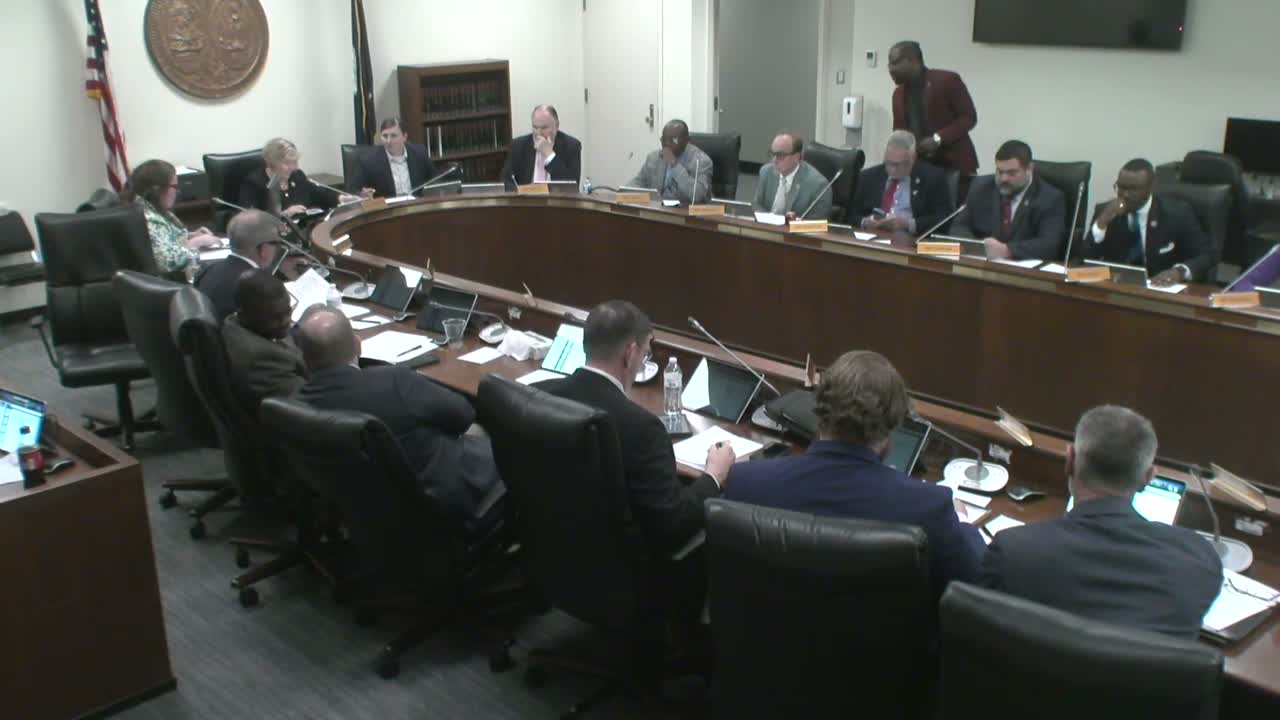
The House Education and Public Works Committee on Thursday advanced multiple bills aimed at tightening oversight and training in South Carolina's higher-education system.
Representative McGinnis introduced a set of measures that included a bill (47-36) requiring newly appointed commissioners of the Commission on Higher Education to participate in an orientation program and complete a minimum of six hours of training within 12 months; the committee voted to report that bill favorably (18-0). "This bill requires all newly appointed commissioners to participate in a board orientation program at least once during their first year of service," McGinnis said when outlining the training requirements.
A related bill (47-37) expands required training for college trustees, adds fiduciary responsibilities to the curriculum and removes an exclusive reference to a single regional accreditor so other national accreditors can qualify; the committee adopted an amendment and approved the change (amendment adopted 18-0). Committee members said the training aims to ensure trustees and commissioners approach governance with consistent expectations.
The committee also considered a cleanup bill (47-38) to remove obsolete statutory language and to clarify distribution rules for funds allocated through the Children's Educational Endowment. Members adopted an amendment by unanimous consent to address drafting and distribution methodology.
Separately, Representative McGinnis presented a bill (47-61) to require annual faculty performance evaluations and a post-tenure review process that includes timelines for review, remediation and, in some cases, revocation. Sponsors said the bill is designed to create uniform accountability across institutions while preserving academic freedom; the sponsor pointed to a specific clause protecting conduct that is constitutionally protected. After extended debate on whether the measure could be used politically, the committee reported the bill favorably by roll call (18-0).
All of the higher-education measures were advanced out of committee for further consideration by the full House. Committee members asked staff to provide technical language and reporting details for implementation in follow-up documents.
Representative McGinnis introduced a set of measures that included a bill (47-36) requiring newly appointed commissioners of the Commission on Higher Education to participate in an orientation program and complete a minimum of six hours of training within 12 months; the committee voted to report that bill favorably (18-0). "This bill requires all newly appointed commissioners to participate in a board orientation program at least once during their first year of service," McGinnis said when outlining the training requirements.
A related bill (47-37) expands required training for college trustees, adds fiduciary responsibilities to the curriculum and removes an exclusive reference to a single regional accreditor so other national accreditors can qualify; the committee adopted an amendment and approved the change (amendment adopted 18-0). Committee members said the training aims to ensure trustees and commissioners approach governance with consistent expectations.
The committee also considered a cleanup bill (47-38) to remove obsolete statutory language and to clarify distribution rules for funds allocated through the Children's Educational Endowment. Members adopted an amendment by unanimous consent to address drafting and distribution methodology.
Separately, Representative McGinnis presented a bill (47-61) to require annual faculty performance evaluations and a post-tenure review process that includes timelines for review, remediation and, in some cases, revocation. Sponsors said the bill is designed to create uniform accountability across institutions while preserving academic freedom; the sponsor pointed to a specific clause protecting conduct that is constitutionally protected. After extended debate on whether the measure could be used politically, the committee reported the bill favorably by roll call (18-0).
All of the higher-education measures were advanced out of committee for further consideration by the full House. Committee members asked staff to provide technical language and reporting details for implementation in follow-up documents.
View the Full Meeting & All Its Details
This article offers just a summary. Unlock complete video, transcripts, and insights as a Founder Member.
✓
Watch full, unedited meeting videos
✓
Search every word spoken in unlimited transcripts
✓
AI summaries & real-time alerts (all government levels)
✓
Permanent access to expanding government content
30-day money-back guarantee
