Subcommittee hears split testimony on film tax credit; debate adjourned for review
March 24, 2026 | 2026 Legislative Meetings, South Carolina
This article was created by AI summarizing key points discussed. AI makes mistakes, so for full details and context, please refer to the video of the full meeting. Please report any errors so we can fix them. Report an error »
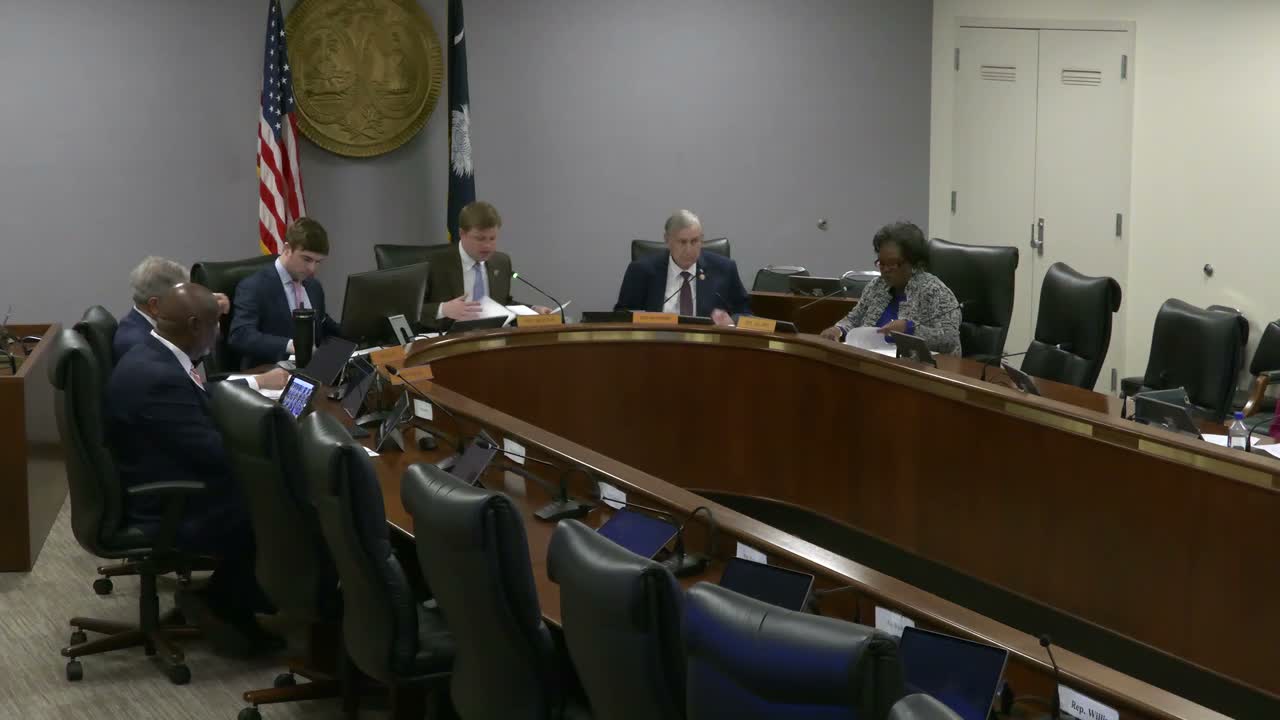
The Economic Development Subcommittee took testimony on House Bill 3832, a film tax credit proposal that drew support from industry groups and tourism partners and opposition from a taxpayer-advocacy group. Chairman Newton said the subcommittee would not vote on the bill at the meeting and instead took testimony from commission staff, local partners and industry representatives.
Dan Rogers of the South Carolina Film Commission told the committee the state has used targeted incentives since 2005 to recruit productions, argued the program produces net new dollars for local communities and stressed global competition for projects. "For every dollar the state gives away, 4 new dollars are brought into the community that they shoot," Rogers said, describing the program’s audited return-on-investment claim. He also noted the program’s modest size relative to some neighboring states and said the program—now a cash rebate model—has helped recruit about 66 major productions since incentives began.
Local tourism and community partners described on-the-ground impacts. Kayla McDonald of Visit Myrtle Beach said a $14,000,000 feature currently shooting in Myrtle Beach generated more than 1,100 hotel room nights in the shoulder season and that productions typically remain in a community six to eight weeks. Dr. Gail Whitson Awan of the Urban League of the Upstate described workforce-development partnerships and a Studio 922 hub that trains below-the-line workers, while Linda Lee of the Carolina Film Alliance said the organization represents about 981 industry workers and roughly 333 vendors statewide whose businesses benefit from production.
Opposition testimony came from Candice Carroll of Americans for Prosperity, who argued that targeted tax incentives "pick winners and losers," introduce subjectivity into tax administration and shift costs to taxpayers. Members pressed staff on the bill’s fiscal tradeoffs: Representative Whitmire asked whether changes would reduce the general fund by about $12,000,000, and Rogers acknowledged that some revenue components (sales/use exemptions and admissions tax allocations) would be restructured under the bill’s design.
Committee members also asked about eligibility for smaller projects; Rogers said a proviso passed last July allows smaller productions to qualify in a $250,000-to-just-under-$1,000,000 tier, which may help documentaries and other lower-budget projects.
After receiving testimony from the film commission, tourism partners, workforce groups and both industry and taxpayer advocates, the subcommittee voted to adjourn debate on HB 3832 so members and stakeholders could review proposed amendments and fiscal details before a future meeting.
Dan Rogers of the South Carolina Film Commission told the committee the state has used targeted incentives since 2005 to recruit productions, argued the program produces net new dollars for local communities and stressed global competition for projects. "For every dollar the state gives away, 4 new dollars are brought into the community that they shoot," Rogers said, describing the program’s audited return-on-investment claim. He also noted the program’s modest size relative to some neighboring states and said the program—now a cash rebate model—has helped recruit about 66 major productions since incentives began.
Local tourism and community partners described on-the-ground impacts. Kayla McDonald of Visit Myrtle Beach said a $14,000,000 feature currently shooting in Myrtle Beach generated more than 1,100 hotel room nights in the shoulder season and that productions typically remain in a community six to eight weeks. Dr. Gail Whitson Awan of the Urban League of the Upstate described workforce-development partnerships and a Studio 922 hub that trains below-the-line workers, while Linda Lee of the Carolina Film Alliance said the organization represents about 981 industry workers and roughly 333 vendors statewide whose businesses benefit from production.
Opposition testimony came from Candice Carroll of Americans for Prosperity, who argued that targeted tax incentives "pick winners and losers," introduce subjectivity into tax administration and shift costs to taxpayers. Members pressed staff on the bill’s fiscal tradeoffs: Representative Whitmire asked whether changes would reduce the general fund by about $12,000,000, and Rogers acknowledged that some revenue components (sales/use exemptions and admissions tax allocations) would be restructured under the bill’s design.
Committee members also asked about eligibility for smaller projects; Rogers said a proviso passed last July allows smaller productions to qualify in a $250,000-to-just-under-$1,000,000 tier, which may help documentaries and other lower-budget projects.
After receiving testimony from the film commission, tourism partners, workforce groups and both industry and taxpayer advocates, the subcommittee voted to adjourn debate on HB 3832 so members and stakeholders could review proposed amendments and fiscal details before a future meeting.
View the Full Meeting & All Its Details
This article offers just a summary. Unlock complete video, transcripts, and insights as a Founder Member.
✓
Watch full, unedited meeting videos
✓
Search every word spoken in unlimited transcripts
✓
AI summaries & real-time alerts (all government levels)
✓
Permanent access to expanding government content
30-day money-back guarantee
