Professionals and utilities urge carve-outs from South Carolina’s proposed regulatory overhaul
March 19, 2026 | 2026 Legislative Meetings, South Carolina
This article was created by AI summarizing key points discussed. AI makes mistakes, so for full details and context, please refer to the video of the full meeting. Please report any errors so we can fix them. Report an error »
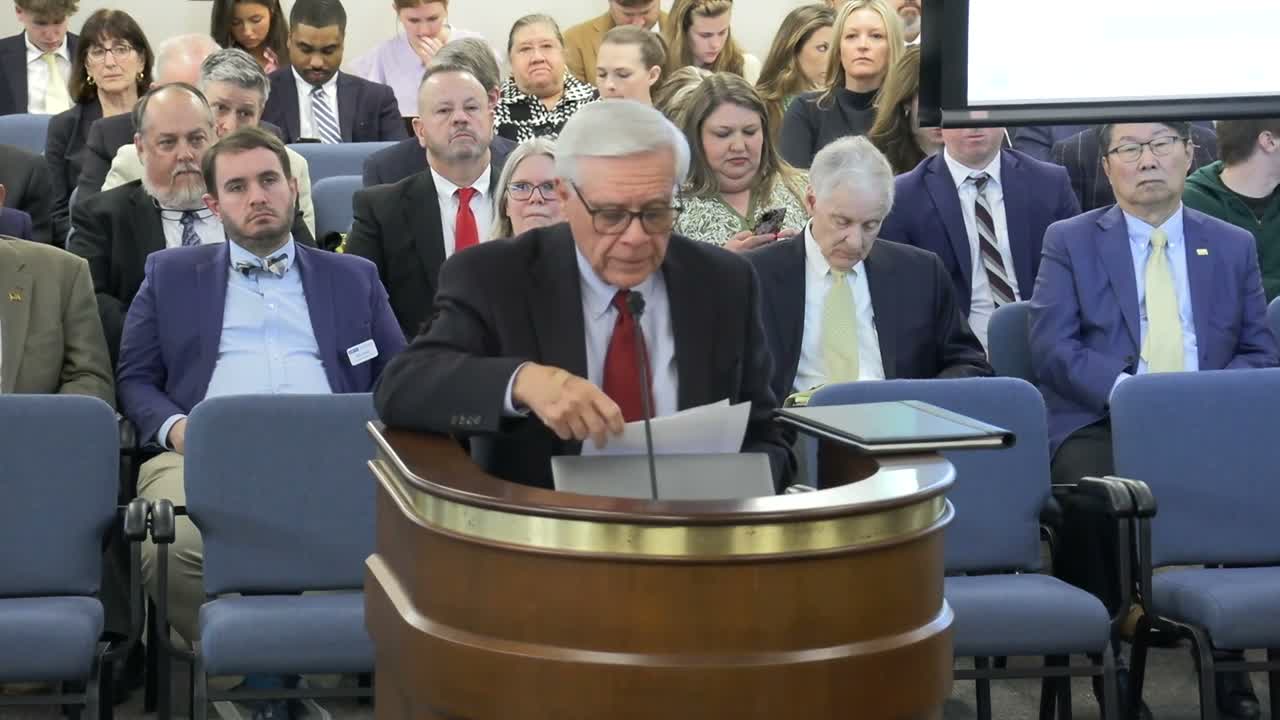
A Senate subcommittee heard more than three hours of testimony from licensed professionals and regulated utilities who urged lawmakers to exempt certain occupations from Senate Bill 254, the Small Business Regulatory Freedom Act, or to rewrite provisions they say would undermine public-safety standards.
Ken Whitener, a CPA licensed in South Carolina who said he is chair of the State Board of Accountancy but spoke in his individual capacity, said he was "concerned about reduced standards" under the bill. Whitener told the panel the bill’s provisions — cited in testimony as a 25% reduction target and a requirement that for every new regulation adopted two must be removed — could eliminate continuing-education, quality-control and peer-review requirements that maintain public trust in the CPA title. "I humbly request consideration for an amendment to this bill to exempt and carve out regulations regarded to accountancy from the provisions," Whitener said.
Engineers and surveyors argued the stakes go beyond professional convenience. Gene Dinkins, who identified himself as chairman of the Board of Registration for Professional Engineers and Surveyors but said he was testifying as an individual professional, said engineering and surveying rules protect "the health, safety, and welfare of the public" and warned that the bill would "significantly reduce the protections" those regulations provide. "When our licensees make a mistake, it can have tragic consequences for many, many people, not 1 at a time," Dinkins said.
Other witnesses with engineering and surveying credentials pressed the same point in technical terms: Peter Strube said the bill would require explicit statutory authority for every regulation the board adopts, impose a 2-for-1 review that could force elimination of safeguards, create automatic seven-year expirations that risk regulatory gaps, and remove judicial deference to agency expertise. "This legislation would require explicit statutory authority for every regulation adopted by the Board, limiting its ability to update standards as technologies and professional practices evolve," Strube said.
Some committee members attempted to clarify the reach of SB254. One lawmaker told witnesses the 2-for-1 language requires review of two regulations, not an automatic axing of rules, saying, "It says you gotta review 2 regulations. It's not an automatic ax." That exchange underscored a central point of contention: opponents fear the bill’s mechanics and timelines could create sudden gaps in rules designed to ensure public safety; supporters say the bill establishes review and accountability, not immediate repeal.
Representatives of large regulated entities also sought carve-outs on the grounds of regulatory certainty. Tiger Wells, vice president of government affairs for Duke Energy in South Carolina, asked that regulations subject to the Public Service Commission be excluded from the bill’s automatic-sunset provisions because those rules already undergo a five-year review and involve stakeholder processes. "We would ask that we be carved out or that there be an exemption, for PSC regulations that are already subject to a 5 year review, from the automatic sunset that currently appears in sections 3 and section 5 of this bill," Wells said.
Other witnesses — including a member of the South Carolina Real Estate Commission and representatives of behavioral-health coalitions — echoed concerns about the 2-for-1 requirement and the seven-year expiration. Andy Lee of the Real Estate Commission said the 2-for-1 approach is unrealistic for some regulatory programs and would force frequent statutory fixes; Dr. Michelle Cook of the South Carolina Psychological Association reiterated coalition opposition already on file.
Across the panel, several witnesses recommended either explicit carve-outs for professional practice boards and certain regulated industries or substitution of narrower language: improve review timelines and grace periods for reauthorization rather than a blunt automatic expiration; clarify that the bill requires review rather than immediate removal of existing protections; and preserve judicial deference for technical expertise where safety is at stake.
The transcript does not record a formal vote or a committee decision at the conclusion of the hearing; the subcommittee heard testimony and questions and did not announce action on SB254 during the recorded proceedings.
Ken Whitener, a CPA licensed in South Carolina who said he is chair of the State Board of Accountancy but spoke in his individual capacity, said he was "concerned about reduced standards" under the bill. Whitener told the panel the bill’s provisions — cited in testimony as a 25% reduction target and a requirement that for every new regulation adopted two must be removed — could eliminate continuing-education, quality-control and peer-review requirements that maintain public trust in the CPA title. "I humbly request consideration for an amendment to this bill to exempt and carve out regulations regarded to accountancy from the provisions," Whitener said.
Engineers and surveyors argued the stakes go beyond professional convenience. Gene Dinkins, who identified himself as chairman of the Board of Registration for Professional Engineers and Surveyors but said he was testifying as an individual professional, said engineering and surveying rules protect "the health, safety, and welfare of the public" and warned that the bill would "significantly reduce the protections" those regulations provide. "When our licensees make a mistake, it can have tragic consequences for many, many people, not 1 at a time," Dinkins said.
Other witnesses with engineering and surveying credentials pressed the same point in technical terms: Peter Strube said the bill would require explicit statutory authority for every regulation the board adopts, impose a 2-for-1 review that could force elimination of safeguards, create automatic seven-year expirations that risk regulatory gaps, and remove judicial deference to agency expertise. "This legislation would require explicit statutory authority for every regulation adopted by the Board, limiting its ability to update standards as technologies and professional practices evolve," Strube said.
Some committee members attempted to clarify the reach of SB254. One lawmaker told witnesses the 2-for-1 language requires review of two regulations, not an automatic axing of rules, saying, "It says you gotta review 2 regulations. It's not an automatic ax." That exchange underscored a central point of contention: opponents fear the bill’s mechanics and timelines could create sudden gaps in rules designed to ensure public safety; supporters say the bill establishes review and accountability, not immediate repeal.
Representatives of large regulated entities also sought carve-outs on the grounds of regulatory certainty. Tiger Wells, vice president of government affairs for Duke Energy in South Carolina, asked that regulations subject to the Public Service Commission be excluded from the bill’s automatic-sunset provisions because those rules already undergo a five-year review and involve stakeholder processes. "We would ask that we be carved out or that there be an exemption, for PSC regulations that are already subject to a 5 year review, from the automatic sunset that currently appears in sections 3 and section 5 of this bill," Wells said.
Other witnesses — including a member of the South Carolina Real Estate Commission and representatives of behavioral-health coalitions — echoed concerns about the 2-for-1 requirement and the seven-year expiration. Andy Lee of the Real Estate Commission said the 2-for-1 approach is unrealistic for some regulatory programs and would force frequent statutory fixes; Dr. Michelle Cook of the South Carolina Psychological Association reiterated coalition opposition already on file.
Across the panel, several witnesses recommended either explicit carve-outs for professional practice boards and certain regulated industries or substitution of narrower language: improve review timelines and grace periods for reauthorization rather than a blunt automatic expiration; clarify that the bill requires review rather than immediate removal of existing protections; and preserve judicial deference for technical expertise where safety is at stake.
The transcript does not record a formal vote or a committee decision at the conclusion of the hearing; the subcommittee heard testimony and questions and did not announce action on SB254 during the recorded proceedings.
View the Full Meeting & All Its Details
This article offers just a summary. Unlock complete video, transcripts, and insights as a Founder Member.
✓
Watch full, unedited meeting videos
✓
Search every word spoken in unlimited transcripts
✓
AI summaries & real-time alerts (all government levels)
✓
Permanent access to expanding government content
30-day money-back guarantee
