Alaska committee hears broad PFAS bill after residents and scientists warn of 'forever chemicals' in drinking water
March 24, 2026 | 2026 Legislature Alaska, Alaska
This article was created by AI summarizing key points discussed. AI makes mistakes, so for full details and context, please refer to the video of the full meeting. Please report any errors so we can fix them. Report an error »
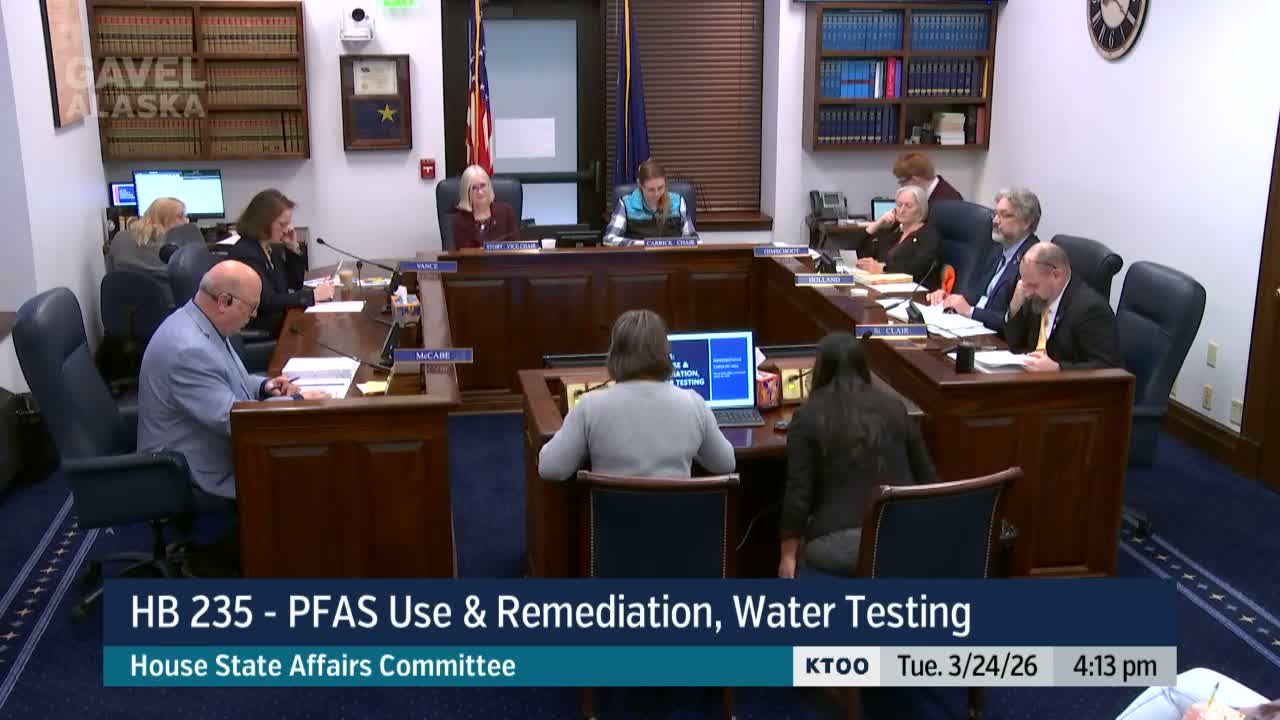
Representative Carolyn Hall introduced HB 235 on March 24, 2026, describing PFAS as persistent ‘‘forever chemicals’’ linked to cancer, endocrine effects and other harms and saying the bill would conform Alaska statute to the U.S. Environmental Protection Agency’s 2024 national primary drinking water regulation.
The bill would amend AS 46.03 to require the Alaska Department of Environmental Conservation to test public water systems at least annually for six listed PFAS (with authority for DEC to add others), require immediate provision of safe drinking water where levels exceed health-based limits, clarify liability for costs of testing and replacement water, provide for retroactive liability for releases, and create permitting standards for facilities that use thermal remediation.
Why it matters: invited testifiers and residents said Alaska’s current guidelines are outdated and unenforceable and described community exposure and health concerns. Pamela Miller, executive director and senior scientist at Alaska Community Action on Toxics, told the committee Alaska uses guideline levels she called ‘‘set much too high’’ and urged statutory standards that are enforceable. Britney Robbins described chronic illnesses in her family she linked to PFAS exposures and said the issue is personal and urgent.
Industry and technical voices urged caution on the bill’s drafting. Owen Jaffin, director of chemical products and technology at the American Chemistry Council, recommended that Alaska reference the EPA’s MCLs rather than enumerating compounds in statute so state rules remain aligned if EPA revises its approach. He said incorporating federal MCLs by reference would avoid a patchwork of state rules.
Committee members pressed technical and fiscal questions. Representative Holland asked whether the bill’s thermal remediation permitting covers technologies that merely concentrate PFAS versus those that destroy them; staff replied the permit is intended to cover thermal remediation broadly but a permit could be denied or revoked if processes re-release PFAS into the air. Miller warned that incineration and some thermal approaches can leave PFAS in residues and pose inhalation risks; she recommended non-combustion technologies such as supercritical water oxidation when destruction is necessary.
Alaska Department of Environmental Conservation Deputy Commissioner Crystal Keeneman described implementation realities: DEC has used federal grant funding to sample 366 of Alaska’s roughly 612 public water systems and found exceedances at a small share (she cited about 3% exceeding the PFOA/PFOS 4 parts-per-trillion federal MCL). She said DEC has lab capacity and existing permit oversight, but that the bill’s statewide testing mandate would substantially increase operational, staffing and laboratory needs and carry significant fiscal costs. Keeneman estimated the cost of providing alternate drinking water at roughly $700 per person per year depending on community size and noted challenges identifying responsible parties for older releases.
Committee members asked for language to address emergencies and faster responses (for example, fast-tracking cisterns in communities such as Gustavus), clarification on who pays cleanup costs and whether the liability provisions would extend to manufacturers. Representative Hall said she was open to amendments to add emergency-response language and acknowledged the bill would carry significant fiscal implications but said the legislature must start addressing PFAS contamination.
What’s next: the committee took invited and public testimony and deferred further committee action; Chair Kerrick said HB 235 will return at the next legislation hearing for more detailed deliberation and potential amendments.
Speakers quoted: Pamela Miller, executive director and senior scientist, Alaska Community Action on Toxics; Britney Robbins, civic engagement coordinator (testifying on her own behalf); Owen Jaffin, director of chemical products and technology, American Chemistry Council; Deputy Commissioner Crystal Keeneman, Alaska Department of Environmental Conservation.
Ending: The committee adjourned after scheduling a follow-up on HB 235 at the next legislative hearing; members asked the sponsor and DEC to provide fiscal and implementation detail for planning possible amendments.
The bill would amend AS 46.03 to require the Alaska Department of Environmental Conservation to test public water systems at least annually for six listed PFAS (with authority for DEC to add others), require immediate provision of safe drinking water where levels exceed health-based limits, clarify liability for costs of testing and replacement water, provide for retroactive liability for releases, and create permitting standards for facilities that use thermal remediation.
Why it matters: invited testifiers and residents said Alaska’s current guidelines are outdated and unenforceable and described community exposure and health concerns. Pamela Miller, executive director and senior scientist at Alaska Community Action on Toxics, told the committee Alaska uses guideline levels she called ‘‘set much too high’’ and urged statutory standards that are enforceable. Britney Robbins described chronic illnesses in her family she linked to PFAS exposures and said the issue is personal and urgent.
Industry and technical voices urged caution on the bill’s drafting. Owen Jaffin, director of chemical products and technology at the American Chemistry Council, recommended that Alaska reference the EPA’s MCLs rather than enumerating compounds in statute so state rules remain aligned if EPA revises its approach. He said incorporating federal MCLs by reference would avoid a patchwork of state rules.
Committee members pressed technical and fiscal questions. Representative Holland asked whether the bill’s thermal remediation permitting covers technologies that merely concentrate PFAS versus those that destroy them; staff replied the permit is intended to cover thermal remediation broadly but a permit could be denied or revoked if processes re-release PFAS into the air. Miller warned that incineration and some thermal approaches can leave PFAS in residues and pose inhalation risks; she recommended non-combustion technologies such as supercritical water oxidation when destruction is necessary.
Alaska Department of Environmental Conservation Deputy Commissioner Crystal Keeneman described implementation realities: DEC has used federal grant funding to sample 366 of Alaska’s roughly 612 public water systems and found exceedances at a small share (she cited about 3% exceeding the PFOA/PFOS 4 parts-per-trillion federal MCL). She said DEC has lab capacity and existing permit oversight, but that the bill’s statewide testing mandate would substantially increase operational, staffing and laboratory needs and carry significant fiscal costs. Keeneman estimated the cost of providing alternate drinking water at roughly $700 per person per year depending on community size and noted challenges identifying responsible parties for older releases.
Committee members asked for language to address emergencies and faster responses (for example, fast-tracking cisterns in communities such as Gustavus), clarification on who pays cleanup costs and whether the liability provisions would extend to manufacturers. Representative Hall said she was open to amendments to add emergency-response language and acknowledged the bill would carry significant fiscal implications but said the legislature must start addressing PFAS contamination.
What’s next: the committee took invited and public testimony and deferred further committee action; Chair Kerrick said HB 235 will return at the next legislation hearing for more detailed deliberation and potential amendments.
Speakers quoted: Pamela Miller, executive director and senior scientist, Alaska Community Action on Toxics; Britney Robbins, civic engagement coordinator (testifying on her own behalf); Owen Jaffin, director of chemical products and technology, American Chemistry Council; Deputy Commissioner Crystal Keeneman, Alaska Department of Environmental Conservation.
Ending: The committee adjourned after scheduling a follow-up on HB 235 at the next legislative hearing; members asked the sponsor and DEC to provide fiscal and implementation detail for planning possible amendments.
Don't Miss a Word: See the Full Meeting!
Go beyond summaries. Unlock every video, transcript, and key insight with a Founder Membership.
✓
Get instant access to full meeting videos
✓
Search and clip any phrase from complete transcripts
✓
Receive AI-powered summaries & custom alerts
✓
Enjoy lifetime, unrestricted access to government data
30-day money-back guarantee
