Subcommittee adopts amendment and advances South Carolina drone bill to the House floor
March 25, 2026 | 2026 Legislative Meetings, South Carolina
This article was created by AI summarizing key points discussed. AI makes mistakes, so for full details and context, please refer to the video of the full meeting. Please report any errors so we can fix them. Report an error »
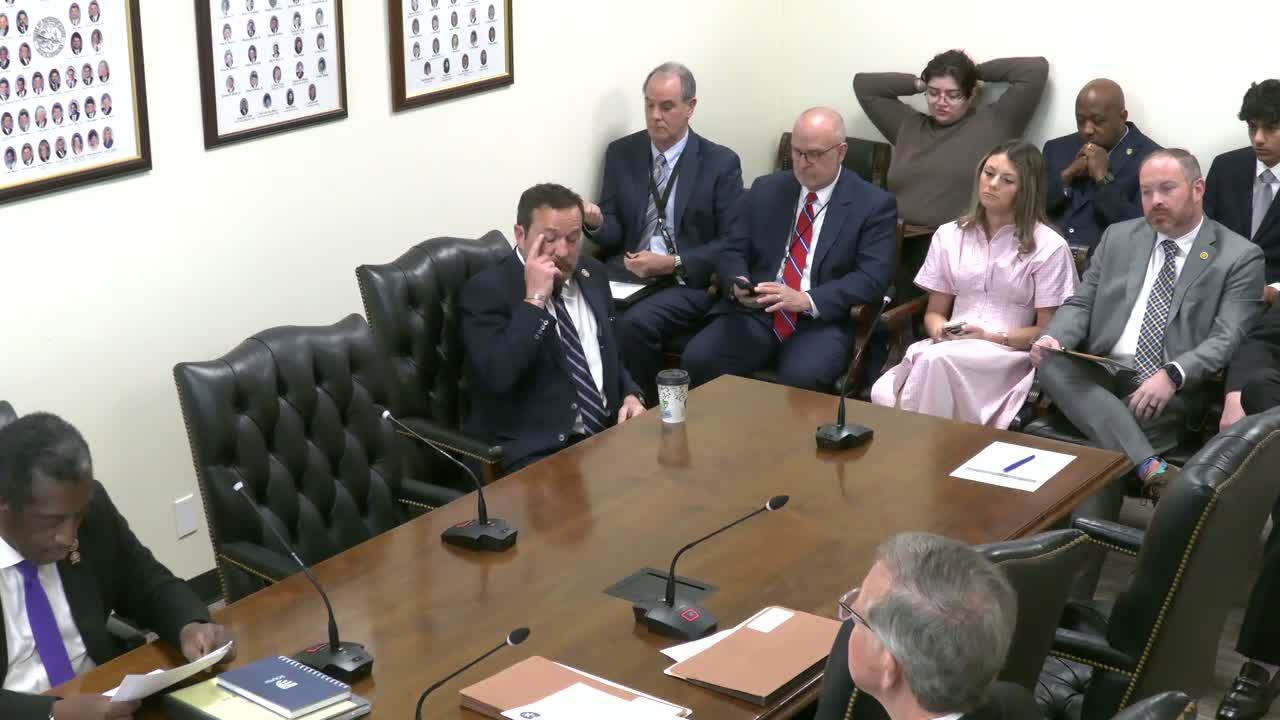
The artificial intelligence, cybersecurity special law subcommittee advanced House Bill 4679 on a favorable report after adopting a substantial clarifying amendment.
The bill, described to the panel as a statewide drone regulation and public-safety act, would define commercial and recreational operators, identify protected facilities, require compliance with applicable Federal Aviation Administration rules, and create criminal prohibitions and penalties for certain drone conduct. The chair summarized the measure as creating prohibited acts (for example, operating a drone within five miles of an airport without FAA authorization, within 1,000 feet of certain critical infrastructure without express consent, and within 1,500 feet of correctional or military installations), adding privacy protections against surveilling people where they have a reasonable expectation of privacy, and setting misdemeanor and felony penalties for escalating conduct.
Why it matters: witnesses and lawmakers said current federal enforcement is largely civil and that state law lacks criminal penalties for many harmful drone uses. Aubrey Richardson, a lieutenant with the South Carolina Law Enforcement Division, told the subcommittee the bill fills enforcement gaps, citing contraband drops into correctional facilities (narcotics and phones), a near-miss involving a law-enforcement helicopter at a large public event, and an apparently thwarted attempted IED delivery. “There’s nothing criminal…there’s no criminal actions associated with drone flight in South Carolina,” Richardson said, arguing that higher criminal penalties and confiscation authority are needed to address emerging threats.
Stakeholder input and amendment: Bailey Vincent, representing the Charleston Metro Chamber of Commerce and Joint Base Charleston interests, said the measure had been a working-group priority and thanked lawmakers for collaborative drafting. The subcommittee then considered and adopted a so-called Moore amendment intended to harmonize overlapping location restrictions, add clearer definitions for military installation and restricted airspace, add mens rea requirements, standardize buffer distances, strengthen confiscation and due-process language, protect agency drone operations conducted in compliance with FAA rules, and repeal conflicting Title 24 provisions governing drone activity near detention facilities.
Privacy and scope: members asked how the bill would distinguish incidental overflights (for example, an agency forestry drone) from intentional harassment or surveillance. One member cautioned that broadly phrased privacy language could prompt excessive calls to law enforcement if any overflight were deemed a violation; several members suggested the statute needs clearer intent elements or time-on-station thresholds. The chair said staff would refine the language before full committee consideration.
Vote and next steps: after the amendment was adopted the subcommittee advanced House Bill 4679 as amended and issued a favorable report to the House floor. The chair announced the recorded result as four in favor, zero against, and one not voting. The committee thanked witnesses and adjourned; the bill will proceed to the House calendar for further action.
Details to note: the measure expressly states it does not supersede federal airspace authority and includes exemptions for law enforcement, emergency responders, certain state research and agricultural operations with permits, and FAA-authorized commercial operations. The Moore amendment adds explicit protections for large live events (defined in the amendment as 15,000 or more people) and clarifies which subsections constitute separate offenses when multiple violations arise from the same operation.
The subcommittee’s hearing transcript shows stakeholders and law enforcement urging a statewide criminal framework to address weaponization, contraband drops, privacy intrusion, and threats to critical infrastructure and public-safety operations. The committee will consider additional technical edits before full committee action on the floor.
The bill, described to the panel as a statewide drone regulation and public-safety act, would define commercial and recreational operators, identify protected facilities, require compliance with applicable Federal Aviation Administration rules, and create criminal prohibitions and penalties for certain drone conduct. The chair summarized the measure as creating prohibited acts (for example, operating a drone within five miles of an airport without FAA authorization, within 1,000 feet of certain critical infrastructure without express consent, and within 1,500 feet of correctional or military installations), adding privacy protections against surveilling people where they have a reasonable expectation of privacy, and setting misdemeanor and felony penalties for escalating conduct.
Why it matters: witnesses and lawmakers said current federal enforcement is largely civil and that state law lacks criminal penalties for many harmful drone uses. Aubrey Richardson, a lieutenant with the South Carolina Law Enforcement Division, told the subcommittee the bill fills enforcement gaps, citing contraband drops into correctional facilities (narcotics and phones), a near-miss involving a law-enforcement helicopter at a large public event, and an apparently thwarted attempted IED delivery. “There’s nothing criminal…there’s no criminal actions associated with drone flight in South Carolina,” Richardson said, arguing that higher criminal penalties and confiscation authority are needed to address emerging threats.
Stakeholder input and amendment: Bailey Vincent, representing the Charleston Metro Chamber of Commerce and Joint Base Charleston interests, said the measure had been a working-group priority and thanked lawmakers for collaborative drafting. The subcommittee then considered and adopted a so-called Moore amendment intended to harmonize overlapping location restrictions, add clearer definitions for military installation and restricted airspace, add mens rea requirements, standardize buffer distances, strengthen confiscation and due-process language, protect agency drone operations conducted in compliance with FAA rules, and repeal conflicting Title 24 provisions governing drone activity near detention facilities.
Privacy and scope: members asked how the bill would distinguish incidental overflights (for example, an agency forestry drone) from intentional harassment or surveillance. One member cautioned that broadly phrased privacy language could prompt excessive calls to law enforcement if any overflight were deemed a violation; several members suggested the statute needs clearer intent elements or time-on-station thresholds. The chair said staff would refine the language before full committee consideration.
Vote and next steps: after the amendment was adopted the subcommittee advanced House Bill 4679 as amended and issued a favorable report to the House floor. The chair announced the recorded result as four in favor, zero against, and one not voting. The committee thanked witnesses and adjourned; the bill will proceed to the House calendar for further action.
Details to note: the measure expressly states it does not supersede federal airspace authority and includes exemptions for law enforcement, emergency responders, certain state research and agricultural operations with permits, and FAA-authorized commercial operations. The Moore amendment adds explicit protections for large live events (defined in the amendment as 15,000 or more people) and clarifies which subsections constitute separate offenses when multiple violations arise from the same operation.
The subcommittee’s hearing transcript shows stakeholders and law enforcement urging a statewide criminal framework to address weaponization, contraband drops, privacy intrusion, and threats to critical infrastructure and public-safety operations. The committee will consider additional technical edits before full committee action on the floor.
View the Full Meeting & All Its Details
This article offers just a summary. Unlock complete video, transcripts, and insights as a Founder Member.
✓
Watch full, unedited meeting videos
✓
Search every word spoken in unlimited transcripts
✓
AI summaries & real-time alerts (all government levels)
✓
Permanent access to expanding government content
30-day money-back guarantee
