RFA urges simpler school‑funding formula: separate capital and technology weights from teacher pay
March 25, 2026 | 2026 Legislative Meetings, South Carolina
This article was created by AI summarizing key points discussed. AI makes mistakes, so for full details and context, please refer to the video of the full meeting. Please report any errors so we can fix them. Report an error »
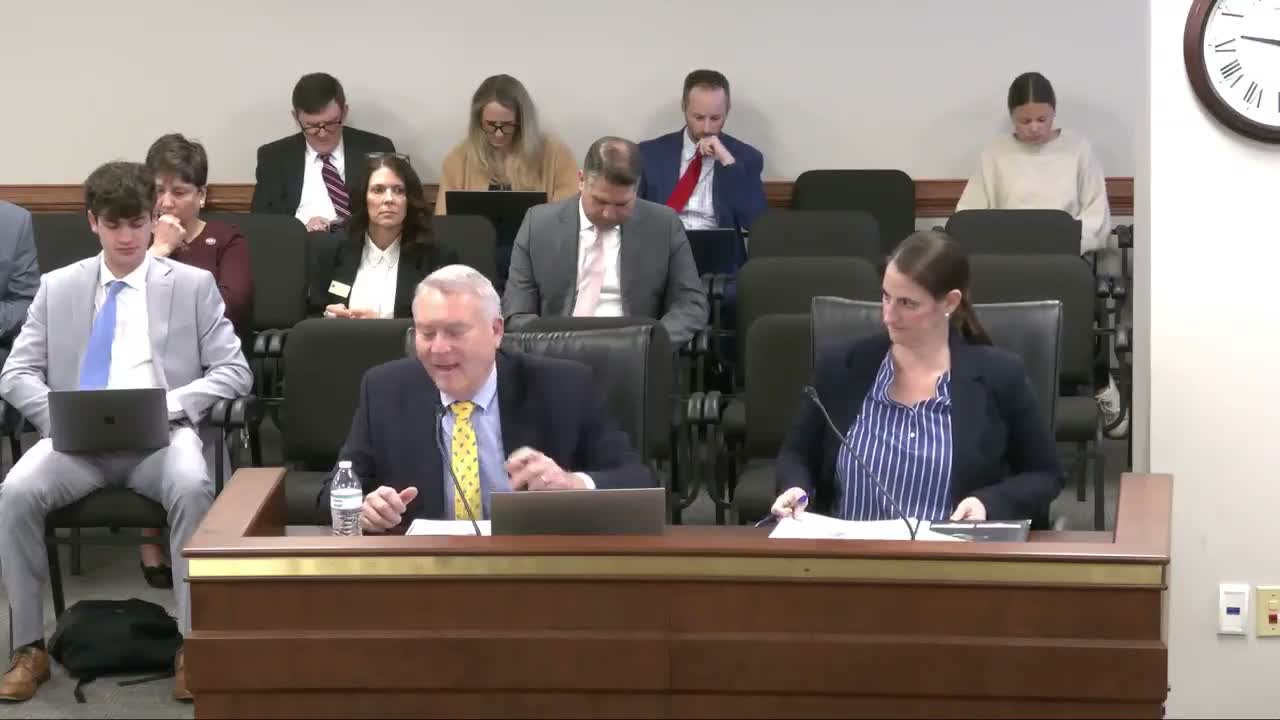
Frank, presenting for the Research and Fiscal Analysis office (RFA), told the subcommittee that RFA’s review of the state’s school‑funding formula found data irregularities and structural problems that complicate equitable allocations.
RFA noted two core challenges: district‑reported data errors that affect allocations, and a blurred line between state objectives and local preferences. Frank said the basic classroom funding approach multiplies estimated teacher positions (students divided by 11.2) by an average teacher cost; RFA cited an average total teacher cost for FY25 of about $75,000.
Key recommendations included routing more funding directly through the formula to maximize property‑tax equity, incorporating health insurance into proportional funding calculations, and reducing the number of small weights that create reporting burdens and potential errors. Frank said roughly 9% of current funding bypasses the formula and estimated that amount at “about $300,000,000…3 to 4 close to $400,000,000 in total,” a figure he offered as an order‑of‑magnitude estimate that will require district‑by‑district review.
RFA recommended separating charter facility (brick‑and‑mortar and virtual) weights and career and technical education (CTE) technology funding from the main salary calculation. Frank argued that the charter facility and CTE weights include capital and equipment elements that should be funded as distinct components so they do not reduce the pool available for teacher salaries in other districts. He noted that charter per‑student facility allotments rose from about $3,915 in 2022 to $4,372 in recent calculations.
Other recommendations included allocating funding based on prior‑year student counts so districts have certainty at budget adoption, allowing a narrow carve‑out for very fast‑growing charter districts, and updating and limiting hold‑harmless provisions so they do not undermine taxpayer equity.
Committee members asked for more district‑level detail and for RFA to provide precise calculations for fringe and total taxpayer cost per teacher; Frank said RFA would follow up with calculations and appendices containing district breakdowns. No formal action was taken; members signaled they will examine the report in more detail as the budget process proceeds.
RFA noted two core challenges: district‑reported data errors that affect allocations, and a blurred line between state objectives and local preferences. Frank said the basic classroom funding approach multiplies estimated teacher positions (students divided by 11.2) by an average teacher cost; RFA cited an average total teacher cost for FY25 of about $75,000.
Key recommendations included routing more funding directly through the formula to maximize property‑tax equity, incorporating health insurance into proportional funding calculations, and reducing the number of small weights that create reporting burdens and potential errors. Frank said roughly 9% of current funding bypasses the formula and estimated that amount at “about $300,000,000…3 to 4 close to $400,000,000 in total,” a figure he offered as an order‑of‑magnitude estimate that will require district‑by‑district review.
RFA recommended separating charter facility (brick‑and‑mortar and virtual) weights and career and technical education (CTE) technology funding from the main salary calculation. Frank argued that the charter facility and CTE weights include capital and equipment elements that should be funded as distinct components so they do not reduce the pool available for teacher salaries in other districts. He noted that charter per‑student facility allotments rose from about $3,915 in 2022 to $4,372 in recent calculations.
Other recommendations included allocating funding based on prior‑year student counts so districts have certainty at budget adoption, allowing a narrow carve‑out for very fast‑growing charter districts, and updating and limiting hold‑harmless provisions so they do not undermine taxpayer equity.
Committee members asked for more district‑level detail and for RFA to provide precise calculations for fringe and total taxpayer cost per teacher; Frank said RFA would follow up with calculations and appendices containing district breakdowns. No formal action was taken; members signaled they will examine the report in more detail as the budget process proceeds.
View the Full Meeting & All Its Details
This article offers just a summary. Unlock complete video, transcripts, and insights as a Founder Member.
✓
Watch full, unedited meeting videos
✓
Search every word spoken in unlimited transcripts
✓
AI summaries & real-time alerts (all government levels)
✓
Permanent access to expanding government content
30-day money-back guarantee
