Largo designates 8th Avenue Southeast as Brownfield after split vote over redevelopment
March 17, 2026 | Largo City, Pinellas County, Florida
This article was created by AI summarizing key points discussed. AI makes mistakes, so for full details and context, please refer to the video of the full meeting. Please report any errors so we can fix them. Report an error »
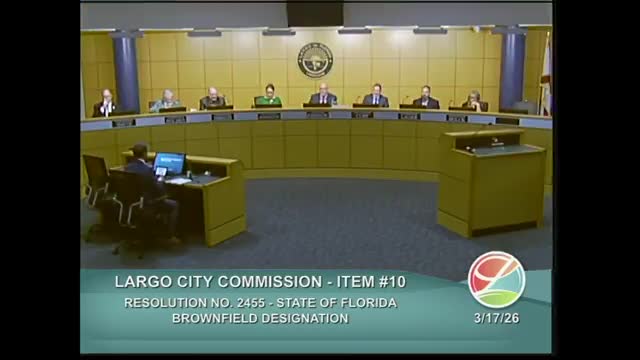
The Largo City Commission voted 4-2 on March 17 to designate an 8th Avenue Southeast parcel as a state Brownfield area, a move staff said unlocks state incentives for remediation but carries no direct local fiscal obligation.
Staff told the commission the site, preliminarily addressed as 605 Twinberry Lane and owned by IL Industrial Limited, has "limited soil and groundwater contamination" including metals and polycyclic aromatic hydrocarbons, and that designation would allow applicants to enter a Brownfield Site Rehabilitation Agreement with the state and pursue voluntary cleanup tax credits. "This designation is consistent with the city's comprehensive plan, strategic plan 2030," staff said during the presentation.
The proposal prompted detailed questioning from commissioners about testing, neighborhood impacts and whether designation would change the project's density. Commissioners and residents tied the Brownfield discussion to a separate, proposed 168-unit multi-family project brought forward under the Live Local Act. Staff repeatedly said the Brownfield designation is an environmental overlay separate from site plan or traffic analyses: it "has no bearing on the project" and does not grant extra density, they said, while noting cleanup and monitoring requirements could be more robust with the designation.
Josh Coldiron, an environmental attorney for the applicant, explained how the state program functions and the financial mechanics of tax credits, saying the tax-credit mechanism is intended to incentive cleanup: "The money that comes back from that is a 50% tax credit," he told commissioners.
Commissioner Smith asked for specifics about prior brownfields and state tax credits: "So, of the 8 previous, approved brownfields, how many of those have been awarded tax credits from the state?" Staff said they did not have that full list on hand and will provide details later.
Opponents and skeptical commissioners raised traffic, flooding and neighborhood concerns tied to the nearby Live Local project; staff referenced a traffic impact analysis and reiterated that project approvals and any traffic remedies would be handled through separate planning and development-review processes.
The commission approved Resolution No. 24-55 designating the area as a Brownfield by roll-call vote (Yes: Commissioner Holmes, Vice Mayor Johnson, Commissioner Lausser, Commissioner Hult; No: Commissioner Smith, Commissioner DeBriese). The resolution states the designation is for environmental remediation and rehabilitation and that it "shall not obligate the city to pay any costs except those attributed to the city's involvement as administrator of the Brownfield area remediation and rehabilitation program."
Staff said state oversight would guide any on-site remediation, including required monitoring and inspection by FDEP if the site proceeds into a Brownfield Site Rehabilitation Agreement. Commissioners and staff agreed to provide a follow-up on which prior local brownfields received state tax credits and further details about remediation timelines.
Staff told the commission the site, preliminarily addressed as 605 Twinberry Lane and owned by IL Industrial Limited, has "limited soil and groundwater contamination" including metals and polycyclic aromatic hydrocarbons, and that designation would allow applicants to enter a Brownfield Site Rehabilitation Agreement with the state and pursue voluntary cleanup tax credits. "This designation is consistent with the city's comprehensive plan, strategic plan 2030," staff said during the presentation.
The proposal prompted detailed questioning from commissioners about testing, neighborhood impacts and whether designation would change the project's density. Commissioners and residents tied the Brownfield discussion to a separate, proposed 168-unit multi-family project brought forward under the Live Local Act. Staff repeatedly said the Brownfield designation is an environmental overlay separate from site plan or traffic analyses: it "has no bearing on the project" and does not grant extra density, they said, while noting cleanup and monitoring requirements could be more robust with the designation.
Josh Coldiron, an environmental attorney for the applicant, explained how the state program functions and the financial mechanics of tax credits, saying the tax-credit mechanism is intended to incentive cleanup: "The money that comes back from that is a 50% tax credit," he told commissioners.
Commissioner Smith asked for specifics about prior brownfields and state tax credits: "So, of the 8 previous, approved brownfields, how many of those have been awarded tax credits from the state?" Staff said they did not have that full list on hand and will provide details later.
Opponents and skeptical commissioners raised traffic, flooding and neighborhood concerns tied to the nearby Live Local project; staff referenced a traffic impact analysis and reiterated that project approvals and any traffic remedies would be handled through separate planning and development-review processes.
The commission approved Resolution No. 24-55 designating the area as a Brownfield by roll-call vote (Yes: Commissioner Holmes, Vice Mayor Johnson, Commissioner Lausser, Commissioner Hult; No: Commissioner Smith, Commissioner DeBriese). The resolution states the designation is for environmental remediation and rehabilitation and that it "shall not obligate the city to pay any costs except those attributed to the city's involvement as administrator of the Brownfield area remediation and rehabilitation program."
Staff said state oversight would guide any on-site remediation, including required monitoring and inspection by FDEP if the site proceeds into a Brownfield Site Rehabilitation Agreement. Commissioners and staff agreed to provide a follow-up on which prior local brownfields received state tax credits and further details about remediation timelines.
View the Full Meeting & All Its Details
This article offers just a summary. Unlock complete video, transcripts, and insights as a Founder Member.
✓
Watch full, unedited meeting videos
✓
Search every word spoken in unlimited transcripts
✓
AI summaries & real-time alerts (all government levels)
✓
Permanent access to expanding government content
30-day money-back guarantee
