Panel debates family-fee changes, attendance rules and prospective-pay costs; backs $11.5M wildfire recovery grants
March 24, 2026 | California State Assembly, House, Legislative, California
This article was created by AI summarizing key points discussed. AI makes mistakes, so for full details and context, please refer to the video of the full meeting. Please report any errors so we can fix them. Report an error »
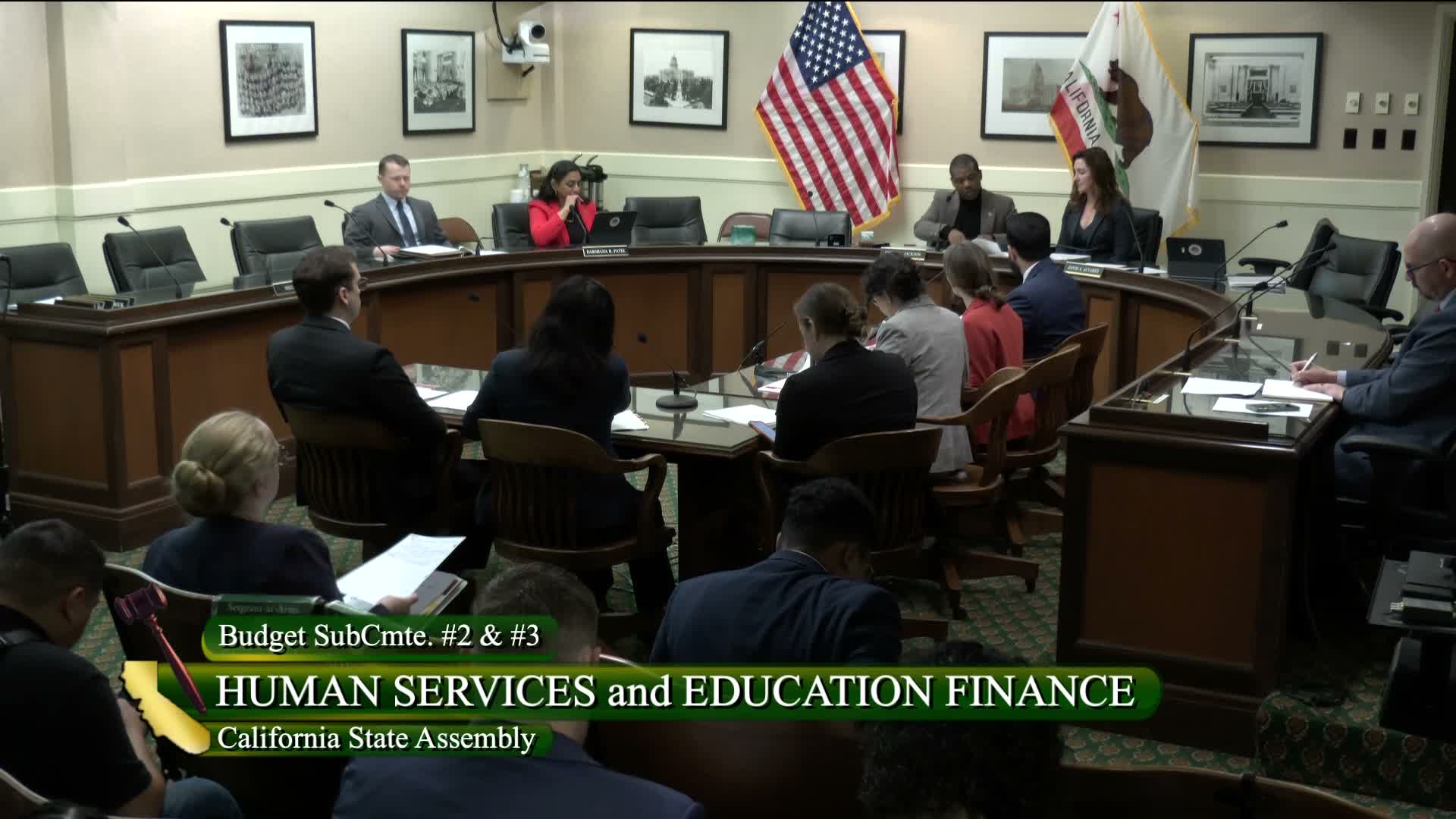
Department of Finance and agency witnesses reviewed several trailer‑bill proposals and related budget requests, and described an $11.5 million Proposition 64 grant to help childcare facilities impacted by 2025 state-declared disasters.
DOF outlined three trailer‑bill topics: codifying family‑fee deductions so contractors reimburse subsidized family childcare providers the full certificate amount without deducting family fees; defining 'excessive unexplained absences' (proposed 30 days in 12 months) to allow outreach and potential disenrollment; and expanding temporary‑absence flexibility so providers may be absent a defined percentage of time while ensuring substitute coverage. Chris Malhotra (DOF) said the family‑fee change is intended to align state practice with federal rules.
Lupe Jaime Milam (CDSS deputy director) said the abandonment‑of‑care guidance mirrors federal CCDF language and that a 30‑day threshold would trigger outreach rather than immediate disenrollment. "That doesn't trigger an automatic, in a sense, disenrollment. It triggers a conversation to find out what has happened," she said, adding the department will work with contractors to provide supports and resources.
On prospective pay, the LAO reviewed the federal rule history and noted a proposed federal change could remove the prospective‑pay requirement; LAO said not moving to prospective pay could save the state about $43,800,000 ongoing included in the governor's budget while implementation carries a substantial one‑time cost. CDSS and CDE said they have paused releasing prospective‑pay automation funds until federal guidance is final; the state has a waiver through Aug. 1, 2026 with potential extensions if needed.
Brittney Thompson (DOF) and other DOF witnesses discussed BCPs for childcare infrastructure and staffing. One BCP would transfer $11,500,000 (Prop 64) to CDSS to issue recovery grants to licensed childcare facilities impacted by 2025 state disasters; CDSS indicated grants would be prioritized for facilities that reported disaster impacts to Community Care Licensing and could be administered through the existing infrastructure grant program for faster distribution.
The committee held the items open for further work on trailer language, administrative implementation, and the prospective‑pay cost estimates by program.
DOF outlined three trailer‑bill topics: codifying family‑fee deductions so contractors reimburse subsidized family childcare providers the full certificate amount without deducting family fees; defining 'excessive unexplained absences' (proposed 30 days in 12 months) to allow outreach and potential disenrollment; and expanding temporary‑absence flexibility so providers may be absent a defined percentage of time while ensuring substitute coverage. Chris Malhotra (DOF) said the family‑fee change is intended to align state practice with federal rules.
Lupe Jaime Milam (CDSS deputy director) said the abandonment‑of‑care guidance mirrors federal CCDF language and that a 30‑day threshold would trigger outreach rather than immediate disenrollment. "That doesn't trigger an automatic, in a sense, disenrollment. It triggers a conversation to find out what has happened," she said, adding the department will work with contractors to provide supports and resources.
On prospective pay, the LAO reviewed the federal rule history and noted a proposed federal change could remove the prospective‑pay requirement; LAO said not moving to prospective pay could save the state about $43,800,000 ongoing included in the governor's budget while implementation carries a substantial one‑time cost. CDSS and CDE said they have paused releasing prospective‑pay automation funds until federal guidance is final; the state has a waiver through Aug. 1, 2026 with potential extensions if needed.
Brittney Thompson (DOF) and other DOF witnesses discussed BCPs for childcare infrastructure and staffing. One BCP would transfer $11,500,000 (Prop 64) to CDSS to issue recovery grants to licensed childcare facilities impacted by 2025 state disasters; CDSS indicated grants would be prioritized for facilities that reported disaster impacts to Community Care Licensing and could be administered through the existing infrastructure grant program for faster distribution.
The committee held the items open for further work on trailer language, administrative implementation, and the prospective‑pay cost estimates by program.
View the Full Meeting & All Its Details
This article offers just a summary. Unlock complete video, transcripts, and insights as a Founder Member.
✓
Watch full, unedited meeting videos
✓
Search every word spoken in unlimited transcripts
✓
AI summaries & real-time alerts (all government levels)
✓
Permanent access to expanding government content
30-day money-back guarantee
