Bill would let Minnesota use state funds for medically tailored meals, produce and tech to reach older adults
March 25, 2026 | 2026 Legislature MN, Minnesota
This article was created by AI summarizing key points discussed. AI makes mistakes, so for full details and context, please refer to the video of the full meeting. Please report any errors so we can fix them. Report an error »
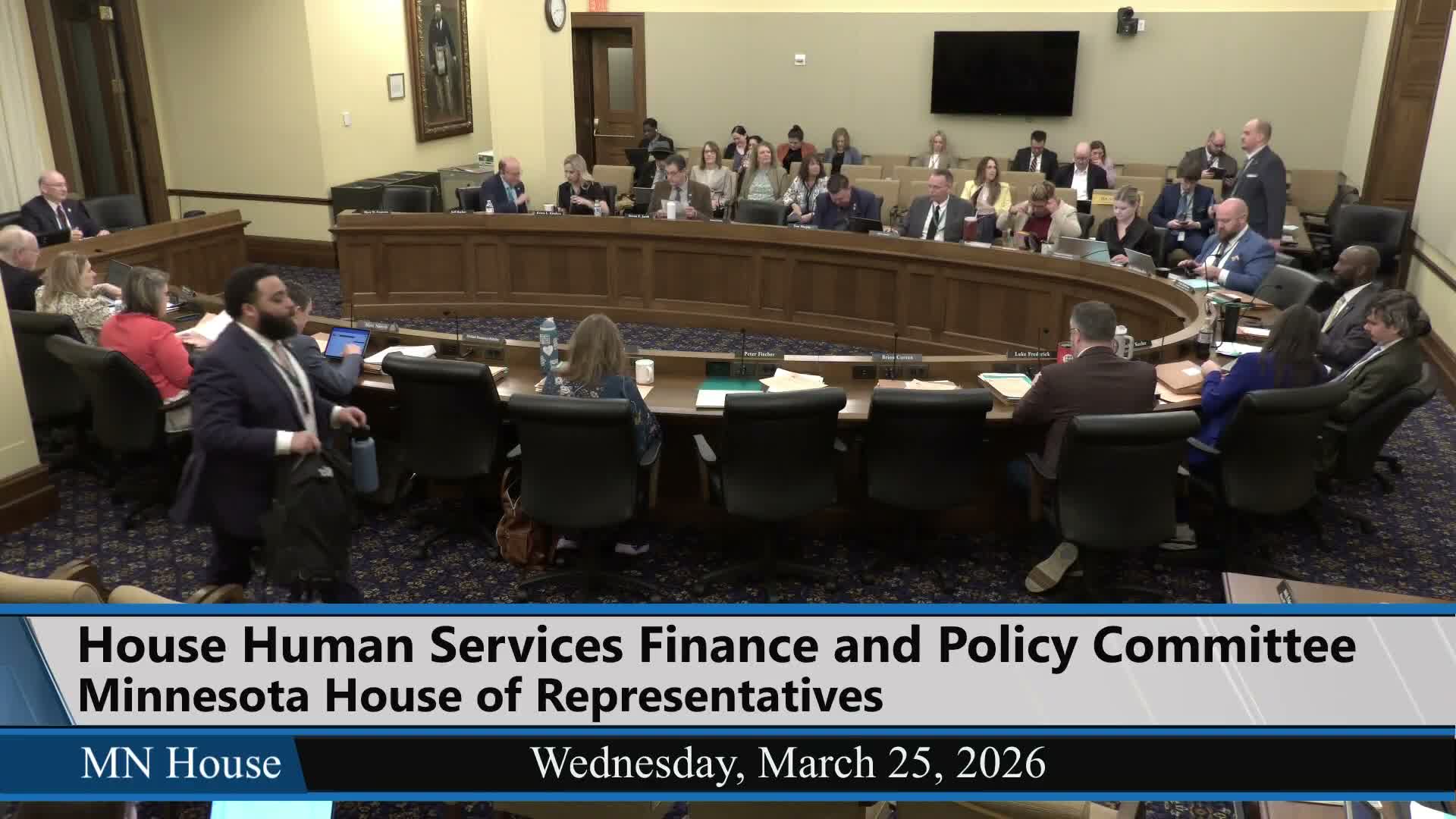
Representative Jeff Fisher moved House File 4210 to the committee, saying the bill updates terminology from 'seniors' to 'older adults' and expands how state funds may be used to increase flexibility for meal providers.
Dawn Simonson, executive director of Trellis and representing the Minnesota Association of Area Agencies on Aging and the Senior Meals and Services Coalition, told the committee that in 2025 the network served more than 16,000 people with home-delivered meals and warned a funding shortfall could lead to about 451,000 fewer meals next year. "The 1 time funds appropriated in 2023 have been exhausted, and the need grows along with the cost of food and labor," Simonson said, urging statutory changes to enable new partnerships while noting the changes do not substitute for ongoing base funding.
Stacy Lund, director of food access at Catholic Charities of the Diocese of Saint Cloud, described practical limits created by current contracts that fund only one prepared meal per day and said the bill would allow providers to deliver produce, food boxes and meal kits and to pilot other approaches. She said rural older adults sometimes face drives of 30 miles to a grocery store and that meal delivery often serves as a daily wellness check: "Many of the home delivered meals that we provide ... are telling us it's the only meal that they have in a day."
Committee members asked about the proposal to allow food-shelf or food-bank products in senior nutrition. Representative Gund said he valued food-shelf partnerships but worried about depleting food-bank inventories; Fisher and witnesses said the intent is to make the system more seamless and to ensure older adults get fresh, nutritious options that prepared meals alone do not always provide. Members also asked how state funds could be used for technology; Simonson described point-of-service verification systems (for example barcode scanning) and provider-level tools to document and verify delivery.
Fisher renewed his motion to lay HF4210 over for possible inclusion; the committee laid the bill over following the presentation and discussion.
The committee will consider funding needs separately; witnesses repeatedly said statutory flexibility would not, by itself, replace additional base funding to prevent cuts in meals and service levels.
Dawn Simonson, executive director of Trellis and representing the Minnesota Association of Area Agencies on Aging and the Senior Meals and Services Coalition, told the committee that in 2025 the network served more than 16,000 people with home-delivered meals and warned a funding shortfall could lead to about 451,000 fewer meals next year. "The 1 time funds appropriated in 2023 have been exhausted, and the need grows along with the cost of food and labor," Simonson said, urging statutory changes to enable new partnerships while noting the changes do not substitute for ongoing base funding.
Stacy Lund, director of food access at Catholic Charities of the Diocese of Saint Cloud, described practical limits created by current contracts that fund only one prepared meal per day and said the bill would allow providers to deliver produce, food boxes and meal kits and to pilot other approaches. She said rural older adults sometimes face drives of 30 miles to a grocery store and that meal delivery often serves as a daily wellness check: "Many of the home delivered meals that we provide ... are telling us it's the only meal that they have in a day."
Committee members asked about the proposal to allow food-shelf or food-bank products in senior nutrition. Representative Gund said he valued food-shelf partnerships but worried about depleting food-bank inventories; Fisher and witnesses said the intent is to make the system more seamless and to ensure older adults get fresh, nutritious options that prepared meals alone do not always provide. Members also asked how state funds could be used for technology; Simonson described point-of-service verification systems (for example barcode scanning) and provider-level tools to document and verify delivery.
Fisher renewed his motion to lay HF4210 over for possible inclusion; the committee laid the bill over following the presentation and discussion.
The committee will consider funding needs separately; witnesses repeatedly said statutory flexibility would not, by itself, replace additional base funding to prevent cuts in meals and service levels.
View the Full Meeting & All Its Details
This article offers just a summary. Unlock complete video, transcripts, and insights as a Founder Member.
✓
Watch full, unedited meeting videos
✓
Search every word spoken in unlimited transcripts
✓
AI summaries & real-time alerts (all government levels)
✓
Permanent access to expanding government content
30-day money-back guarantee
