House committee advances package of bills on victim protections, fraud, cannabis data and administrative rules
March 25, 2026 | 2026 Legislature MN, Minnesota
This article was created by AI summarizing key points discussed. AI makes mistakes, so for full details and context, please refer to the video of the full meeting. Please report any errors so we can fix them. Report an error »
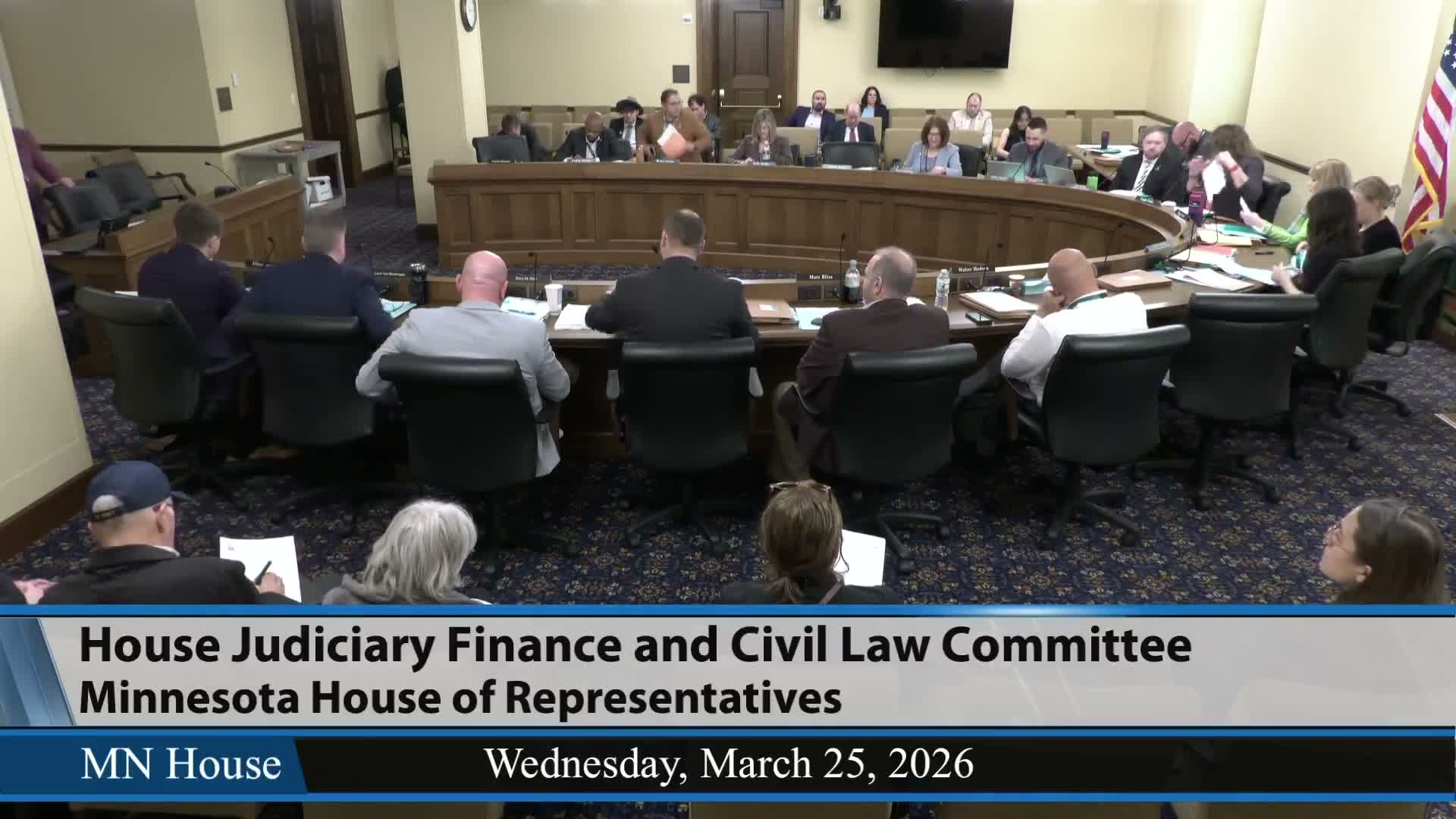
A House committee on (committee hearing) moved a package of bills forward Tuesday after a series of presentations, author amendments and voice votes.
The lead measures included House File 3825, which expands crime-victim protections; changes to Bureau of Criminal Apprehension (BCA) authority in House File 3826 to require a probable-cause standard for certain administrative subpoenas and to broaden identity-theft to include AI-based duplication of voice or likeness; a technical BCA bill (House File 3827) clarifying reimbursement language and crime-data reporting; House File 4200 to mark certain cannabis applicant and business operational information as nonpublic; House File 3908 to strengthen privacy designations for optional driver’s license indicators; a broad set of corrections and clarifications to the Minnesota Common Interest Ownership Act in House File 3495; and House File 3711, which aligns Minnesota Human Rights Act procedures with the court of administrative hearings.
Why it matters: several bills change how sensitive data is handled and clarify agency authority. Committee members pressed witnesses about implementation, notice and data access; the measures were presented as technical or protective fixes rather than major policy overhauls.
Key items and what the committee heard
House File 3825 — victim-notice and privacy changes: Representative Repinski summarized the bill as a Department of Public Safety Office of Justice Programs proposal to protect victim identities in prosecutor petitions and to ensure victims are notified when cases are eligible for automatic expungement. OJP executive director Kim Beibine outlined section-by-section protections for minors and a courtroom procedure to confirm victims have been notified and can be heard. Repinski said, “This bill provides important protections for crime victims in Minnesota.” Committee members asked whether courts or county attorneys had concerns; Beibine said they had not received objections but had not had detailed conversations with the courts yet.
House File 3826 — administrative subpoenas, AI identity theft and statute of limitations: An author’s amendment inserted a probable-cause standard into the administrative-subpoena language for the statute at issue, aligning it with how wage-theft investigations are treated. BCA Superintendent Drew Evans told the panel the change helps investigations while aligning the standard to what members were comfortable with; on expanding identity-theft language he said the bill would cover “the wrongful use, duplication of a person's voice or likeness, including their digital likeness,” to address emerging AI-enabled fraud. The bill would also extend certain fraud statutes of limitations from three to seven years to account for lengthy investigations.
House File 3827 — BCA technical fixes and reimbursement fund: Superintendent Evans described a technical change replacing the word “grant” with “reimbursement” for a fund used to offset large unexpected law-enforcement expenses, and alignment with NIBRS-based reporting. He highlighted an example where local agencies incurred “1,000,000 plus dollars” in an Anoka County homicide response to illustrate the reimbursement need. Members asked whether the BCA or courts would lose access to data; Evans said Minnesota maintains its crime data and will not lose it.
House File 4200 — cannabis data privacy: Eric Taubel, executive director of the Office of Cannabis Management, described HF 4200 as a market-protection measure that classifies certain application details, social-equity status and security-site plans as nonpublic so competitors or malicious actors cannot access site-security layouts or wholesale transaction details. Taubel said the office publishes aggregate market dashboards while keeping firm-level security and transaction data protected.
House File 3908 — DVS privacy and interlock program clarifications: The driver and vehicle services director, Peng Zhang, described technical fixes to the ignition-interlock program and moved autism and certain mental-health indicators to private-data status on IDs to strengthen privacy protections for drivers who opt into such indicators.
House File 3495 — Common Interest Ownership Act corrections: Representative Feist presented a largely technical 97-page bill to correct cross-references and make limited substantive clarifications for common-interest communities: how owner approvals are evidenced for recording, when amended plats are required, board-size rules for very small associations, insurance-priority options in some commercial contexts, and requirements for sellers to provide maintenance plans and budgets to prospective buyers. Tom Bray of the Minnesota State Bar Association explained the changes and their intent to reduce confusion and align rules that had become outdated.
House File 3711 — administrative-hearing alignment for MDHR: Nico Bauer of the Minnesota Department of Human Rights said HF 3711 updates statutory language to reflect administrative rules and the recent court name change, clarifies timelines for initiating cases with the court of administrative hearings, and removes a county-only venue requirement while keeping parties’ rights (including litigation) intact.
Votes at a glance (committee action): all bills listed above were moved and the committee recorded voice votes forwarding them (author amendments adopted where noted). The hearing recorded ayes on each motion and no roll-call tallies were read into the record; further action will be determined on the general register or in the referred committee noted by the chairs.
Procedural notes and next steps: several author amendments were adopted (for HF 4075, HF 3826, HF 4200 and HF 3495 among others) before final motions. Where members asked for implementation detail (for example, how courts would be engaged on victim-notice rules or how data access is maintained for crime reporting), witnesses said they would follow up or that statute/rules already preserve the state's data holdings. The committee adjourned after moving the package.
Sources: Committee hearing transcript; direct quotes and summaries are attributed to the speakers who made them during the hearing.
The lead measures included House File 3825, which expands crime-victim protections; changes to Bureau of Criminal Apprehension (BCA) authority in House File 3826 to require a probable-cause standard for certain administrative subpoenas and to broaden identity-theft to include AI-based duplication of voice or likeness; a technical BCA bill (House File 3827) clarifying reimbursement language and crime-data reporting; House File 4200 to mark certain cannabis applicant and business operational information as nonpublic; House File 3908 to strengthen privacy designations for optional driver’s license indicators; a broad set of corrections and clarifications to the Minnesota Common Interest Ownership Act in House File 3495; and House File 3711, which aligns Minnesota Human Rights Act procedures with the court of administrative hearings.
Why it matters: several bills change how sensitive data is handled and clarify agency authority. Committee members pressed witnesses about implementation, notice and data access; the measures were presented as technical or protective fixes rather than major policy overhauls.
Key items and what the committee heard
House File 3825 — victim-notice and privacy changes: Representative Repinski summarized the bill as a Department of Public Safety Office of Justice Programs proposal to protect victim identities in prosecutor petitions and to ensure victims are notified when cases are eligible for automatic expungement. OJP executive director Kim Beibine outlined section-by-section protections for minors and a courtroom procedure to confirm victims have been notified and can be heard. Repinski said, “This bill provides important protections for crime victims in Minnesota.” Committee members asked whether courts or county attorneys had concerns; Beibine said they had not received objections but had not had detailed conversations with the courts yet.
House File 3826 — administrative subpoenas, AI identity theft and statute of limitations: An author’s amendment inserted a probable-cause standard into the administrative-subpoena language for the statute at issue, aligning it with how wage-theft investigations are treated. BCA Superintendent Drew Evans told the panel the change helps investigations while aligning the standard to what members were comfortable with; on expanding identity-theft language he said the bill would cover “the wrongful use, duplication of a person's voice or likeness, including their digital likeness,” to address emerging AI-enabled fraud. The bill would also extend certain fraud statutes of limitations from three to seven years to account for lengthy investigations.
House File 3827 — BCA technical fixes and reimbursement fund: Superintendent Evans described a technical change replacing the word “grant” with “reimbursement” for a fund used to offset large unexpected law-enforcement expenses, and alignment with NIBRS-based reporting. He highlighted an example where local agencies incurred “1,000,000 plus dollars” in an Anoka County homicide response to illustrate the reimbursement need. Members asked whether the BCA or courts would lose access to data; Evans said Minnesota maintains its crime data and will not lose it.
House File 4200 — cannabis data privacy: Eric Taubel, executive director of the Office of Cannabis Management, described HF 4200 as a market-protection measure that classifies certain application details, social-equity status and security-site plans as nonpublic so competitors or malicious actors cannot access site-security layouts or wholesale transaction details. Taubel said the office publishes aggregate market dashboards while keeping firm-level security and transaction data protected.
House File 3908 — DVS privacy and interlock program clarifications: The driver and vehicle services director, Peng Zhang, described technical fixes to the ignition-interlock program and moved autism and certain mental-health indicators to private-data status on IDs to strengthen privacy protections for drivers who opt into such indicators.
House File 3495 — Common Interest Ownership Act corrections: Representative Feist presented a largely technical 97-page bill to correct cross-references and make limited substantive clarifications for common-interest communities: how owner approvals are evidenced for recording, when amended plats are required, board-size rules for very small associations, insurance-priority options in some commercial contexts, and requirements for sellers to provide maintenance plans and budgets to prospective buyers. Tom Bray of the Minnesota State Bar Association explained the changes and their intent to reduce confusion and align rules that had become outdated.
House File 3711 — administrative-hearing alignment for MDHR: Nico Bauer of the Minnesota Department of Human Rights said HF 3711 updates statutory language to reflect administrative rules and the recent court name change, clarifies timelines for initiating cases with the court of administrative hearings, and removes a county-only venue requirement while keeping parties’ rights (including litigation) intact.
Votes at a glance (committee action): all bills listed above were moved and the committee recorded voice votes forwarding them (author amendments adopted where noted). The hearing recorded ayes on each motion and no roll-call tallies were read into the record; further action will be determined on the general register or in the referred committee noted by the chairs.
Procedural notes and next steps: several author amendments were adopted (for HF 4075, HF 3826, HF 4200 and HF 3495 among others) before final motions. Where members asked for implementation detail (for example, how courts would be engaged on victim-notice rules or how data access is maintained for crime reporting), witnesses said they would follow up or that statute/rules already preserve the state's data holdings. The committee adjourned after moving the package.
Sources: Committee hearing transcript; direct quotes and summaries are attributed to the speakers who made them during the hearing.
Don't Miss a Word: See the Full Meeting!
Go beyond summaries. Unlock every video, transcript, and key insight with a Founder Membership.
✓
Get instant access to full meeting videos
✓
Search and clip any phrase from complete transcripts
✓
Receive AI-powered summaries & custom alerts
✓
Enjoy lifetime, unrestricted access to government data
30-day money-back guarantee
