Union leaders, Minnesota lawmakers push to ban ‘‘surveillance pricing’’ tied to electronic shelf labels
March 25, 2026 | 2026 Legislature MN, Minnesota
This article was created by AI summarizing key points discussed. AI makes mistakes, so for full details and context, please refer to the video of the full meeting. Please report any errors so we can fix them. Report an error »
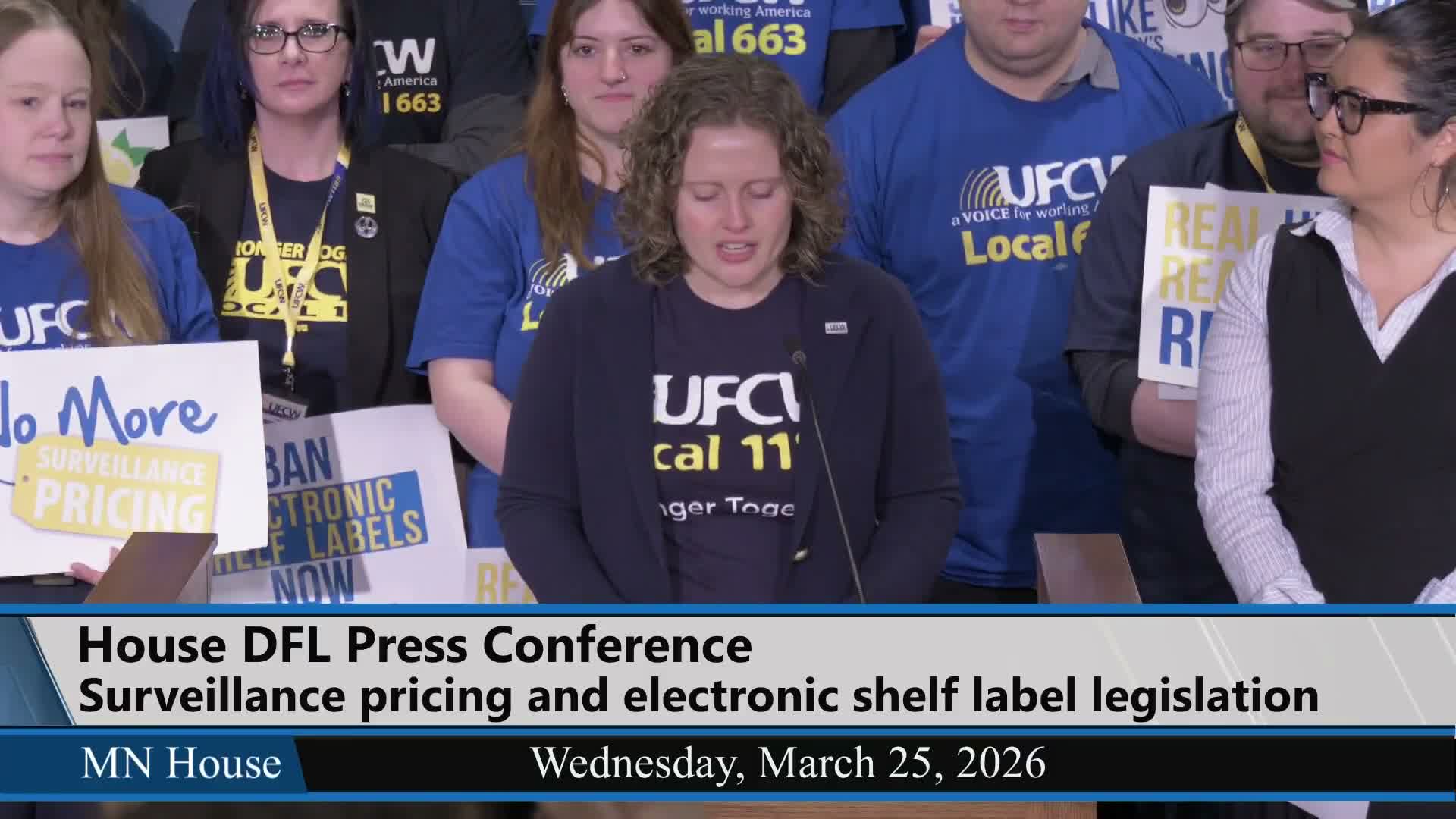
At a Capitol briefing, union officials and DFL lawmakers urged the Minnesota Legislature to ban ‘‘surveillance pricing’’ enabled by AI‑powered electronic shelf labels (ESLs), arguing the technology can raise prices in real time and put steady union grocery jobs at risk.
Diana Tassidamer, secretary treasurer of UFCW 1189, said the tools allow algorithms to change prices during a single shopping trip and that ‘‘consumers don’t stand a chance’’ against mass data collection and automated pricing. ‘‘It’s time to slam the door to shut and protect working families and the essential workers who feed our communities,’’ she said.
The nut of the organizers’ argument: automated, centrally controlled price changes remove predictability for shoppers and remove job tasks performed by local workers. Haley, an e‑commerce worker at Cub Foods in Burnsville who said she is due in August, said fluctuating prices for essentials such as baby formula could force families to spend hours driving between stores to find an affordable product. ‘‘If grocery stores are allowed to install surveillance pricing that can change from the beginning of a shopping trip to the end, how can families be expected to budget and thrive?’’ she said.
Jenny Winkles, a pricing coordinator at Super 1 Foods in Two Harbors, told lawmakers that local staff use knowledge of inventory, expiration and seasonal needs to manage prices and stock. She warned that removing that local control in favor of an AI command center ‘‘is a recipe for chaos on the store floor, creating confusion for workers and customers alike as prices could change by the second.’’
State Representative Samantha Sansamura (D‑District 63A) said the bill she is sponsoring responds to concerns about affordability and data privacy. "We are putting our foot down and saying no more big tech exploitation, no more unchecked corporate profiteering," she said, asking the Legislature to act before such systems become widespread.
Senate Majority Leader Erin Murphy endorsed the approach as a consumer‑protection measure and framed it in the context of rising costs, noting recent fuel price growth lawmakers have seen. Murphy said several proposals are pending at the Capitol and expressed surprise that a referenced bill by Representative Greenman "didn’t make it out of committee this morning." She said legislators should be proactive about technology that can track and price shoppers differently.
Rina Wong, president of UFCW Local 663, reiterated union concerns about job losses and consumer harms and cited a local finding that the online grocery platform Instacart ran pricing experiments that produced price variation of nearly 7 percent. She said for her local union membership the union counted roughly 150 scanning/pricing coordinator jobs and about 350 department‑head roles — about 500 positions she said could be affected if pricing and scan tasks were automated.
Organizers pressed lawmakers for a ban rather than expanded disclosure, arguing that telling customers about data use is not the same as preventing companies from tracking and re‑pricing purchases. When asked whether disclosure requirements (noted in some other states) would be a sufficient compromise, speakers replied that Minnesotans prefer not to be ‘‘spied on’’ in the first place.
No formal committee action or vote occurred during the briefing. Speakers said they planned meetings with lawmakers later that day and urged constituents to contact elected officials about the proposals.
The session concluded with organizers and lawmakers agreeing to continue advocacy and legislative work on proposals to limit or prohibit automated surveillance pricing.
Diana Tassidamer, secretary treasurer of UFCW 1189, said the tools allow algorithms to change prices during a single shopping trip and that ‘‘consumers don’t stand a chance’’ against mass data collection and automated pricing. ‘‘It’s time to slam the door to shut and protect working families and the essential workers who feed our communities,’’ she said.
The nut of the organizers’ argument: automated, centrally controlled price changes remove predictability for shoppers and remove job tasks performed by local workers. Haley, an e‑commerce worker at Cub Foods in Burnsville who said she is due in August, said fluctuating prices for essentials such as baby formula could force families to spend hours driving between stores to find an affordable product. ‘‘If grocery stores are allowed to install surveillance pricing that can change from the beginning of a shopping trip to the end, how can families be expected to budget and thrive?’’ she said.
Jenny Winkles, a pricing coordinator at Super 1 Foods in Two Harbors, told lawmakers that local staff use knowledge of inventory, expiration and seasonal needs to manage prices and stock. She warned that removing that local control in favor of an AI command center ‘‘is a recipe for chaos on the store floor, creating confusion for workers and customers alike as prices could change by the second.’’
State Representative Samantha Sansamura (D‑District 63A) said the bill she is sponsoring responds to concerns about affordability and data privacy. "We are putting our foot down and saying no more big tech exploitation, no more unchecked corporate profiteering," she said, asking the Legislature to act before such systems become widespread.
Senate Majority Leader Erin Murphy endorsed the approach as a consumer‑protection measure and framed it in the context of rising costs, noting recent fuel price growth lawmakers have seen. Murphy said several proposals are pending at the Capitol and expressed surprise that a referenced bill by Representative Greenman "didn’t make it out of committee this morning." She said legislators should be proactive about technology that can track and price shoppers differently.
Rina Wong, president of UFCW Local 663, reiterated union concerns about job losses and consumer harms and cited a local finding that the online grocery platform Instacart ran pricing experiments that produced price variation of nearly 7 percent. She said for her local union membership the union counted roughly 150 scanning/pricing coordinator jobs and about 350 department‑head roles — about 500 positions she said could be affected if pricing and scan tasks were automated.
Organizers pressed lawmakers for a ban rather than expanded disclosure, arguing that telling customers about data use is not the same as preventing companies from tracking and re‑pricing purchases. When asked whether disclosure requirements (noted in some other states) would be a sufficient compromise, speakers replied that Minnesotans prefer not to be ‘‘spied on’’ in the first place.
No formal committee action or vote occurred during the briefing. Speakers said they planned meetings with lawmakers later that day and urged constituents to contact elected officials about the proposals.
The session concluded with organizers and lawmakers agreeing to continue advocacy and legislative work on proposals to limit or prohibit automated surveillance pricing.
View the Full Meeting & All Its Details
This article offers just a summary. Unlock complete video, transcripts, and insights as a Founder Member.
✓
Watch full, unedited meeting videos
✓
Search every word spoken in unlimited transcripts
✓
AI summaries & real-time alerts (all government levels)
✓
Permanent access to expanding government content
30-day money-back guarantee
