Committee advances bill letting Minnesota cities, counties bond for thermal energy networks
March 25, 2026 | 2026 Legislature MN, Minnesota
This article was created by AI summarizing key points discussed. AI makes mistakes, so for full details and context, please refer to the video of the full meeting. Please report any errors so we can fix them. Report an error »
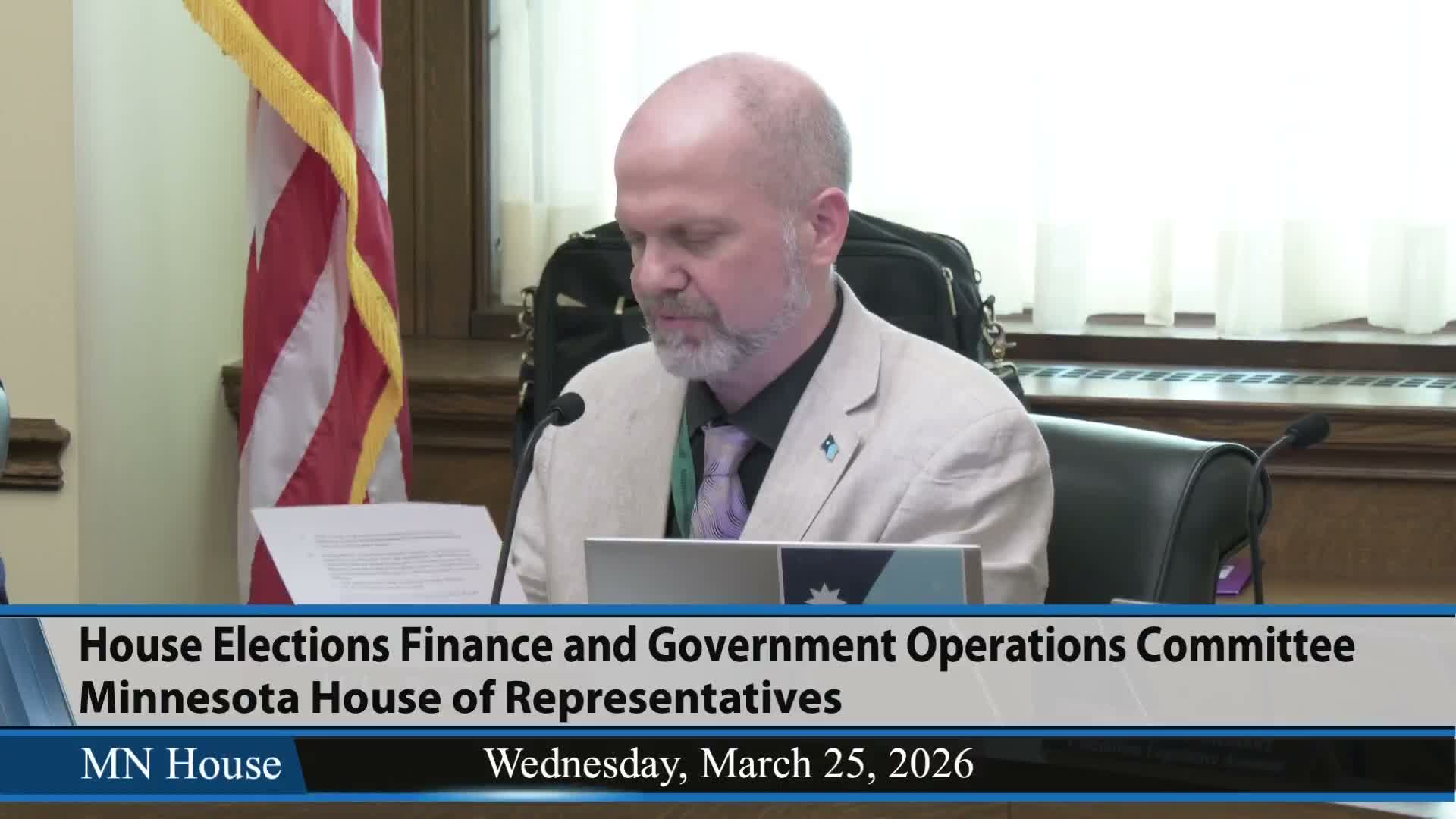
Representative Kraft moved House File 4348 as amended to the general register, saying the bill would allow local units of government and counties to issue general obligation bonds to finance thermal energy networks — underground piping and heat pumps that deliver heating and cooling across multiple buildings.
Kraft said the measure would give communities the same tool they use for water and sewer to finance long‑lived energy infrastructure and cited federal interest in geothermal technology. "This bill is about Minnesota doing the same," Kraft said, arguing bonding lowers financing costs and enables public ownership of durable systems.
Two industry witnesses urged support. Andrew Campbell, president of the Minnesota Pipe Trades Association, testified that bonding would ease upfront costs and provide work for members in piping and HVAC trades. "We firmly believe House File 4348 will spur more interest in implementation of thermal energy networks," Campbell said. Carly Varga Werner, speaking for Evergreen Energy and District Energy of Saint Paul, described an Oberlin College geothermal project she helped develop and said similar systems can reduce long‑term costs and greenhouse‑gas emissions. She cited the Oberlin project’s reported reductions and savings as an example of potential outcomes.
Members pressed for technical details. Co‑chair Quam raised questions about whether systems would be closed‑loop or draw from aquifers and said he was concerned about downstream drinking water and electrical loads for heat pumps. Kraft said the bill’s statutory definition does not mandate closed‑loop or single‑flow designs and offered to follow up; he said he would be willing to consider an amendment before the floor to require closed‑loop systems if that would address members’ concerns.
The committee adopted the A1 amendment and re‑referred HF 4348, as amended, to the general register by voice vote. The A1 amendment clarified that counties, as well as other local units of government, may use bonding authority for such projects.
The bill’s next steps: HF 4348 will go to the general register, where floor scheduling and any further amendments will be decided.
Kraft said the measure would give communities the same tool they use for water and sewer to finance long‑lived energy infrastructure and cited federal interest in geothermal technology. "This bill is about Minnesota doing the same," Kraft said, arguing bonding lowers financing costs and enables public ownership of durable systems.
Two industry witnesses urged support. Andrew Campbell, president of the Minnesota Pipe Trades Association, testified that bonding would ease upfront costs and provide work for members in piping and HVAC trades. "We firmly believe House File 4348 will spur more interest in implementation of thermal energy networks," Campbell said. Carly Varga Werner, speaking for Evergreen Energy and District Energy of Saint Paul, described an Oberlin College geothermal project she helped develop and said similar systems can reduce long‑term costs and greenhouse‑gas emissions. She cited the Oberlin project’s reported reductions and savings as an example of potential outcomes.
Members pressed for technical details. Co‑chair Quam raised questions about whether systems would be closed‑loop or draw from aquifers and said he was concerned about downstream drinking water and electrical loads for heat pumps. Kraft said the bill’s statutory definition does not mandate closed‑loop or single‑flow designs and offered to follow up; he said he would be willing to consider an amendment before the floor to require closed‑loop systems if that would address members’ concerns.
The committee adopted the A1 amendment and re‑referred HF 4348, as amended, to the general register by voice vote. The A1 amendment clarified that counties, as well as other local units of government, may use bonding authority for such projects.
The bill’s next steps: HF 4348 will go to the general register, where floor scheduling and any further amendments will be decided.
View the Full Meeting & All Its Details
This article offers just a summary. Unlock complete video, transcripts, and insights as a Founder Member.
✓
Watch full, unedited meeting videos
✓
Search every word spoken in unlimited transcripts
✓
AI summaries & real-time alerts (all government levels)
✓
Permanent access to expanding government content
30-day money-back guarantee
