Committee hears hours of debate on advertising tax and sales‑tax modernization
March 25, 2026 | 2026 Legislature MN, Minnesota
This article was created by AI summarizing key points discussed. AI makes mistakes, so for full details and context, please refer to the video of the full meeting. Please report any errors so we can fix them. Report an error »
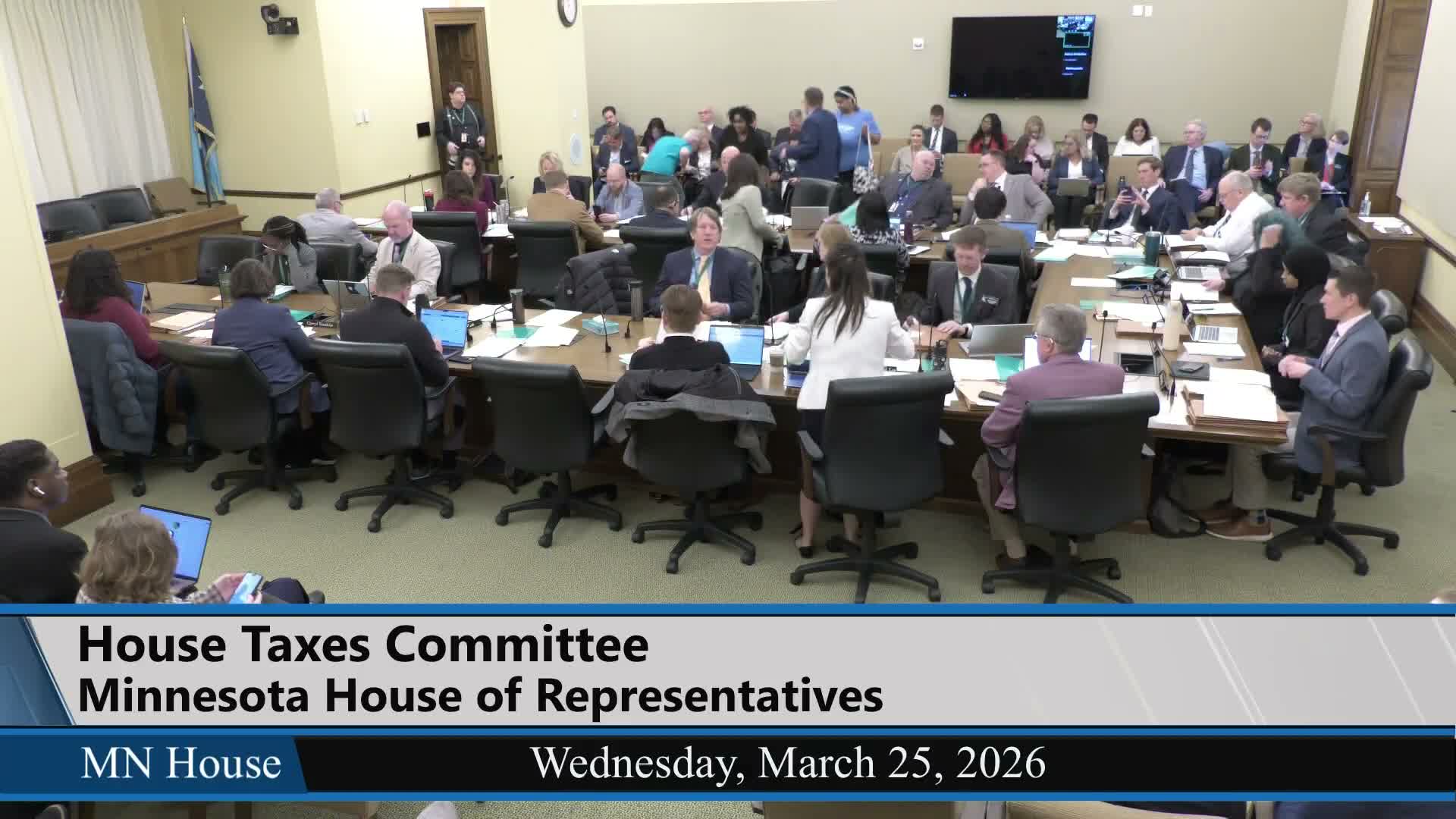
Representative Lee introduced House File 4343 as legislation to "modernize our sales tax code" by broadening the base to include certain advertising services, including digital advertising and out‑of‑home ads, and using the broader base to lower the statewide sales tax rate modestly.
Proponents argued the digital advertising sector has grown dramatically and that excluding it shrinks the tax base and places a higher rate on other transactions. Eric Bernstein (We Make Minnesota) told the committee the sector has expanded rapidly and said a broader base can enable a lower rate, citing comparisons with other states. Tanner Fritzinger (Minnesota Association of Professional Employees) and several nonprofit and labor speakers framed the proposal as one way to address structural budget pressures and preserve public services.
Opponents warned of broad economic and legal risks. Dalton Danielson (Minnesota Business Partnership) said the bill would tax business inputs, create tax pyramiding, and carry litigation risk given interstate ad transactions. Brian Cook (Minnesota Chamber of Commerce) cited Maryland's experience and warned of legal uncertainty that could imperil projected revenue. Industry witnesses and association representatives argued many small businesses would face higher costs for marketing and that the tax burden would be passed through to consumers.
Members pressed technical and distributional questions: Vice Chair Joy and others asked whether the tax is imposed at the sale of service (answer: yes, department staff said) and whether the tax is primarily business‑to‑business; Representative Wiener and others warned pass‑through would hit consumers and small businesses; Representative Smith and the bill author discussed how widening a base can change the suits index and potentially make sales tax less regressive if the base is broadened thoughtfully. Representative Lee said similar statutes in Maryland are collecting revenue and argued the bill is drafted to avoid the drafting choices that led to litigation elsewhere.
Several community speakers said the revenues could fund child care, hospitals and other essential services; Sarah Frank (AFSCME/HCMC) urged the committee to consider those needs. Others, including Deb Peters (Americans for Digital Opportunity / Internet Coalition), urged rejection, saying the tax would harm small businesses and local advertising markets.
Representative Lee renewed her motion to lay House File 4343, as amended, over for possible inclusion in the 2026 taxes bill; the committee laid the bill over.
The committee did not take a roll-call vote on the layover; the motion was adopted by voice and the bill will be considered for the omnibus taxes bill.
Proponents argued the digital advertising sector has grown dramatically and that excluding it shrinks the tax base and places a higher rate on other transactions. Eric Bernstein (We Make Minnesota) told the committee the sector has expanded rapidly and said a broader base can enable a lower rate, citing comparisons with other states. Tanner Fritzinger (Minnesota Association of Professional Employees) and several nonprofit and labor speakers framed the proposal as one way to address structural budget pressures and preserve public services.
Opponents warned of broad economic and legal risks. Dalton Danielson (Minnesota Business Partnership) said the bill would tax business inputs, create tax pyramiding, and carry litigation risk given interstate ad transactions. Brian Cook (Minnesota Chamber of Commerce) cited Maryland's experience and warned of legal uncertainty that could imperil projected revenue. Industry witnesses and association representatives argued many small businesses would face higher costs for marketing and that the tax burden would be passed through to consumers.
Members pressed technical and distributional questions: Vice Chair Joy and others asked whether the tax is imposed at the sale of service (answer: yes, department staff said) and whether the tax is primarily business‑to‑business; Representative Wiener and others warned pass‑through would hit consumers and small businesses; Representative Smith and the bill author discussed how widening a base can change the suits index and potentially make sales tax less regressive if the base is broadened thoughtfully. Representative Lee said similar statutes in Maryland are collecting revenue and argued the bill is drafted to avoid the drafting choices that led to litigation elsewhere.
Several community speakers said the revenues could fund child care, hospitals and other essential services; Sarah Frank (AFSCME/HCMC) urged the committee to consider those needs. Others, including Deb Peters (Americans for Digital Opportunity / Internet Coalition), urged rejection, saying the tax would harm small businesses and local advertising markets.
Representative Lee renewed her motion to lay House File 4343, as amended, over for possible inclusion in the 2026 taxes bill; the committee laid the bill over.
The committee did not take a roll-call vote on the layover; the motion was adopted by voice and the bill will be considered for the omnibus taxes bill.
View the Full Meeting & All Its Details
This article offers just a summary. Unlock complete video, transcripts, and insights as a Founder Member.
✓
Watch full, unedited meeting videos
✓
Search every word spoken in unlimited transcripts
✓
AI summaries & real-time alerts (all government levels)
✓
Permanent access to expanding government content
30-day money-back guarantee
