Rep. Ray Rauer’s bill would let state housing tax credit fund service reserves for supportive housing; laid over
March 25, 2026 | 2026 Legislature MN, Minnesota
This article was created by AI summarizing key points discussed. AI makes mistakes, so for full details and context, please refer to the video of the full meeting. Please report any errors so we can fix them. Report an error »
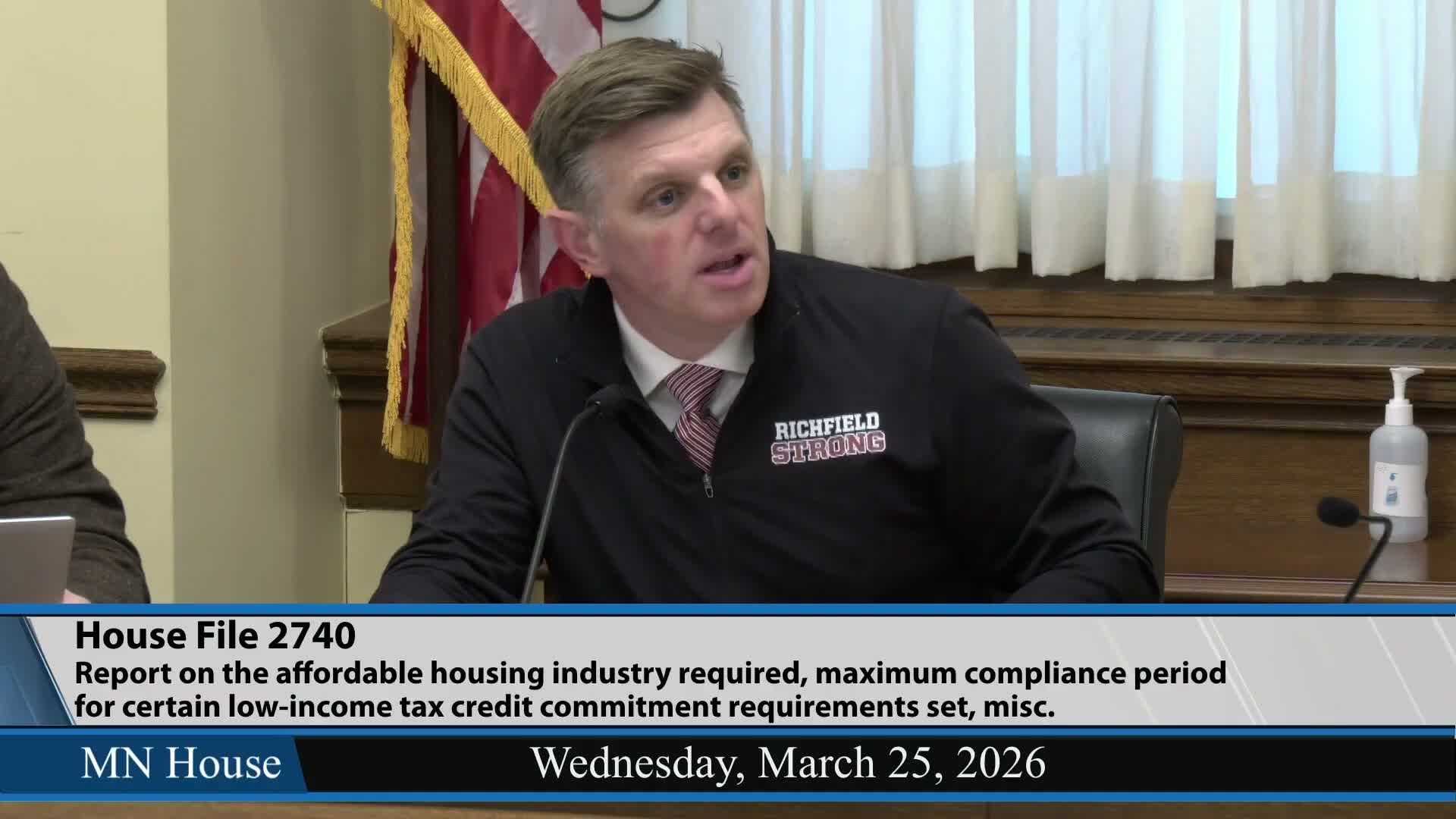
Representative Ray Rauer introduced House File 2901, saying the bill would add an eligible use to Minnesota’s state housing tax credit so it can fund capitalized service reserves for supportive housing. Rauer told the committee the housing tax credit has mobilized private contributions — he said about $9,900,000 in credits was fully subscribed this year — and that allowing the credit to seed service reserves would help bridge the gap between capital funding and ongoing service needs.
"Supportive housing isn't just a roof and walls. It's a roof plus services," Rauer said, urging the committee to allow the tax credit to support service reserves that stabilize projects for people exiting homelessness and those with disabilities.
Kevin Walker, vice president of housing development at Beacon Interfaith Housing Collaborative, told the committee supportive housing relies on three financing pieces — capital, rent subsidies and services — and that gaps in services funding can average about $2,000 per supportive unit per year. He said a one‑time capitalized services reserve (he offered an illustrative reserve on the order of hundreds of thousands to roughly $1–$2 million for some projects) can make projects fundable and reduce the risk that developments will not proceed.
"Without all these pieces assembled, the underwriting for developers or investors typically doesn't work," Walker said. Alyssia House, co‑CEO of RS Eden, and Amy Stetzel, Upper Midwest director for the Corporation for Supportive Housing (CSH), echoed that testimony, arguing the tax credit is currently targeted at bricks‑and‑mortar costs and that making service reserves an eligible use would improve long‑term outcomes and reduce unsheltered homelessness.
Members asked why tax credit proceeds — typically used for capital projects — would be used for service funding and whether the Department of Human Services (DHS) already covers those costs. Witnesses said DHS funding often covers part of a services budget on an individual basis, while a capitalized reserve helps demonstrate to investors and lenders that services will be available long enough to stabilize a property. Several members said they were sympathetic but cautious and that the committee should consider program capacity and whether the tax credit itself should be expanded.
The committee adopted Representative Ferrero's A1 amendment, which its proponent described as clarifying how and where money would flow, heard testimony, and ultimately laid HF2901 over for further work.
"Supportive housing isn't just a roof and walls. It's a roof plus services," Rauer said, urging the committee to allow the tax credit to support service reserves that stabilize projects for people exiting homelessness and those with disabilities.
Kevin Walker, vice president of housing development at Beacon Interfaith Housing Collaborative, told the committee supportive housing relies on three financing pieces — capital, rent subsidies and services — and that gaps in services funding can average about $2,000 per supportive unit per year. He said a one‑time capitalized services reserve (he offered an illustrative reserve on the order of hundreds of thousands to roughly $1–$2 million for some projects) can make projects fundable and reduce the risk that developments will not proceed.
"Without all these pieces assembled, the underwriting for developers or investors typically doesn't work," Walker said. Alyssia House, co‑CEO of RS Eden, and Amy Stetzel, Upper Midwest director for the Corporation for Supportive Housing (CSH), echoed that testimony, arguing the tax credit is currently targeted at bricks‑and‑mortar costs and that making service reserves an eligible use would improve long‑term outcomes and reduce unsheltered homelessness.
Members asked why tax credit proceeds — typically used for capital projects — would be used for service funding and whether the Department of Human Services (DHS) already covers those costs. Witnesses said DHS funding often covers part of a services budget on an individual basis, while a capitalized reserve helps demonstrate to investors and lenders that services will be available long enough to stabilize a property. Several members said they were sympathetic but cautious and that the committee should consider program capacity and whether the tax credit itself should be expanded.
The committee adopted Representative Ferrero's A1 amendment, which its proponent described as clarifying how and where money would flow, heard testimony, and ultimately laid HF2901 over for further work.
View the Full Meeting & All Its Details
This article offers just a summary. Unlock complete video, transcripts, and insights as a Founder Member.
✓
Watch full, unedited meeting videos
✓
Search every word spoken in unlimited transcripts
✓
AI summaries & real-time alerts (all government levels)
✓
Permanent access to expanding government content
30-day money-back guarantee
