Senate advances Strong Readers Act reform to standardize screeners, expand early interventions
March 25, 2026 | 2026 Legislature OK, Oklahoma
This article was created by AI summarizing key points discussed. AI makes mistakes, so for full details and context, please refer to the video of the full meeting. Please report any errors so we can fix them. Report an error »
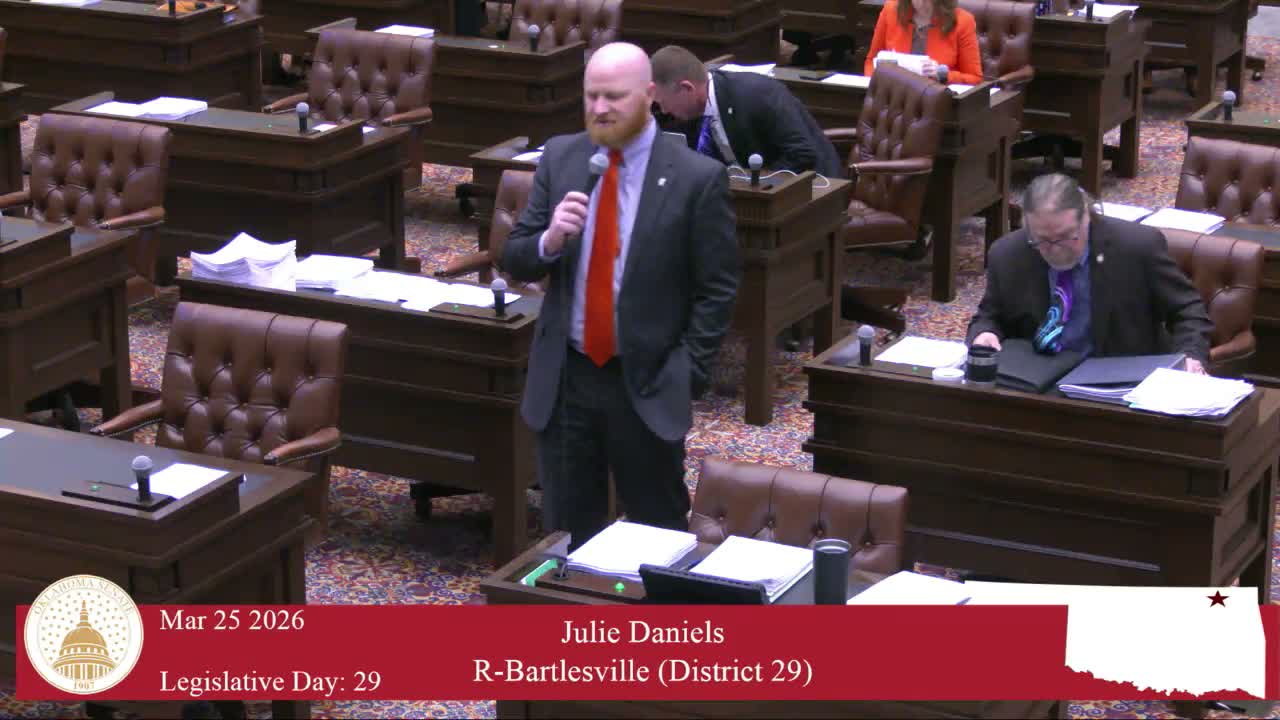
Senator Pugh, the bill’s author, explained a floor substitute to Senate Bill 17‑78 that he said ‘‘updates the Strong Readers Act’’ by putting a distribution formula into statute and directing the State Department of Education on how to spend Strong Readers dollars. ‘‘The biggest thing that the Strong Readers Act does is…updates the formulary,’’ Pugh told colleagues, adding the change moves the distributive process from administrative rule into law to create consistency across districts.
Pugh said the bill also directs OEQA (the Office of Educational Quality and Accountability) to vet and recommend a short list of screeners to the State Board, from which the board will select a single screener that the state will pay for and require as the screening instrument. ‘‘We are providing that one screener for everyone and telling everyone that’s the screener they have to use,’’ Pugh said, describing a goal of comparing ‘‘apples to apples’’ across districts.
The proposal makes third‑grade retention a last resort after multiple early interventions, including kindergarten-through-second-grade identification, transitional classroom options, pull‑out tutoring and summer programming. Pugh described the bill as intended to shift emphasis to earlier identification and intervention: ‘‘We’re actually focusing on first grade as the inflection point,’’ he said, adding that interventions, retesting and flexibility are built into the design so children showing sufficient growth can still be promoted.
The bill also authorizes the secretary of education and OEQA to audit teacher‑preparation programs and, if programs do not align with ‘‘science of reading’’ instruction, to place them on probation; the author said financial consequences may follow those accreditation findings. On funding, Pugh said the summer teacher‑training academies would be a separate line item in the budget limits bill and noted a request for $5 million to establish intensive two‑week academies run by higher‑education institutions.
Members asked about data privacy and screener functionality during the vetting process; the author directed educators and districts to be involved in OEQA’s review. Senators also pressed about exemptions to retention, supports for small districts, and how literacy coaches will be deployed. The author said the State Department currently employs about a dozen literacy coaches and that the bill prioritizes districts based on need until statewide capacity is reached.
An amendment ‘‘to restore the title’’ on the measure was adopted by voice vote. The chamber later advanced the bill on a roll call and the clerk announced the final tally; the measure was declared passed and advanced as an emergency measure.
What’s next: With the Senate’s passage, the measure moves on for any next-step processing required by state law and, because the Senate declared an emergency, proponents said they intend for provisions to take effect immediately on the emergency designation.
Pugh said the bill also directs OEQA (the Office of Educational Quality and Accountability) to vet and recommend a short list of screeners to the State Board, from which the board will select a single screener that the state will pay for and require as the screening instrument. ‘‘We are providing that one screener for everyone and telling everyone that’s the screener they have to use,’’ Pugh said, describing a goal of comparing ‘‘apples to apples’’ across districts.
The proposal makes third‑grade retention a last resort after multiple early interventions, including kindergarten-through-second-grade identification, transitional classroom options, pull‑out tutoring and summer programming. Pugh described the bill as intended to shift emphasis to earlier identification and intervention: ‘‘We’re actually focusing on first grade as the inflection point,’’ he said, adding that interventions, retesting and flexibility are built into the design so children showing sufficient growth can still be promoted.
The bill also authorizes the secretary of education and OEQA to audit teacher‑preparation programs and, if programs do not align with ‘‘science of reading’’ instruction, to place them on probation; the author said financial consequences may follow those accreditation findings. On funding, Pugh said the summer teacher‑training academies would be a separate line item in the budget limits bill and noted a request for $5 million to establish intensive two‑week academies run by higher‑education institutions.
Members asked about data privacy and screener functionality during the vetting process; the author directed educators and districts to be involved in OEQA’s review. Senators also pressed about exemptions to retention, supports for small districts, and how literacy coaches will be deployed. The author said the State Department currently employs about a dozen literacy coaches and that the bill prioritizes districts based on need until statewide capacity is reached.
An amendment ‘‘to restore the title’’ on the measure was adopted by voice vote. The chamber later advanced the bill on a roll call and the clerk announced the final tally; the measure was declared passed and advanced as an emergency measure.
What’s next: With the Senate’s passage, the measure moves on for any next-step processing required by state law and, because the Senate declared an emergency, proponents said they intend for provisions to take effect immediately on the emergency designation.
View the Full Meeting & All Its Details
This article offers just a summary. Unlock complete video, transcripts, and insights as a Founder Member.
✓
Watch full, unedited meeting videos
✓
Search every word spoken in unlimited transcripts
✓
AI summaries & real-time alerts (all government levels)
✓
Permanent access to expanding government content
30-day money-back guarantee
