Senate committee advances "Regulatory Freedom Act of 2026" after business and advocacy testimony
March 25, 2026 | 2026 Legislature TN, Tennessee
This article was created by AI summarizing key points discussed. AI makes mistakes, so for full details and context, please refer to the video of the full meeting. Please report any errors so we can fix them. Report an error »
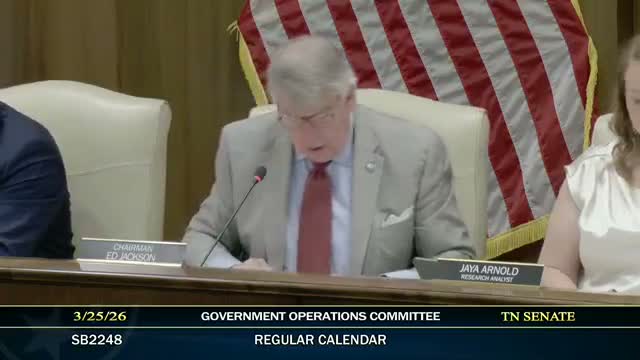
Senator John Lowe presented Senate Bill 2199, the Regulatory Freedom Act of 2026, to the Government Operations Committee, saying the measure would require agencies to solicit and quantify economic impacts on regulated communities and to surface impacts that might otherwise be hidden until after rules are promulgated. "This is the Regulatory Freedom Act of 2026," Lowe said, explaining it would identify impacts above a $1,000,000 threshold over five years and provide more transparent impact statements to legislators.
Supporters including Kevin Hensley of the Tennessee Farm Bureau, Jack Powers of Beacon Impact and Michael Lott of Americans for Prosperity testified in favor. Hensley told the committee, "This bill is about making good government better," arguing it would give regulated industries a stronger voice in rule development. Lott said the bill would "ensure when burdensome rules and regulations have the force of law, that those rules are treated with the same oversight and careful consideration as laws themselves are." Powers said the measure protects Tennesseans "from unnecessary burdensome costly regulations."
Committee members pressed witnesses on implementation and scope. Senator Oliver and others asked whether the committee's existing, year-round oversight and public-comment channels already provide similar protections and whether the measure would impose additional administrative work on agencies. Witnesses and Senator Lowe said qualitative testimony and existing fiscal notes would remain part of the process; the bill aims to quantify impacts where possible and align with current agency timelines. Witnesses noted the bill includes an enactment date of January 2027 to allow agencies time to update systems.
The bill's fiscal note was described in testimony as "insignificant." After closing remarks from Senator Lowe, the clerk took a roll-call vote and reported the committee's recommendation carried and the bill was moved to the state and local government committee (clerk reported 6 ayes, 1 no, 2 absent). The committee record shows both broad support from industry groups and concerns from some members about adding procedural steps for agencies; proponents said the added outreach would not mandate acceptance of outside feedback but would make the expected impacts more transparent to lawmakers.
The bill will next be considered by the state and local government committee.
Supporters including Kevin Hensley of the Tennessee Farm Bureau, Jack Powers of Beacon Impact and Michael Lott of Americans for Prosperity testified in favor. Hensley told the committee, "This bill is about making good government better," arguing it would give regulated industries a stronger voice in rule development. Lott said the bill would "ensure when burdensome rules and regulations have the force of law, that those rules are treated with the same oversight and careful consideration as laws themselves are." Powers said the measure protects Tennesseans "from unnecessary burdensome costly regulations."
Committee members pressed witnesses on implementation and scope. Senator Oliver and others asked whether the committee's existing, year-round oversight and public-comment channels already provide similar protections and whether the measure would impose additional administrative work on agencies. Witnesses and Senator Lowe said qualitative testimony and existing fiscal notes would remain part of the process; the bill aims to quantify impacts where possible and align with current agency timelines. Witnesses noted the bill includes an enactment date of January 2027 to allow agencies time to update systems.
The bill's fiscal note was described in testimony as "insignificant." After closing remarks from Senator Lowe, the clerk took a roll-call vote and reported the committee's recommendation carried and the bill was moved to the state and local government committee (clerk reported 6 ayes, 1 no, 2 absent). The committee record shows both broad support from industry groups and concerns from some members about adding procedural steps for agencies; proponents said the added outreach would not mandate acceptance of outside feedback but would make the expected impacts more transparent to lawmakers.
The bill will next be considered by the state and local government committee.
View the Full Meeting & All Its Details
This article offers just a summary. Unlock complete video, transcripts, and insights as a Founder Member.
✓
Watch full, unedited meeting videos
✓
Search every word spoken in unlimited transcripts
✓
AI summaries & real-time alerts (all government levels)
✓
Permanent access to expanding government content
30-day money-back guarantee
