Austin staff outline plan to transition to low‑embodied‑carbon concrete
March 25, 2026 | Austin, Travis County, Texas
This article was created by AI summarizing key points discussed. AI makes mistakes, so for full details and context, please refer to the video of the full meeting. Please report any errors so we can fix them. Report an error »
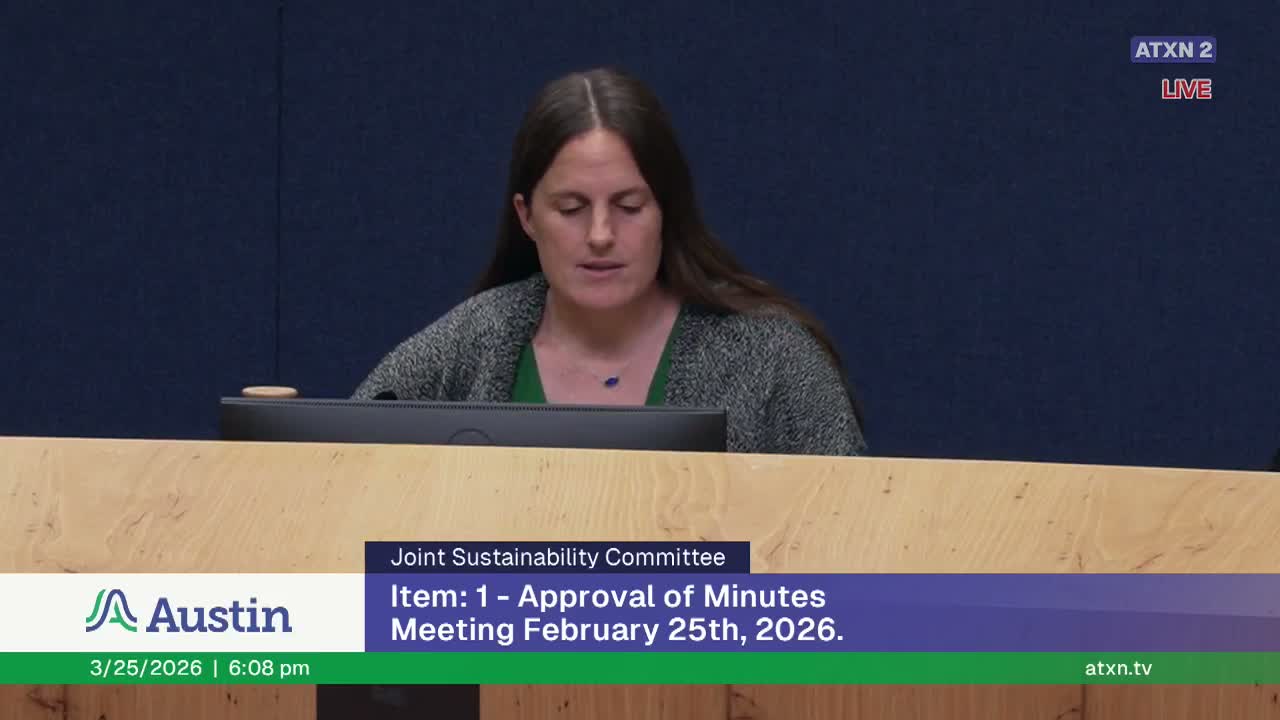
Amika Bose, assistant director in the Office of the City Engineer (Transportation & Public Works), told the Joint Sustainability Commission that the city is moving to require Environmental Product Declarations (EPDs) for concrete mixes and to replace its prescriptive concrete standard with a performance‑based specification to lower the material’s global warming potential.
“Through our capital projects and private development, we have the real ability to reduce emissions in the near term and influence the broader market,” Bose said, describing a three‑part effort: tracking concrete volumes and carbon footprints via EPDs, creating a new performance‑based specification (standard specification 403), and reporting annually to City Council on progress.
Staff said they have collected roughly 500 EPDs from five major local producers so far and that Austin’s ordinance requires all concrete producers operating in the city to submit EPDs following an extended deadline of 2025‑03‑31. City staff noted there are 12 producers serving the area; six currently use volumetric mixes and are awaiting an associated product category rule so they can produce EPDs.
The proposed performance specification loosens prescriptive items (water‑to‑cement ratio, slump) and allows use of supplementary cementitious materials such as fly ash; staff said those changes are intended to preserve required concrete strength while enabling lower‑carbon mixes. Bose said the city will retain acceptance and testing requirements—engineer‑certified mix submissions and 7‑, 28‑ and, where appropriate, 56‑day strength verification—and may use contractual language (including payment adjustments) to address nonconforming mixes.
Commissioners pressed staff for distributional detail on the EPD data (standard deviations and outliers) and asked whether anonymized producer‑level data could be published. Staff said they have begun statistical analysis, are pursuing more Texas‑specific NRMCA data, and will consult legal counsel about whether and how to publish anonymized points without revealing proprietary vendor information.
Bose said the draft performance spec has been circulated to partner departments (Capital Delivery Services, Austin Water, Austin Energy, Parks & Watershed Protection) and that staff will use the city’s rules posting process this year to solicit broader stakeholder input. The presentation noted staff are aiming for an adopted specification in 2027 and plan concurrent benchmarking and procurement‑policy work to ensure the specification has enforceable purchasing requirements. Bose emphasized that specification and procurement must move together: without aligned purchasing language, contractors might not be able to bid or comply.
The commission asked staff to return with benchmarking results and additional public‑engagement steps; staff offered to come back in early summer with an update.
“Through our capital projects and private development, we have the real ability to reduce emissions in the near term and influence the broader market,” Bose said, describing a three‑part effort: tracking concrete volumes and carbon footprints via EPDs, creating a new performance‑based specification (standard specification 403), and reporting annually to City Council on progress.
Staff said they have collected roughly 500 EPDs from five major local producers so far and that Austin’s ordinance requires all concrete producers operating in the city to submit EPDs following an extended deadline of 2025‑03‑31. City staff noted there are 12 producers serving the area; six currently use volumetric mixes and are awaiting an associated product category rule so they can produce EPDs.
The proposed performance specification loosens prescriptive items (water‑to‑cement ratio, slump) and allows use of supplementary cementitious materials such as fly ash; staff said those changes are intended to preserve required concrete strength while enabling lower‑carbon mixes. Bose said the city will retain acceptance and testing requirements—engineer‑certified mix submissions and 7‑, 28‑ and, where appropriate, 56‑day strength verification—and may use contractual language (including payment adjustments) to address nonconforming mixes.
Commissioners pressed staff for distributional detail on the EPD data (standard deviations and outliers) and asked whether anonymized producer‑level data could be published. Staff said they have begun statistical analysis, are pursuing more Texas‑specific NRMCA data, and will consult legal counsel about whether and how to publish anonymized points without revealing proprietary vendor information.
Bose said the draft performance spec has been circulated to partner departments (Capital Delivery Services, Austin Water, Austin Energy, Parks & Watershed Protection) and that staff will use the city’s rules posting process this year to solicit broader stakeholder input. The presentation noted staff are aiming for an adopted specification in 2027 and plan concurrent benchmarking and procurement‑policy work to ensure the specification has enforceable purchasing requirements. Bose emphasized that specification and procurement must move together: without aligned purchasing language, contractors might not be able to bid or comply.
The commission asked staff to return with benchmarking results and additional public‑engagement steps; staff offered to come back in early summer with an update.
View the Full Meeting & All Its Details
This article offers just a summary. Unlock complete video, transcripts, and insights as a Founder Member.
✓
Watch full, unedited meeting videos
✓
Search every word spoken in unlimited transcripts
✓
AI summaries & real-time alerts (all government levels)
✓
Permanent access to expanding government content
30-day money-back guarantee
