ESG pitches guaranteed energy‑savings program to School City of East Chicago amid rising NIPSCO rates
March 24, 2026 | School City of East Chicago, School Boards, Indiana
This article was created by AI summarizing key points discussed. AI makes mistakes, so for full details and context, please refer to the video of the full meeting. Please report any errors so we can fix them. Report an error »
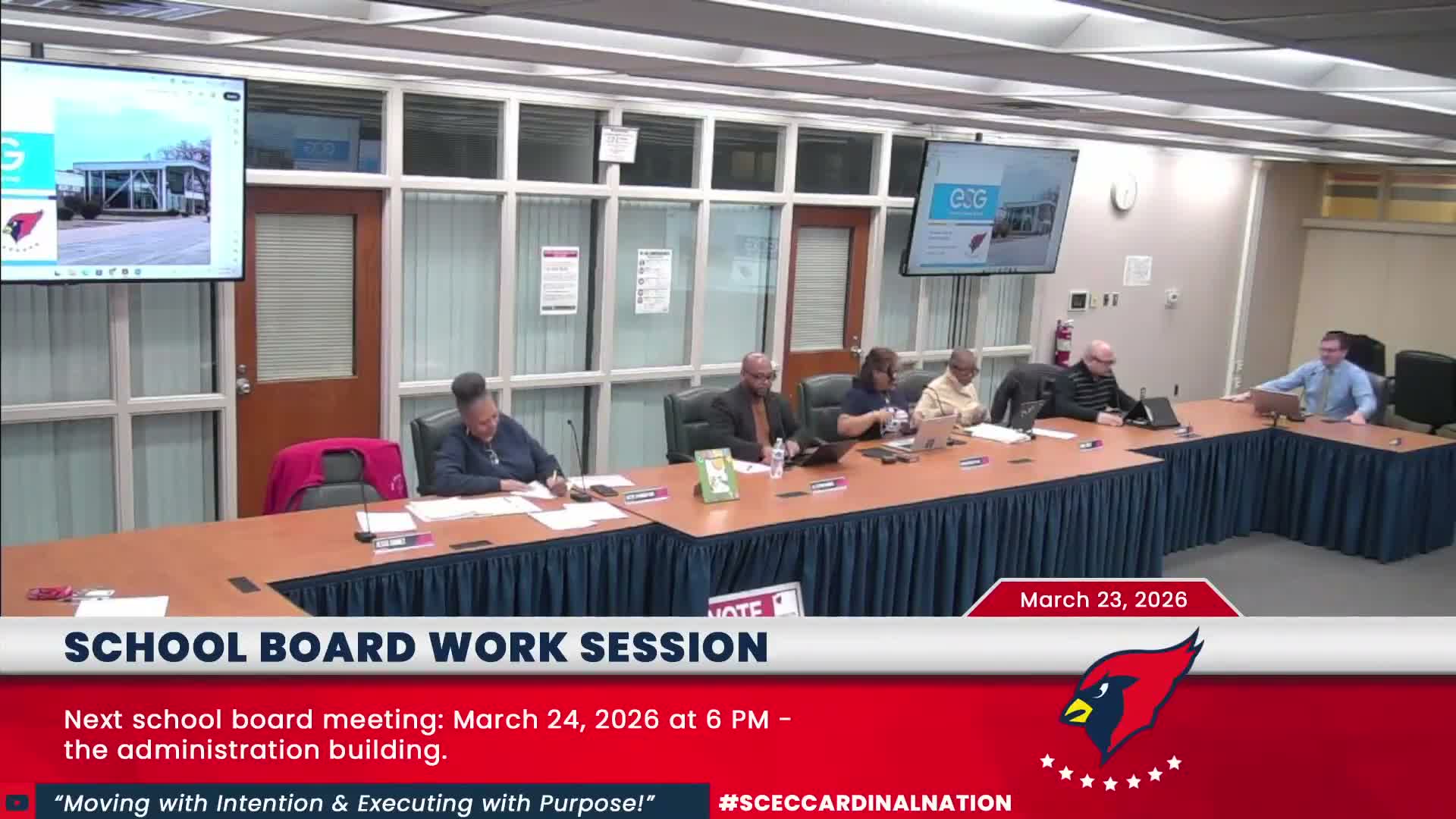
Jacob Paulsley, a representative of ESG, told the School City of East Chicago board on Monday that the company would serve as a performance contractor to design, fund and build energy‑efficiency projects across the district and guarantee savings to cover project costs. ESG framed the work as a two‑phase program: immediate operational and maintenance savings followed by capital investments to address deferred maintenance.
The presentation, introduced by the superintendent (transcript identifies the speaker as “Doctor Morne”), said ESG would begin with a facility‑by‑facility deep‑dive assessment of HVAC, lighting and controls, then use pre‑ and post‑measurements to quantify savings. ‘‘We are at risk and you are not anymore,’’ Paulsley said, describing how an energy‑savings contract sets the company on the hook for meeting guaranteed savings while protecting the district against cost overruns.
Why it matters: Trustees heard that School City buildings have large square footage and aging systems, and that regional utility provider NIPSCO has driven unusually large electricity and gas increases in recent years. ESG said those rate pressures make performance contracting and renewable incentives financially attractive and that, if feasible, solar and geothermal projects paired with IRA incentives could produce substantial net benefits.
Details and trustee questions: ESG cited a firm estimate from its analysis that a solar project could qualify for roughly 40–42% in tax‑credit/ incentive value and suggested geothermal could boost operational savings to roughly 30–50% at some sites. The presenters emphasized they would not replace recently installed equipment unnecessarily, would reuse the district’s existing engineering studies, and promised a design‑to‑bid process that vets local contractors and produces fixed, guaranteed prices before the board would ever vote to build.
Trustees pressed on three practical points: which budget line would pay for design and construction, whether ESG would guarantee work done by previous contractors, and how quickly the district must act to capture federal incentives. Administration said any construction would be presented with exact dollar amounts and that, for now, the RFQ presentation was informational. ESG said the federal solar tax incentive window shrinks after 2027 and recommended beginning design work soon if solar is viable.
Next steps: No contract or vote took place at the work session. ESG asked for authorization to move forward into detailed design and testing; trustees requested written proposals, itemized scopes, and dollar estimates tied to the district’s prior facility studies before taking a formal vote.
The presentation, introduced by the superintendent (transcript identifies the speaker as “Doctor Morne”), said ESG would begin with a facility‑by‑facility deep‑dive assessment of HVAC, lighting and controls, then use pre‑ and post‑measurements to quantify savings. ‘‘We are at risk and you are not anymore,’’ Paulsley said, describing how an energy‑savings contract sets the company on the hook for meeting guaranteed savings while protecting the district against cost overruns.
Why it matters: Trustees heard that School City buildings have large square footage and aging systems, and that regional utility provider NIPSCO has driven unusually large electricity and gas increases in recent years. ESG said those rate pressures make performance contracting and renewable incentives financially attractive and that, if feasible, solar and geothermal projects paired with IRA incentives could produce substantial net benefits.
Details and trustee questions: ESG cited a firm estimate from its analysis that a solar project could qualify for roughly 40–42% in tax‑credit/ incentive value and suggested geothermal could boost operational savings to roughly 30–50% at some sites. The presenters emphasized they would not replace recently installed equipment unnecessarily, would reuse the district’s existing engineering studies, and promised a design‑to‑bid process that vets local contractors and produces fixed, guaranteed prices before the board would ever vote to build.
Trustees pressed on three practical points: which budget line would pay for design and construction, whether ESG would guarantee work done by previous contractors, and how quickly the district must act to capture federal incentives. Administration said any construction would be presented with exact dollar amounts and that, for now, the RFQ presentation was informational. ESG said the federal solar tax incentive window shrinks after 2027 and recommended beginning design work soon if solar is viable.
Next steps: No contract or vote took place at the work session. ESG asked for authorization to move forward into detailed design and testing; trustees requested written proposals, itemized scopes, and dollar estimates tied to the district’s prior facility studies before taking a formal vote.
View the Full Meeting & All Its Details
This article offers just a summary. Unlock complete video, transcripts, and insights as a Founder Member.
✓
Watch full, unedited meeting videos
✓
Search every word spoken in unlimited transcripts
✓
AI summaries & real-time alerts (all government levels)
✓
Permanent access to expanding government content
30-day money-back guarantee
