Gadsden County commissioners debate ordinance to let commercial property owners finance energy upgrades
March 17, 2026 | Gadsden County, Florida
This article was created by AI summarizing key points discussed. AI makes mistakes, so for full details and context, please refer to the video of the full meeting. Please report any errors so we can fix them. Report an error »
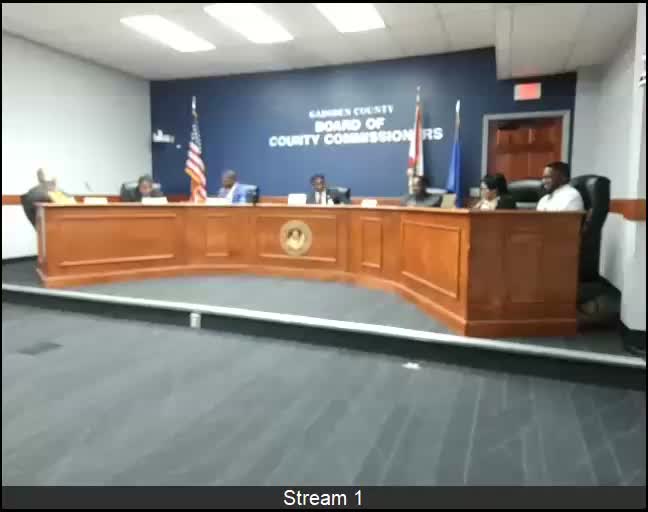
Gadsden County Board of County Commissioners members discussed a proposed ordinance to authorize a commercial property-assessed clean energy (CPACE) program during a March workshop. The ordinance, presented by the clerk (Clerk), would allow commercial and multifamily rental property owners to voluntarily finance energy-efficiency, renewable-energy and wind-hardening improvements through ad valorem assessments.
"This is a commercial program and it's totally voluntary," said the presenter (Presenter), who told commissioners the multifamily portion would apply to rental properties, not owner-occupied homes. The presenter added that CPACE can lower financing costs for large projects, saying it can reduce borrowing costs "by 2 to 3 percentage points" and that the program could make the county more competitive for commercial development such as a data center.
Several commissioners raised concerns about how the program would affect homeowners and the mechanics of collection. "If they borrow the money and they don't pay it back, then we're gonna get on the property like we would anyway," said a committee member (Committee member), reflecting concern about county involvement in tax collection. Another commissioner asked that the tax collector be consulted before the county moves forward.
County legal/staff advisers stressed that adopting the ordinance would not by itself authorize property owners to obtain CPACE loans. "Passing this ordinance opens the door to nothing without an interlocal agreement," said a staff member (Staff member), who said any CPACE company would still need to negotiate an interlocal agreement (ILA) with the county, the property appraiser and the tax collector under the cited statutory framework. The staff member also noted that statewide PACE litigation has mainly concerned residential PACE; he said CPACE litigation is much less common and that the ordinance merely creates the local enabling authority to negotiate an ILA.
Commission discussion also focused on program administration options. One commissioner suggested the county could require a third-party administrator to accept and escrow payments before forwarding them to the tax collector; the presenter said the ordinance does not mandate a single administrative model and that those details would be negotiated in the later ILA.
Supporters said CPACE can make commercial projects more affordable when market interest rates are high. The presenter noted increasing adoption across the state and corrected earlier participant counts, saying the statewide number of participants is larger than an earlier figure cited in the workshop.
Next steps: Commissioners asked staff to add a clear definition of "multifamily" to the draft ordinance, request an opinion or input from the tax collector, and return with ILA options and administrative-model recommendations. No ordinance adoption or final vote was recorded in the workshop transcript.
"This is a commercial program and it's totally voluntary," said the presenter (Presenter), who told commissioners the multifamily portion would apply to rental properties, not owner-occupied homes. The presenter added that CPACE can lower financing costs for large projects, saying it can reduce borrowing costs "by 2 to 3 percentage points" and that the program could make the county more competitive for commercial development such as a data center.
Several commissioners raised concerns about how the program would affect homeowners and the mechanics of collection. "If they borrow the money and they don't pay it back, then we're gonna get on the property like we would anyway," said a committee member (Committee member), reflecting concern about county involvement in tax collection. Another commissioner asked that the tax collector be consulted before the county moves forward.
County legal/staff advisers stressed that adopting the ordinance would not by itself authorize property owners to obtain CPACE loans. "Passing this ordinance opens the door to nothing without an interlocal agreement," said a staff member (Staff member), who said any CPACE company would still need to negotiate an interlocal agreement (ILA) with the county, the property appraiser and the tax collector under the cited statutory framework. The staff member also noted that statewide PACE litigation has mainly concerned residential PACE; he said CPACE litigation is much less common and that the ordinance merely creates the local enabling authority to negotiate an ILA.
Commission discussion also focused on program administration options. One commissioner suggested the county could require a third-party administrator to accept and escrow payments before forwarding them to the tax collector; the presenter said the ordinance does not mandate a single administrative model and that those details would be negotiated in the later ILA.
Supporters said CPACE can make commercial projects more affordable when market interest rates are high. The presenter noted increasing adoption across the state and corrected earlier participant counts, saying the statewide number of participants is larger than an earlier figure cited in the workshop.
Next steps: Commissioners asked staff to add a clear definition of "multifamily" to the draft ordinance, request an opinion or input from the tax collector, and return with ILA options and administrative-model recommendations. No ordinance adoption or final vote was recorded in the workshop transcript.
Don't Miss a Word: See the Full Meeting!
Go beyond summaries. Unlock every video, transcript, and key insight with a Founder Membership.
✓
Get instant access to full meeting videos
✓
Search and clip any phrase from complete transcripts
✓
Receive AI-powered summaries & custom alerts
✓
Enjoy lifetime, unrestricted access to government data
30-day money-back guarantee
