Committee backs codifying place-based substance-use outreach program; fiscal impact questions remain
March 17, 2026 | Committee of the Whole, Committees, Legislative, District of Columbia
This article was created by AI summarizing key points discussed. AI makes mistakes, so for full details and context, please refer to the video of the full meeting. Please report any errors so we can fix them. Report an error »
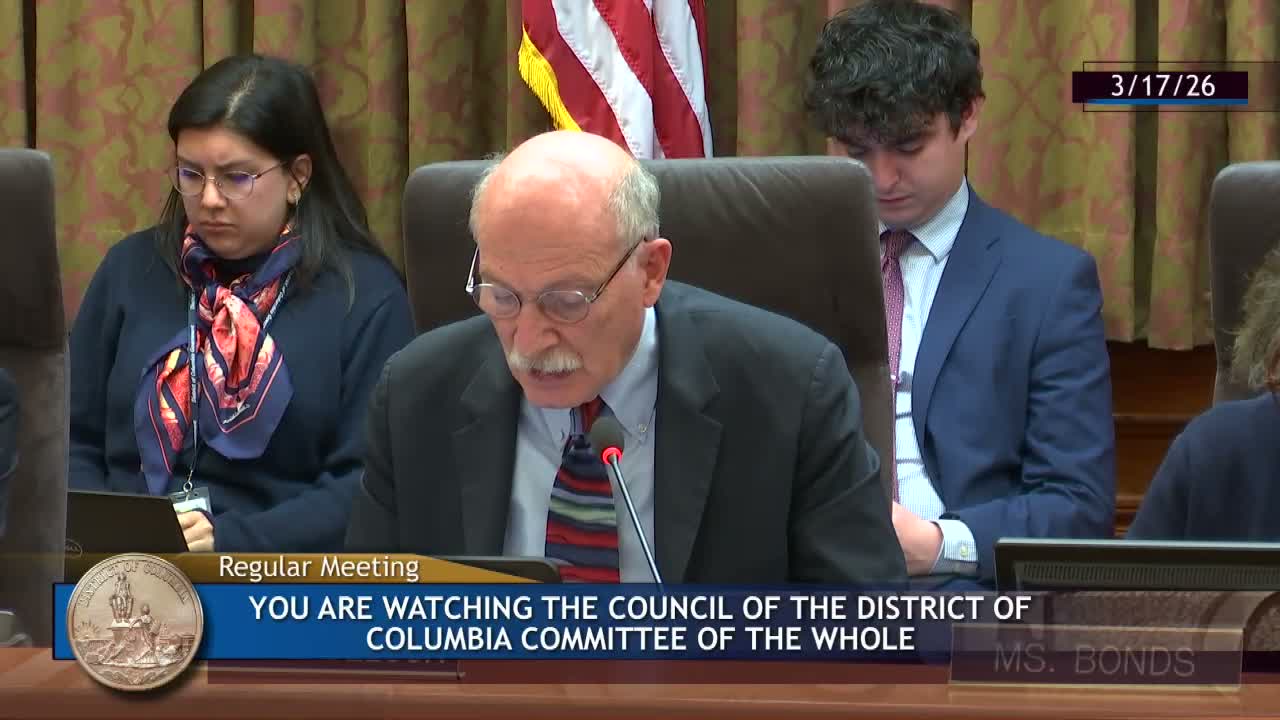
The Committee of the Whole moved forward on March 17 with a bill to codify a place-based substance use disorder outreach program within the Department of Behavioral Health (DBH) that would fund nonprofits to provide outreach, harm-reduction services, and connections to treatment and housing.
Councilmember Christina Henderson, a sponsor, said the legislation builds on a pilot deployed through the FY24 budget support act. The bill would authorize DBH to issue grants to nonprofit organizations experienced in outreach in designated high-need areas, strengthen reporting requirements (including public performance data on outreach engagement, connections to treatment, and overdose reversals), require community notification near program sites, and formalize interagency coordination with housing, health and public-safety agencies.
Henderson cited recent pilot activity at 7th and T NW in Shaw, saying outreach there helped connect people to services and reduced visible drug-use activity near a school drop-off point. A councilmember sponsoring the pilot reported that, in pilot sites, nonfatal overdoses declined by about 51 percent within the first six months of program deployment and that grantees are tracking engagement and outcomes; committee members used those pilot results to argue for codifying the model.
Members raised fiscal and implementation questions. The committee record shows a fiscal impact statement (FIS) of $115,000 in the first year and $479,000 over the financial plan, but Councilmember Henderson said DBH later requested an additional full-time equivalent (FTE) to run the program and the committee had not yet received an updated FIS reflecting that need. Councilmember Crawford asked whether an updated FIS had been provided; Henderson said the department had flagged the FTE ask but no updated FIS was available at the markup.
The committee approved moving the bill onto the consent agenda for the March 31 legislative meeting and recommended staff make technical and conforming edits. Sponsors and colleagues emphasized the program’s success connecting people to treatment and the need to fix grants-management issues so funds can be distributed reliably.
Councilmember Christina Henderson, a sponsor, said the legislation builds on a pilot deployed through the FY24 budget support act. The bill would authorize DBH to issue grants to nonprofit organizations experienced in outreach in designated high-need areas, strengthen reporting requirements (including public performance data on outreach engagement, connections to treatment, and overdose reversals), require community notification near program sites, and formalize interagency coordination with housing, health and public-safety agencies.
Henderson cited recent pilot activity at 7th and T NW in Shaw, saying outreach there helped connect people to services and reduced visible drug-use activity near a school drop-off point. A councilmember sponsoring the pilot reported that, in pilot sites, nonfatal overdoses declined by about 51 percent within the first six months of program deployment and that grantees are tracking engagement and outcomes; committee members used those pilot results to argue for codifying the model.
Members raised fiscal and implementation questions. The committee record shows a fiscal impact statement (FIS) of $115,000 in the first year and $479,000 over the financial plan, but Councilmember Henderson said DBH later requested an additional full-time equivalent (FTE) to run the program and the committee had not yet received an updated FIS reflecting that need. Councilmember Crawford asked whether an updated FIS had been provided; Henderson said the department had flagged the FTE ask but no updated FIS was available at the markup.
The committee approved moving the bill onto the consent agenda for the March 31 legislative meeting and recommended staff make technical and conforming edits. Sponsors and colleagues emphasized the program’s success connecting people to treatment and the need to fix grants-management issues so funds can be distributed reliably.
Don't Miss a Word: See the Full Meeting!
Go beyond summaries. Unlock every video, transcript, and key insight with a Founder Membership.
✓
Get instant access to full meeting videos
✓
Search and clip any phrase from complete transcripts
✓
Receive AI-powered summaries & custom alerts
✓
Enjoy lifetime, unrestricted access to government data
30-day money-back guarantee
